
• Home
  • About Diana Telfer
  • Family Law
    ▼
    • Collaborative Divorce
    • Mediation
    • Premarital Agreements
    • Limited Representation Services
    • Child Custody/Child Support
    • Alimony
    • Negotiated Settlements
    • Special Master
  • Blog
    ▼
    • In The News
  • Contact Us
  • Pay Online
  • Skip to primary navigation
  • Skip to main content
  • Skip to primary sidebar
  • Skip to footer

Telfer Family Law & Mediation

Salt Lake City Divorce & Mediation

phone number
801-464-4004

  • Home
  • About Diana Telfer
  • Family Law
    • Collaborative Divorce
    • Mediation
    • Premarital Agreements
    • Limited Representation Services
    • Child Custody/Child Support
    • Alimony
    • Negotiated Settlements
    • Special Master
  • Blog
    • In The News
  • Contact Us
  • Pay Online

Diana Telfer

Divorce, Abraham Maslow, and Financial Support

December 1, 2021 By Diana Telfer

It would be lovely if the starting point of any divorce could be deciding what we want. But more often than not, my first consultation with clients involves questions of survival. Many clients fear what their financial future will look like. They have worked hard to get where they are financially. Divorce presents a sharp reality that what one has now will not be what one has in the near future. Clients come wanting assurance. They want to know whether they will be able to stay in their home, maintain sufficient financial support for their household, and walk away with sufficient funds to maintain the lifestyle to which they have become accustomed. It can be a struggle to move the conversation beyond these basic concerns.

Abraham Maslow developed a motivational theory that consists of five levels of needs. The bottom level involves the physiological needs of food, shelter, warmth, and air. The most basic of all needs. These needs MUST be satisfied before any other issue can be explored. This explains why a stay-at-home parent who has not worked for years because they have dedicated their lives to serving the family at home may fixate upon support or on keeping the home. With Maslow’s explanation of human motivation, a person worried about their basic biological needs of food and shelter cannot think about the future.

So what type of financial support is available in Utah?

Child Support

If there are minor children, meaning children under the age of 18 or not graduated from high school, whichever is later, one parent is entitled to receive child support. Child support is relatively easy to calculate using the Utah.gov Child Support Calculator. It is based on the (i) number of overnights each parent has the children each year and (ii) each parent’s gross income. Gross income includes income from any source whether earned or unearned including salaries, wages, commissions, bonuses, rents, gifts from anyone, prizes, dividends, unemployment compensation, social security benefits, capital gains, alimony, etc. If one parent does not currently work, that parent has generally imputed income based upon his or her employment potential and probable earnings. A judge will look at such things as that parent’s work history, occupation qualifications, education, literacy, age, health, employment opportunities, criminal record, other employment barriers and background factors, and prevailing earnings and job availability of persons of similar backgrounds in the community. A parent who has no recent work history or if a parent’s occupation is unknown, that parent has imputed an income at the federal minimum wage for a 40-hour workweek. If one parent has the children for less than 110 overnights then child support is calculated using a sole custody worksheet. If each parent has more than 110 overnights then child support is calculated using a joint custody worksheet.

Alimony

Spousal support or alimony is the second form of support. It is the second most litigated issue in a divorce next to custody. The policy behind Utah’s alimony laws is to enable the receiving spouse to maintain as nearly as possible the standard of living enjoyed during the marriage and to prevent the spouse from becoming a public charge.
Unlike child support, there is no calculator to determine an appropriate amount of alimony. There are seven (7) different factors that a judge must consider when determining alimony with the three most significant ones being (i) the financial condition and needs of the recipient spouse, (ii) the recipient spouse’s earning capacity or ability to produce income; and (iii) the ability of the payor spouse to provide support. A recipient spouse’s need is based on the standard of living enjoyed during the marriage. Other factors include the length of the marriage, whether the recipient spouse has custody of a minor child requiring support, whether the recipient spouse worked in a business owned or operated by the other spouse; and whether the recipient spouse directly contributed to an increase in the payor spouse’s skill by paying for education received by the payor spouse or enabling the payor spouse to attend school during the marriage. A judge may consider the fault of the parties under certain circumstances (e.g. one party engaging in an extramarital affair, abuse, or a party substantially undermining the financial stability of the other party or the children). The length of alimony cannot exceed the length of the marriage and terminates upon remarriage, cohabitation as defined by Utah law, and death of either party.

Figuring out how much alimony you may be entitled to or may be expected to pay is a difficult task and one that you will likely want to seek legal advice on.

Next to the children, financial support is one of the biggest obstacles in divorce or separation. No one can reasonably be expected to focus on other issues if they are worried about how they are going to pay their bills, feed their children, or keep a roof over their head. It is critical for couples to understand and recognize that the financial needs of the other party to help move toward settlement. Not addressing these issues fairly create long-term negative effects on the family.
Filed Under: Blog

A Checklist for Divorce Financial Planning

December 1, 2021 By Diana Telfer

Ten Types of Documents to Gather When Considering Divorce

Socrates said, “The only true wisdom is in knowing you know nothing.”  This may be true in life but is extremely damaging in divorce.  It is critically important that you take affirmative steps to understand and familiarize yourself with your finances when considering divorce.  You will be in a much better position if you understand what you have so that you can figure out where you want to be at the end of the divorce process.  You want to be confident that you have the information to make informed decisions and to take control of your own path.  This can be an intimidating step if you have not previously been involved in the financial aspects of your marriage.  But your future financial health depends upon you taking the time to gather information.

Below is a useful checklist of documents to gather when considering divorce:

  • Tax Returns – personal and business – for the most recent two (2) years, including complete federal and state income tax returns, Form W-2, Form 1099, and Schedule K-1 forms, and supporting tax schedules and attachments filed by you, your spouse, and by any entity in which you or your spouse have a majority or controlling interest.
  • Pay Stubs – for the past twelve (12) months, provide copies of all of your and your spouse’s paystubs and/or other evidence of all earned and unearned income. At a minimum, you will need the most current paystub and the last paystub issued in the previous calendar year from each employer, assuming the paystubs include year-to-day income.
  • All loan applications and financial statements prepared or used by you or your spouse within the last twelve (12) months.
  • Documents verifying the value of all real estate in which you or your spouse have an interest, including the most recent appraisal, tax valuation notices, deeds, purchase documents, settlement statements, and refinance documents.
  • Current titles and appraisals/valuation documents for all vehicles, boats, campers, trailers, recreations vehicles, jewelry, major household items, and other personal property. To determine the value of your vehicles, you will want to complete a Kelley Blue Book (kbb.com) or NADA (nada.com) report for each vehicle, boat, camper, trailer, and recreational vehicle in your possession.
  • For all businesses in which you or your spouse have an interest, you will want copies of all the following as may apply: current profit/loss statements, balance sheets, income statements, cash flow statements, payroll reports, aged account receivable documents, depreciation schedules, Articles of Incorporation, Articles of Organization, Operating Agreements, nature of business, percentage owned, name(s) of all owners, current value, complete business tax returns for the most recent two (2) years, and business checking and savings account statements for the last three (3) months.
  • All statements for the last three (3) months for all financial asset accounts, including checking, savings, profit-sharing, annuity, money market funds, certificates of deposit, brokerage, investment, retirement, and trusts (for you and your spouse).
  • Current statements for all life insurance policies, with and without cash value (for you and your spouse).
  • Credit card statements and other debt statements for the last three (3) months (for you and your spouse).
  • Copies of your most recent billing statements for the last three (3) months verifying each of your monthly expenses, such as utility bills, mortgage statements, daycare receipts, medical billings, and insurance explanation of benefits, etc.

See Also

Financial Planning in Divorce – 5 Steps to Getting Your House in Order
The Soft Side of Finance: Navigating Divorce with Experts Diana & Chalise
Alimony – To Pay or Not To Pay?
The 5 Step P.L.A.N.S. for a Positive Divorce: Weathering the Storm

Filed Under: Blog

Alimony – To Pay or Not To Pay?

December 1, 2021 By Diana Telfer

Next to child custody, alimony is the most hotly contested issue if you are divorcing in Utah.  Why? Because there is no formula or calculator to determine the amount of alimony.  Instead, alimony is based on multiple factors, which can be highly subjective.  In Utah, the primary purposes of alimony are (1) to get the parties as close as possible to the same standard of living that existed during the marriage; (2) to equalize the standards of living of each party; and (3) to prevent the recipient spouse from becoming a public charge.”[1]  Alimony is not fashioned to provide for only the basic needs of the recipient spouse but should consider the parties’ standard of living enjoyed during the marriage as closely as possible.[2]  While this calculation may seem relatively easy, there is broad discretion when figuring out a recipient spouse’s needs and how long alimony should be paid.

The Utah legislature has identified seven factors[3] that must be considered when determining whether to award alimony with the primary three factors, often referred to as the “Jones factors,” requiring the examination of “(i) the financial condition and needs of the recipient spouse, (ii) the recipient’s earning capacity or ability to produce income; and (iii) the ability of the payor spouse to provide support.”[4]  To determine these factors, each spouse must complete a court-approved Financial Declaration that includes among other things, a monthly budget of expenses.  Certain financial documentation must also be exchanged including income verification documents, bank statements, and credit card statements.

Calculating the Needs of the Recipient Spouse and Payor Spouse’s Ability to Pay

It is common that a spouse’s circumstances will be different after the couple separates. For instance, one spouse may move in with his or her parents to avoid incurring any additional housing costs during the pendency of the divorce proceeding.  However, when calculating alimony, a couple is to look to the standard of living prior to separation rather than after separation.  The standard of living is based on the monthly expenditures.  So it is important for each spouse to be thorough when preparing their monthly budget.  It is advisable to review bank and credit card statements from the 6 to 12 months prior to your separation.  However, in most cases, a divorcing couple is not going to be able to maintain the standard of living during the marriage because there simply will not be enough money to go around.  In that situation, calculating alimony then turns to equalizing the standards of living between the parties so that each party has close to the same cash flow each month.

Each spouse needs to complete a budget to determine how much each spouse needs to live.  The spouses’ budgets will likely be different based on the expenses that the spouse will have post-divorce or the amount of time the children will be with each parent.  It is possible that one spouse will agree to be responsible for paying the marital debt after divorce.  That will obviously increase that spouse’s monthly expenses and decrease the other spouse’s expenses.  When completing the budget, it is important to include all expenses.  The court-approved Financial Declaration form is not an exhaustive list of expenses.  For instance, you will want to include such things as travel, grooming, pet expenses, gym memberships, tax preparation/accounting fees, etc.  These categories are missing from the court-approved Financial Declaration form but should be added if these are expenses incurred during the marriage.

If an expense was incurred during the marriage but will no longer exist after the divorce or the expense will be reduced in the future then that expense should be eliminated or adjusted in your monthly budget.  Many expenses will need to be adjusted.  For instance, if you are not the spouse that provides health insurance, it will be important for you to get quotes on how much your health insurance will be post-divorce since you will not be able to remain on your spouse’s health insurance.  If you have an older vehicle that will likely need to be replaced in the near future then you will likely want to include a reasonable amount for a future loan payment to replace that vehicle.  You will want to include student loan payments.  Student loans are typically the responsibility of the spouse that acquired the loan, regardless of whether it was incurred during the marriage to pay for family expenses.  If you typically contributed to retirement and other savings plans, those expenses can also be considered.

When determining future housing expenses, each party should do the research to determine what that amount will be since it will likely change.  If one spouse intends to keep the marital residence but will be required to buy out the other spouse’s interest, the mortgage payment will go up.  Or if you intend to sell your home, you will want to figure out what funds you will have for a down payment, the home price range that you can afford, and the amount of your mortgage payment.  There is a wide range of mortgage calculators that you can use to help with this process.  Also, depending upon the amount of time the children are spending with each parent, budgets for each parent may be different.  Lastly, if the budgets are contested, it will be critical to gather the financial documentation to support the amount of claimed expenses.

Depending upon the complexity of your situation, you might want to consider hiring a forensic accountant or certified divorce financial advisor to help review your financial records and create your budget.  Accurately creating your budget can feel overwhelming but it is one of the most important tasks to complete in your divorce.

Determining Incomes

Determining the incomes of each spouse can be relatively simple if you both worked during your marriage but there are a few principles that are often misunderstood.  The  Utah child support statute provides that child support is based on a 40-hour workweek.  However, if a spouse has historically worked overtime or received bonuses then that additional income should be included when calculating that spouse’s gross monthly income.

If the recipient spouse remained home to be a full-time caretaker for the children but is capable of working, then that spouse will likely be imputed income.  The question that must be answered is what is that spouse capable of earning?  Any income imputation is based on education, work history, occupation qualifications, employment opportunities, and the prevailing earnings for persons of similar backgrounds in the community.[5]

Determining incomes for a spouse who is self-employed can also be a challenge since the income reported on tax returns is undoubtedly less than what the actual gross income is.  For the self-employed, gross income is “calculated by subtracting the necessary expenses required for self-employment of business operation from gross receipts.”[6]  However, when calculating the necessary expenses, you want to make sure that you are not double-counting that expense.  Many expenses are commonly used for both business and personal purposes.  For instance, if a car loan or cellphone is paid by the business then that same expense should not be included in the self-employed spouse’s personal monthly budget.  Another approach, which was adopted in the Miner case, is to divide the expense in half applying one half of the expense as a reasonable business expense and the other half considered a personal expense.  Determining whether an expense is a necessary business expense or a personal expense is based on whether that expense is “necessary to allow the business to operate at a reasonable level.”[7]

How Long Should Alimony Be Awarded

Once alimony is calculated then the length of alimony must be determined.  The Utah “legislature has set an outer boundary on the length of alimony awards, mandating that, in the absence of extenuating circumstances, alimony may not be ordered for a duration longer than the number of years that the marriage existed.  But there is no inner boundary on the length of an alimony award.”[8]  Alimony can be paid for a shorter period of time, or the alimony award may taper off gradually.  This is often referred to as “rehabilitative alimony.”  “Rehabilitative alimony is a remedy intended to ease the recipient spouse’s financial adjustment period.”[9]  This is often considered appropriate “where the recipient spouse is of an age and in possession of employment skills that make self-sufficiency likely.”[10]  Rehabilitative alimony may be awarded to allow sufficient time for the recipient spouse to return to college and earn a higher degree.  Thus, increasing that spouse’s earning capacity and ability to provide for his or her own monthly needs.  Alimony also terminates upon the remarriage or cohabitation of the recipient spouse and the death of either spouse.

Conclusion

Determining alimony is a complicated issue.  If you have more questions, feel free to contact Telfer Family Law.

[1] See Rule v. Rule, 2017 UT App 137, ¶ 14, 402 P.3d 153.
[2] Id.
[3]
[4] Miner v. Miner, 2021 UT App 77, ¶ 16.
[5] Vanderzon v. Vanderzon, 2017 UT App 150, ¶ 63 (quoting Utah Code § 78B-12-203(7)(b).
[6] Utah Code § 78B-12-203(4).
[7] Barrani v. Barrani, 2014 UT App 204, ¶¶ 15-16, 334 P.3d 994.)
[8] Miner, 2017 UT App 77, ¶ 91 (quotation simplified).
[9] Id. At ¶ 92.
[10] Id.

See Also

A Checklist for Divorce Financial Planning
Financial Planning in Divorce – 5 Steps to Getting Your House in Order
The Soft Side of Finance: Navigating Divorce with Experts Diana & Chalise
The 5 Step P.L.A.N.S. for a Positive Divorce: Weathering the Storm

Filed Under: Blog

Financial Planning in Divorce – 5 Steps to Getting Your House in Order

December 1, 2021 By Diana Telfer

Author and Netflix superstar Marie Kondo says, “When you put your house in order, you put your affairs and your past in order, too.”  Nothing could be closer to the truth in divorce— When you put your financial house in order in divorce, you put your affairs and your past in order, too.  Here are 5 steps to getting your house in order:

Step 1: Be Knowledgeable About Finances

In a previous blog post, I emphasized that “knowledge is power.”  Whether you have managed your family’s finances, or your spouse did, it is critical that you both understand your finances.  Here are the categories to identify and understand:

  • Income: Identify each spouse’s incomes.  Understand what the gross income (before tax) is and net income (income available after tax).
  • Assets: Identify the assets held in your name, your spouse’s name, and assets that are jointly held. List when and how the asset was acquired. Assets include but are not limited to real property, vehicles, financial accounts including checking, savings, investment, and retirement accounts, personal property in the home (furniture, furnishings, art, etc.), stock and stock options, and life insurance that has a cash value.
  • Liabilities: Identify the debts that you and/or your spouse have (individually and jointly) including mortgage(s), HELOCs, credit card debt, student loans, business loans, and other liabilities.
  • Insurance: Make a list of your family’s insurance coverage including medical, dental, home/property, auto, and life insurance.
  • Prenuptial or postnuptial agreement: If you and your spouse signed a prenuptial or postnuptial agreement, make sure you have a copy to provide to your attorney.
  • Estate planning: Gather copies of your estate planning documents including any will, trust agreement, power of attorney, and/or health directive to provide to your counsel.

Step 2: Understand Monthly Expenses:

It is important to understand what you and your spouse spend each month for your basic needs and discretionary expenses. For an accurate and realistic picture, it will be helpful to review six to twelve months of your bank and credit card statements.  Create a spreadsheet of each expense (mortgage/rent, utilities, food, clothing, travel, etc.) and then average your spending for each expense and month.   It is extremely important to have a clear and accurate picture of your spending so you can compare that with your net income.  This is especially important to determine if ongoing spouse support/alimony will be needed.  It will also provide a guide to where you can adjust your spending post-divorce if that becomes necessary.

Step 3: Gather Financial Records:

Locate and make copies of bank statements for the past twelve months including cancelled checks, tax returns (personal and corporate/partnership) for the past three to five years, deeds to real property, titles to vehicles, paystubs, insurance policies, credit card statements, loan statements, closing records from mortgages, recent appraisals, etc. The sooner you do this the better in case the documents disappear.  Keep the copies in a safe place, whether that be in your home, a friend or other family member’s home, or a bank safety deposit box.

Step 4: Open Your Own Bank Account:

It is important that you have funds available in case of emergency.

Step 5: Pay Attention to Your Credit Card:

It is important that you build your credit before filing for divorce. If you do not have a credit card in your own name, you will want to apply for one prior to filing for divorce.  You will then want to use it and pay off the balance each month.  This helps build credit in your own name.

Having an accurate and thorough understanding of your finances prior to filing for divorce is an important step toward easing the fear and anxiety that often accompanies divorce.  It is an affirmative step toward putting your financial house in order.

See Also

A Checklist for Divorce Financial Planning
The Soft Side of Finance: Navigating Divorce with Experts Diana & Chalise
Alimony – To Pay or Not To Pay?
The 5 Step P.L.A.N.S. for a Positive Divorce: Weathering the Storm

Filed Under: Blog

Update from the 2nd District Court and In Person Hearings

December 1, 2021 By Diana Telfer

FROM THE SECOND DISTRICT COMMISSIONERS RE: RESUMPTION OF IN-PERSON HEARINGS

WHEN:

We are currently contemplating returning to in-person court on September 1, 2021. In-person court can resume if the courts are in Yellow as long as appropriate precautions are taken. If the virus count prompts a return to Red, in-person hearings will only take place if there is exigency on a case-by-case basis.

HOW:

Until the court is in Green, everyone coming to the courthouse will need to wear a mask, even if vaccinated. Court patrons will be responsible for maintaining appropriate social distancing in the hallways. Masks must be worn at all times except when directly addressing the court.

Other than witnesses for evidentiary hearings, each party will be limited to TWO observers/support persons. When seated in the gallery, each group will be responsible for seating themselves at least 6 feet apart. At the bailiff’s discretion, patrons may be admitted to the courtroom one hearing at a time.

At the conclusion of each hearing, counsel, the parties, and observers will need to wipe down any surfaces they touched with sanitizing wipes. Sanitizing wipes will be provided for this purpose. Patrons are requested to leave the courthouse as soon as their hearing is completed.

PROTECTIVE ORDERS:

Protective order litigants may only bring ONE observer/support person. Additional security and volunteers will hopefully be available to assist in maintaining order and distancing during large protective order calendars. Because of the limited space available in the courtrooms, not all parties will be allowed in the courtroom at the same time. Efforts will be made to serve new orders electronically so that parties are not waiting for copies of orders.

CAVEATS:

  1. At the discretion of the commissioner conducting the hearing, the courtroom may be closed to everyone except those essential to conducting the hearing.
  2. The transition process will be fluid, and there may be unexpected difficulties. Please be patient and understand that these procedures may require adjustment as we go forward.
  3. Each commissioner may, at his or her discretion, continue to conduct certain types of hearings remotely even after COVID restrictions are no longer in place. Notice of this will be provided at the time the hearing is scheduled.
  4. If you have any questions about whether to appear in person, please contact the assigned commissioner’s team via the commissioner’s team email address.

Filed Under: Blog

What is the Difference Between Collaborative Divorce and Mediation?

December 1, 2021 By Diana Telfer

I cannot count the number of times that prospective clients are shocked to learn that there are ways to divorce or resolve their family law dispute without the nastiness of court.  The court system is set up to be adversarial.  However, there are ways to resolve your family law dispute amicably without going to court. This does not mean that there will be no conflict. With the right professionals, there are alternative dispute resolution approaches that support parties resolving their conflict in more healthy and less traumatic ways.  Collaborative Divorce (also referred to as Collaborative Practice, Collaborative Law, or Collaborative Process) and Mediation are two such approaches.  Folks often confuse the two so here is an explanation of the differences.

Collaborative Divorce

Collaborative Divorce is a voluntary dispute resolution process where parties commit to settling their divorce or family law dispute without going to court.  A collaborative divorce is not limited to married spouses but also applies to unmarried couples who are separating or involved in a child custody dispute.  In a contested family law dispute, judges are required to make the final decision and are limited by state law.  Parties electing the Collaborative Divorce approach maintain control over the entire process.  The collaborative process allows parties to maintain flexibility and creativity in reaching solutions that focus on the needs and interests of their unique situation rather than focus on the rights and obligations defined by law.

In a Collaborative Divorce, each party hires an attorney specially trained in the collaborative process.  (Beware there are attorneys who claim to be collaborative law attorneys but have not received the specialized training). Each party, with their attorney, signs a collaborative participation agreement that describes the collaborative process.  Specifically, the parties agree to voluntarily disclose all information that is relevant and material to their case.  Each party agrees to use good faith efforts in their negotiations. Each party agrees to treat the other with respect.  The parties agree to keep the discussions and process confidential.   If the parties are unable to reach a settlement and a contested court proceeding commences, each lawyer’s representation terminates, and the parties must find new litigation counsel.  This provides a safe container for the parties to be creative without the threat of proposals or information being used against them in court.  It also provides the incentive to work through the issues and reach a final resolution.

The process utilizes a team approach that supports the parties throughout the process.  This process is a complete paradigm shift for attorneys.  Instead of proceeding in an adversarial manner, collaboratively trained attorneys with the parties work together to support the immediate and future needs of the family unit.  Parties also have the option to retain other professionals with specialized knowledge.  For example, a financial neutral (e.g. accountant or certified divorce financial advisor) are often retained to analyze the financial data and assist parties in generating settlement options on financial issues such as child support, alimony, and the division of property acquired during the marriage or relationship.   A mental health professional trained in the collaborative process (often referred to as divorce coaches or facilitators) can also be hired to assist in developing parenting plans.  Divorce coaches assist parties to work through the emotional and communication barriers that often impede resolution.

The most significant difference between a Collaborative Divorce from traditional litigation or mediation is that you and your spouse/partner have a team of trained professionals who are there to support and guide you through the entire process.  You have the benefit of lawyers, divorce coaches, and financial neutrals who are there to help reach the best possible outcome for your family. The process promotes open communication and transparency.  You are able to create shared solutions focused on your highest priorities.

Mediation

Mediation is another voluntary approach to resolving disputes for families in conflict.  Mediators are neutral professionals trained to assist divorcing or separating couples in reaching a settlement.  Unlike in a collaborative divorce, parties can retain a mediator without retaining an attorney. However, a mediator does not have the authority to make a decision for the parties nor can a mediator provide legal advice.  A mediator is a neutral third party who works with the couple to find a mutually acceptable resolution.

In mediation, the divorcing or separating couple meet with the mediator.  Each party has the option to retain an attorney, who can also attend mediation.  Mediation starts with everyone in the same room although some mediators prefer keeping the parties in separate rooms.  The mediator has the parties identify the issues that need to be resolved.  The parties then begin negotiations by offering their respective settlement proposals. The mediator then works with the parties to reach a resolution.  The mediator helps the parties focus on what is important and find areas of compromise.  Mediators can help clarify the issues, assess the strengths and weaknesses of each party’s positions, and provide reality checks. Mediators also offer creative approaches and innovative solutions while maintaining their neutral and unbiased perspectives.  Similar to Collaborative Divorce, mediation is a confidential process, which means that statements, settlement offers, or other information discussed during mediation cannot be used or brought up in a court proceeding.

Collaborative Divorce and Mediation are two effective alternative dispute resolution processes available to those interested in staying out of the adversarial court system.  Both processes minimize the trauma on you and your family.   Both processes are generally less expensive than a contested divorce, paternity, or custody dispute litigated in court.  Most important, you and your spouse/partner maintain control over the entire process.

Filed Under: Blog

Seven Frequently Asked Questions About Divorce in Utah

December 1, 2021 By Diana Telfer

Many of the clients who schedule initial consultations have not made the decision to divorce yet.  Often, the client or the client’s spouse has brought up the topic of divorce and my client simply wants to know what his or her options are in the event the couple decides to divorce. Here are answers to the most frequently asked questions

1. How much will my divorce cost me?

This question is a difficult one to answer because it depends upon whether the spouses are in agreement on the issues relating to the children, financial support, and division of the assets and property acquired by the spouses.  If the spouses have worked out the terms of their divorce and only need an attorney to draft up the documents, the cost can be as low as $1,500 to $3,000 including the court fees to file for divorce.  If it is a contested divorce, meaning the spouses have significant disagreements on the issues of custody, parent-time, child support, alimony, and property division, then it can cost significantly more.  Anywhere from $10,000 to $50,000 or more.

The cost of the divorce really depends on how much the spouses agree upon, the complexity of the marital estate, and whether the spouses retain attorneys who are committed to resolving their clients’ disputes outside of the court system. A spouse contemplating divorce often thinks she needs a bulldog attorney to fight for what she is entitled to but bulldog attorneys often fight for the sake of fighting and that only means increased legal fees.   Finding an attorney who is committed to helping you work through your disputes collaboratively and amicably (e.g., collaborative divorce, mediation, or negotiated settlement) will not only save the spouses significant money in legal fees but also minimize the trauma on the family.

2. What are the legal grounds of divorce?

Utah is a no-fault state, meaning that spouses can get divorced on the grounds of irreconcilable differences.  This is the most common legal ground for divorce since you are not required to prove anything.  Irreconcilable differences mean that the marriage relationship has broken down, the spouses have tried to work through their issues, have been unable to successfully repair the damage, and no longer wish to be married.  Other legal grounds for divorce include adultery, willful desertion for more than a year, willful neglect, habitual drunkenness, cruel to the extent of causing bodily injury or great mental distress, or when the spouses have lived separately under a decree of separate maintenance for three consecutive years without cohabitation.  If a petition for divorce is filed on legal grounds other than irreconcilable differences, evidence must be provided to the court proving the grounds of divorce.  For this reason, almost all divorces are sought based on irreconcilable differences, because nothing needs to be proven.

3. Is there an advantage to file for divorce first?

The simple answer is no, there is no advantage to the spouse filing for divorce first. The spouse who files for divorce is called the petitioner.  The spouse who is served papers of divorce is called the respondent.  Being the petitioner, or the spouse who files for divorce first, simply means that if the spouses require a judge to make a decision at trial then the petitioner gets to present his or her case first. The petitioner is in the position to present her position and “narrative” of the divorce first.    However, the respondent gets to present his or her case afterward and so will be the last position and “narrative” of the divorce that the judge hears.   The majority of divorces resolve without a trial so there really is no advantage to being the first spouse to file.

4. If my spouse and I have things worked out already, do I have to hire an attorney?

The Utah courts provide an online option that allows divorcing spouses to prepare their own legal paperwork to divorce.  However, the language in the court forms is boilerplate and often spouses do not know how or where to insert the terms of their divorce settlement.  If spouses attempt to be creative in their resolution, it more often than not creates conflicting or ambiguous provisions within the final decree of divorce.  These conflicting provisions create future conflict and varying interpretations between the divorced spouses. This often results in significantly more legal fees to hire an attorney to correct the errors (e.g. tens of thousands of dollars) than if the parties had retained an attorney to draft the initial settlement agreement and final divorce documents.

5. How does the divorce process start?

A divorce proceeding begins with one party filing a petition for divorce in the Utah court system.  The other spouse must then be personally served a copy of the petition for divorce by a constable or process server or accept service of the petition for divorce to avoid having to be personally served the divorce papers.

6. How long does the divorce process take in Utah?

The answer depends upon whether the divorcing couple has settled on the terms of their divorce relative to custody, parent-time, child support, alimony, and the division of the couple’s assets and debts.  There is a minimum 30 day waiting period in Utah meaning a Utah judge cannot sign a decree of divorce within 30 days of a petition for divorce being filed.  One of the spouses can request the court waive the 30 day waiting period for extraordinary circumstances.

If the couple has minor children under the age of 18, a judge cannot sign a decree of divorce until each spouse attends the mandatory educational course and the mandatory orientation course for divorcing parents. The courses can be taken online or in person.  More information can be found at https://www.utcourts.gov/en/self-help/case-categories/family/dived.html.

7. What if my spouse wants a divorce but I don’t? Can I stop the divorce?

So long as one spouse wants a divorce, the other spouse cannot stop the divorce from happening.

Understanding the options you have in divorce is important. Finding the right attorney will also significantly impact how the divorce will proceed.  

Filed Under: Blog

Musing of a Utah Family Law Attorney in Transition – One Year Later

December 1, 2021 By Diana Telfer

One year ago this month, I stepped into my dream of establishing an integrative family law practice.  I made the decision to shift from a litigation model to offering out-of-court resolutions where my clients have the option to work with mental health professionals, financial neutrals, and various other professionals in reaching the best possible outcome for their families.   My practice now offers collaborative divorce, mediation, unbundled services, and assisted settlement negotiations.

Since 2009, after my second divorce, I realized how transformative divorce could be.  I wrote about this in my first blog article but sometimes we are faced with a life experience that utterly breaks us.  This can be in the form of a life-threatening illness, a death, lost job, divorce, or breakdown of an intimate relationship.  For me, my second marriage utterly crushed me emotionally.  But that experience forced me to look at myself, figure out the beliefs, patterns, and choices that no longer served me.  I figured out who I was through diving deep into my beliefs, searching various spiritual philosophies, exploring Jungian archetypes, attending therapy, and writing into my pain.  It was a difficult soul journey, but it opened my eyes to the opportunity that divorce offers in finding oneself and one’s life purpose.  From this experience, I dreamed about approaching my law practice from an integrated/holistic perspective addressing the whole family system.  I realized that my family law clients could benefit from an integrated team approach that involved working with collaboratively minded attorneys, mental health professionals, financial advisors, mediators, vocational advisors, spiritual advisors, meditation teachers, and other professionals.

In the 1970s, many medical professionals embraced a different approach to medical care, recognizing the need to treat the whole human system (mind/body/soul).  The United States saw the introduction of meditation, acupuncture, Chinese medicine, homeopathy, naturopathy, biofeedback, reiki, massage, yoga, yoga nidra, shamanism, and many other practices.  However, these practices were shunned by the traditional medical profession.  Yet, 40 years later many of these practices have become mainstream. Courses in mindfulness, meditation, and yoga are now taught in medical and business schools worldwide.

I find that the legal profession is in a similar transition period right now.  There are many alternative dispute resolution approaches to divorce, custody disputes, and other similar family law disputes where couples resolve their dispute outside of court.  Some of these approaches have been around for 30 years.  For example, mediation as an alternative to resolving issues in court started in the late 1970s/early 1980s.   Yet, Utah did not adopt the mandatory divorce mediation program until 2005 and the Uniform Mediation Act until 2006.  Now, a trial in a court divorce proceeding cannot be scheduled unless the parties have attended at least one session of mediation.  In 2010, Utah was the first state to adopt the Uniform Collaborative Law Act [1].  However, the majority of the public does not know this approach exists and few attorneys in the state are trained in collaborative law.

Last year, I stepped off the “cliff” and dedicated myself to offering integrated approaches to resolving family law disputes outside of court. I still litigate issues at times, but my focus is helping clients discover a better way to divorce.  What has been surprising is the reluctance and confusion from clients and other attorneys that I have experienced over the last year.  Many clients respond when I inform them that my role is to help them reach a resolution outside of court with “Well, I don’t want to go to court.”  But others assume their case will have to be litigated and they do not see a possibility of resolving their case out of court.

This year has been full of unlearning much of my legal training and redefining my role as an attorney.  My approach recognizes the emotions that steer decision-making.  Time is taken to explore what really matters to my clients.  It does not shy away from conflict. It recognizes conflict as a means of discovering what really matters.   When conflict exists between two people, it is because something of value is being threatened.  How can parties reach their best possible settlement outcome without fully understanding what really matters to each individual?

It is a challenge to shift away from the traditional approach to conflict resolution and family law litigation. The easy path is to follow what has been done before.   But it has been incredibly rewarding to work with divorcing couples in this new way. To witness couples signing agreements satisfied with the results.  Couples who each feel heard and have confidence moving forward.  I have no regrets in choosing a path that focuses on integrated approaches to family law disputes.

[1] A true collaborative divorce is a complete paradigm shift where the parties and attorneys commit to full disclosure, transparency, and a focus on the needs and interests of the parties rather than the rights and obligations recognized under the law.

Filed Under: Blog

The 5 Step P.L.A.N.S. for a Positive Divorce: Weathering the Storm

December 1, 2021 By Diana Telfer

“Feare no more the heate o’ th’ Sun,
Nor the furious Winter’s rages.”
– William Shakespeare

As with any devastating storm, your divorce can often leave a path of destruction.  Feelings of helplessness and despair regularly take over.  Fear prevails.  Anger may ensue. Must it be this way? “NO.” Can you avoid it?  The answer is an affirming “YES.”

The key to weathering any storm is preparation and planning.  Aesop’s fable, “The Ant and the Grasshopper” illustrates this point artfully.  The fable begins one summer day when a Grasshopper, who is hopping and singing to his heart’s content, comes across an Ant.  The Ant is working hard carrying an ear of corn to his nest when the Grasshopper suggests he join in his frolicking.  The Ant answers, “I am helping lay-up food for the winter and recommend you do the same.”  The Grasshopper responds by saying, “Why bother about winter?”  When winter comes the Grasshopper finds himself without food and dying of hunger while he watches the Ant distributing corn and grain from his stores.  At this point, the Grasshopper realizes only too late that “It is best to prepare for the days of necessity.”

Preparation and planning will be essential in reducing the conflict and stress that so often overshadows divorce.   Once the decision to divorce has been made, take the time to prepare mentally, physically, emotionally, and spiritually for what is about to unfold.  Explore your feelings and motivations.  Identify your wants and needs.  In his article entitled “Waging War Against Procrastination,” Dr. Bill Knaus points out that “Decisions are affected by the preparations you take prior to taking any action.”

Divorcing couples so often forget that they are the most critical piece of the divorce process.  Retaining the right attorney and/or mediator will be important.  However, you and your spouse will be setting the tone of your divorce.  You will be making the decisions.  Most importantly, you and your spouse will be the ones having to live with the final resolution.  Taking the time to reflect and gather information will be instrumental in keeping you focused.  It will lessen the chance of being driven by emotionally based decision-making.   It will help you “keep your eye on the ball.” Remember that even if a judge is left to make the ultimate decision as to your divorce, the choice to proceed to trial is yours.  Why choose to leave the determination of your life to a stranger?

Prior to retaining an attorney, take the time to complete the following few steps that I refer to as P.L.A.N.S.  This is best done as a couple, but it can still be effective if done on an individual basis as well.

Step 1:  PINPOINT the issues in your divorce.  The following issues are among those most addressed in divorce.

  • Child-Related Issues
    • Who will have decision-making authority (legal custody) relative to your children?
    • Where will your children live?
    • How should the time with your children be shared between each parent?
    • How much in child support will there be?
    • Who will cover the medical, dental, and vision insurance for the children?
    • Who will be responsible for paying the out-of-pocket expenses including premiums, medical expenses, dental expenses, orthodontia, mental health, and vision expenses?
    • How do you want to handle the participation, transportation, and payment of the extracurricular activities for your children?
    • Who should be responsible for paying school fees including private school tuition, tutoring, or other fees?
    • Do you want to create or maintain educational funds for your children?
    • How will you handle college related payments on behalf of your children?
  • Alimony and Other Related Issues:
    • How much income does each of you earn a year?
    • What will your monthly expenses be during the divorce and after divorce?
    • Does one of you need additional financial support from the other spouse?
    • How long will that person need additional financial support?
    • Who will cover health insurance during the divorce? Where will each of you get health insurance coverage after the divorce? How will it be paid?
    • Should you get or maintain life insurance on our lives while the children are minors?
  • Property and Liabilities:
    • What real property do you own?
    • Who will get the property and who will pay for it?
    • How do you handle the marital home? Does one of you get the home or do you sell it? Who will pay the mortgage on the home?
    • For the moving spouse, where will you live during the divorce and after?
    • What is the value of your real property?
    • How do you handle joint bank accounts during the divorce? Do you maintain or close them?
    • How do you want your debts and other obligations to be paid (e.g., mortgages, auto loans, auto insurance, credit cards, and other loan obligations)?

Step 2:  LIST your marital assets and liabilities that may include the following:

  • What do you own as a couple?
    • Real property
    • Automobiles
    • Recreational vehicles
    • Personal property
    • Bank accounts (savings, checking, money market, etc.)
    • Education savings accounts
    • Investment accounts
    • Retirement accounts
    • Life insurance policies
  • What debts do you share as a couple?
    • Mortgage, home equity loans, HELOCs
    • Personal loans
    • Automobile loans
    • Student loans
    • Credit cards; and
    • Any other liability.

Step 3: ASSEMBLE all documentation. You must verify your incomes, assets, and liabilities. You may need to contact your accountant or financial advisor to help you with this step.  Documents may include monthly statements, titles to property, copies of policies, billing statements, tax returns including W-2s, 1099s, and K-1s, and other supporting tax schedules and attachments, appraisals, property tax assessments, financial statements, and loan applications.

Step 4: NOTE the issues that are most emotionally charged for you and your spouse.

Step 5: START writing down the ideal outcomes.  First, begin by imagining the ideal outcome from your perspective.  Write this down.  Second, imagine the ideal outcome from your spouse’s perspective.  Write that down.  Third, identify where the areas of agreement and disputes will likely be.   As part of this process, consider looking at the areas where compromises may be made.

These exercises will not only help you with getting organized but are also intended to help you see the divorce from each side’s perspective.   As the wise Chinese military general, strategist, and philosopher Sun Tzu once said, “If ignorant both of your enemy and yourself, you are certain to be in peril.” Know yourself and know your spouse.  By viewing the situation from both perspectives, you will be better prepared for finding a resolution.

Following the steps above will be well worth your time.  You will be in a much better position to face the winter storm of divorce.

See Also

A Checklist for Divorce Financial Planning
Financial Planning in Divorce – 5 Steps to Getting Your House in Order
The Soft Side of Finance: Navigating Divorce with Experts Diana & Chalise
Alimony – To Pay or Not To Pay?

Filed Under: Blog

Could Our Limits Be Gifts to Discovering Our Potential?

December 1, 2021 By Diana Telfer

Today’s blog provides a question rather than answers.

In his book, The Sacred Enneagram, author Christopher L. Heuertz writes that our limitations, destructive patterns, addictions, or other seemingly unpresentable parts are invitations “to return to what wounded us as children so that our eyes may be opened to the gift of who we are and who we can become.”   Mr. Heuertz has spent his career understanding the Enneagram of Personality.  If you have not heard of the Enneagram, it is a tool that has been around for thousands of years.  As Mr. Heuertz explains, the Enneagram offers nine personality types that “explain the ‘why’ of how we think, act, and feel.”  He further writes “the Enneagram is a blueprint for developing character that each of us carries throughout our life, but one that we don’t open until we discover our type.”  The Enneagram types explain the strengths common in each type and also the “shadow” side of each type caused by childhood wounds. For instance, my dominant type is Type Six, the Loyalist.  It is the type that needs to be sure and certain.  At their best Sixes are a source of determination and strength. But often Sixes doubt themselves.  Type Sixes include individuals who were often raised in unpredictable situations that left them doubting and disbelieving.    The Enneagram is a complex tool that not only can help us understand who we are, the good and the bad, but also our incredible potential that is there to be uncovered.  Mr. Heuertz asks “are we suffering the pathology of how we were hurt or neglected in our childhood?  Is it because someone harmed us or is it because we actually need an obvious limitation as an invitation to give ourselves to our inner work?”

Here’s my question for you to ponder: What would happen if you perceived your destructive tendencies as needed gifts rather than limitations and invitations to discover who we are and who we can become?  

Filed Under: Blog

Sharing Custody, The Holidays, and COVID-19: “Create a Roadmap for Success”

December 1, 2021 By Diana Telfer

Last year the Association of Family and Conciliation Courts published some useful tools to help those sharing custody in the holiday season.

For the full Roadmap, visit their file here.

“1. PLAN EARLY:
If there is one piece of advice you take away from these guidelines, it has to be this one. If there was ever a holiday season that could not be successfully navigated by the seat of your pants at the last minute, it is this season. Consider travel logistics, your holiday traditions, events with family and friends and the parenting time schedule, as usual. Include an accurate assessment of applicable guidelines and possible tracing requirements and quarantine times based on protections needed in each household.

2. FOLLOW THE RULES OF THE ROAD:
Stick to your parenting plan or schedule as much as you can, if there is one. If not, start working out a plan. Communicate with your co-parent as soon as possible if you think your customary schedule, family gatherings or travel arrangements will have to change because of the virus.

3. AGREE ON A DESTINATION:
Be straightforward with each other about your goals for the holidays. Discuss how to have a holiday that is both happy and safe for everyone. Look carefully at the level of disease at any location where you might plan to go and also where you live. You have to consider if you could be carrying the risk from your home to another part of the country, as well as the infection and positivity rates present in the community you will be visiting. Will you be among people who are carefully observing the recommendations and rules (masks, social distancing, hand washing)?

4. PLAN YOUR ROUTE TOGETHER:
Talk about the where, when and how. Agree on how to proceed if you disagree. Find ways to resolve disputes with each other, a trusted advisor, a mediator or a parenting coordinator—always a preferable alternative to going to court. If the dispute continues, consider reaching out to a mediator, with or without an attorney, to resolve the issues before seeking court intervention.

5. DON’T BE AFRAID TO STOP AND ASK FOR DIRECTIONS:
Your particular situation may benefit from a consultation with an expert, who might be the family pediatrician (if the point of dispute involves health risks), a family therapist, or your lawyer.

6. YIELD TO HAZARD SIGNS:
Be prepared to abide by local, state and national instructions regarding health and safety as they are updated.

7. SLOW DOWN IF THERE IS CONSTRUCTION OR AN ACCIDENT AHEAD:
Be willing to take a step back, slow down and communicate about any new concerns that may arise related to health and safety.

8. BE OPEN TO ALTERNATIVE ROUTES:
This year is going to be an exception for everyone, not just coparents. Everybody is concerned about doing the right thing, which will lead inevitably to finding new ways to gather and celebrate. For some it will mean get-togethers only on Zoom; for others, there will be gatherings of limited size and limited time, with masks and social distancing. Consider holding any gathering outside, if the weather permits. If you must be indoors, good ventilation with doors and windows open is a must. Social and family connections will have to be balanced by safe behaviors and mitigating risk.

Above all and despite the extra complications of the circumstances, we wish everyone a healthy, happy and peaceful holiday season!”

“From leaders of the American Academy of Matrimonial Lawyers and the Association of Family and Conciliation Courts, groups that deal with families in crisis:
Susan Myres, President, American Academy of Matrimonial Lawyers (AAML)
Larry Fong, President, Association of Family and Conciliation Courts (AFCC)
Mindy Mitnick, AFCC President Elect
Matt Sullivan, AFCC Past President
Laura Belleau, AAML Second Vice President
Kim Bonuomo, AAML committee co-chair for AAML/AFCC program
Nancy Kellman, AAML committee co-chair for AAML/AFCC program
Jill Peña, AAML Executive Director
Peter Salem, AFCC Executive Director”

Filed Under: Blog

Divorce and Holiday Parent-Time in Utah – Tis the Season

December 1, 2021 By Diana Telfer

If you are a separated or divorced parent confused over your holiday parent-time schedule, you are not alone.  You would think figuring out when you have your children for a holiday would be straightforward.  Unfortunately, it is not so easy if your custody order follows the statutory holiday schedules.  Oftentimes, even attorneys are unable to agree on their interpretations of the holiday schedule.

The first step to figuring out what holiday schedule applies to you is looking at your custody decree or order.  You may have an order that specifically identifies the division of holidays with straightforward start and end times.  If so, count yourself lucky.  But it is more likely that you have a custody order that references one of the parent-time statutes (e.g. Utah Code Sections 30-3-35, 30-3-35.1, or 30-3-35.2).

The statutory parent-time schedules divide holidays between even-numbered years and odd-numbered years. Essentially holidays alternate between the parents throughout the year.  The statute lists the holidays assigned to the non-custodial parent (the parent who has less parent-time) in even and odd numbered years.  The custodial parent’s holidays in even-numbered years are the holidays assigned to the non-custodial parent in odd-numbered years.  In odd-numbered years, the custodial parent gets the non-custodial parent’s assigned even numbered year holidays.

The primary difference between the holiday schedules in Utah Code Section 30-3-35 and Section 30-3-35.1 is when the holiday ends.   In Section 30-3-35, holidays generally end at 7 p.m. the night before school resumes.  In Section 30-3-35.1, holidays extend through to the morning when school commences.  Let’s take the President’s Day holiday as an example.  The holiday typically involves a 3-day weekend with school resuming on Tuesday morning.  Under Section 30-3-35, the holiday weekend ends at 7 p.m. on Monday and under Section 30-3-35.1, the holiday weekend ends Tuesday morning when school resumes.

This is where it gets tricky.  Holidays include any snow days, teacher development days, or other days when school is not scheduled and is contiguous to the holiday. For instance, if school dismisses on Thursday before Martin Luther King’s birthday weekend then the holiday extends from Thursday through Monday at 7 p.m. or Tuesday morning when school commences, depending upon which schedule you follow.   If the holiday falls on a weekend or on a Friday or Monday and the total holiday period extends beyond that time and the parent is free to care for the children, then the holiday extends over the time school is out.   For instance, if a school takes off the week following President’s Day weekend, then the President’s Day holiday includes the weekend and the following week.  Parent-time would resume either at 7 p.m. the night before school starts or the day school starts.

There are other nuances to holidays, including when parent-time can commence.  The best advice is to use common sense.  Talk to the other parent to ensure you are both on the same page.  If you are not, reach out to your attorneys if you have one.   Holidays are difficult enough.  Fighting over the length of a holiday only adds to the stress.

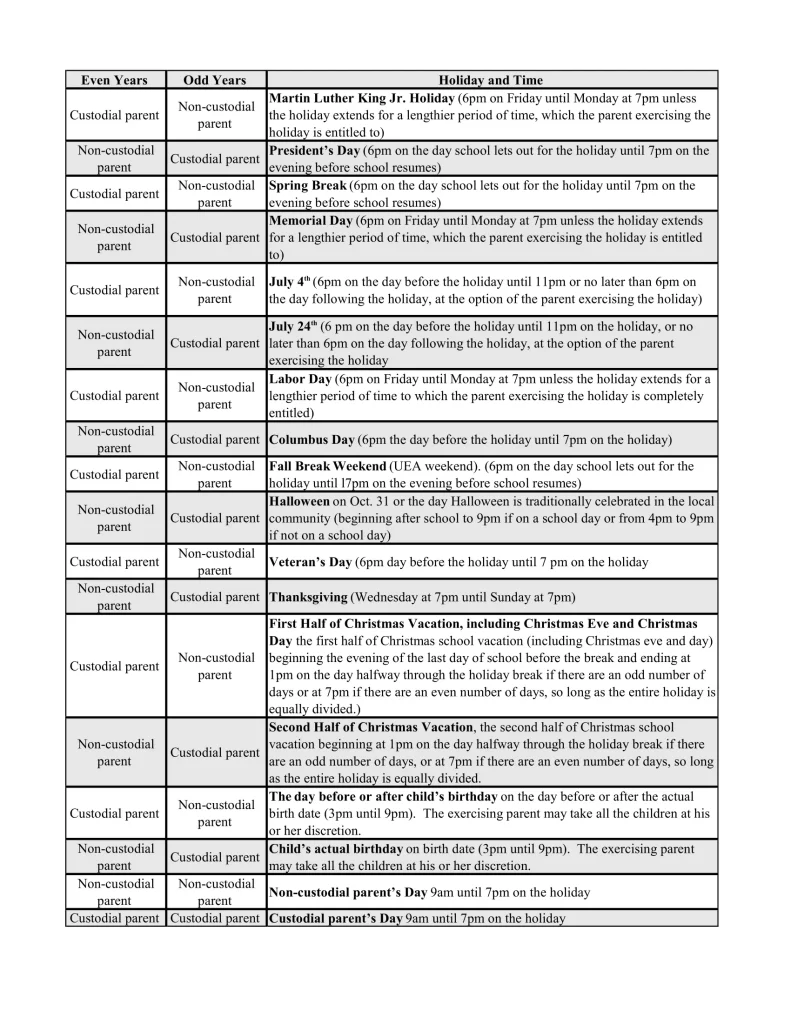
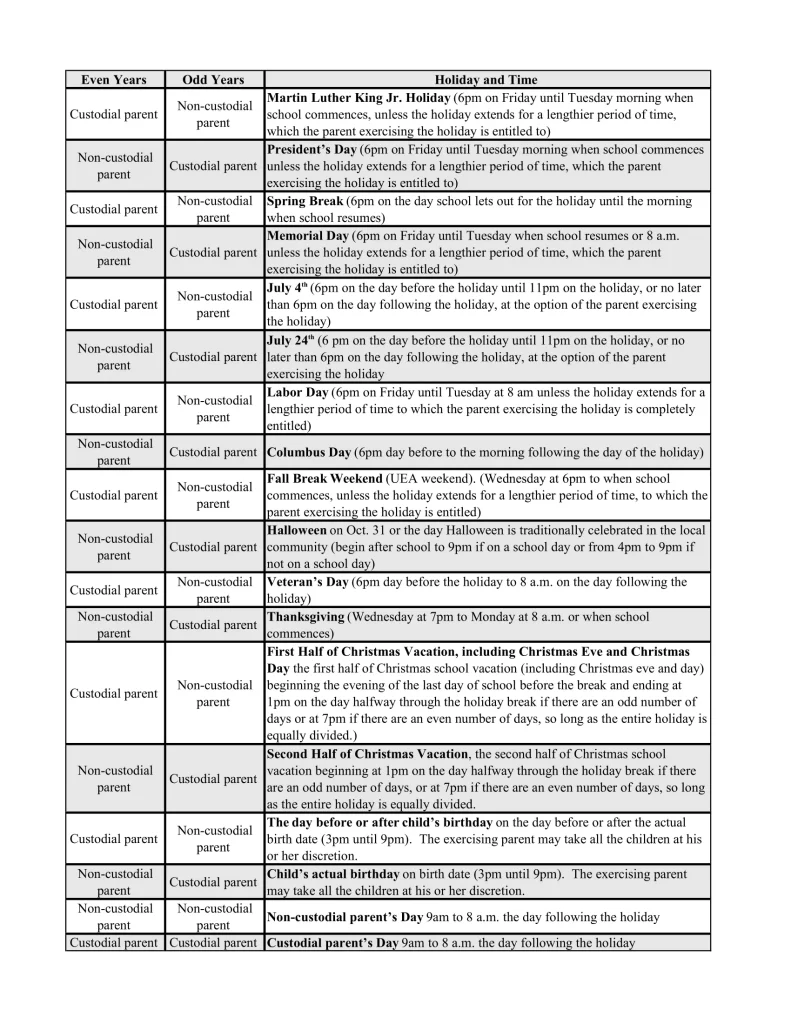
Below are two easy to read charts outlining the holidays for each statute for your reference.

Holiday Schedule Under Utah Code § 30-3-35:

Holiday Schedule Under Utah Code § 30-3-35

Holiday Schedule Under Utah Code § 30-3-35.1:

Holiday Schedule Under Utah Code § 30-3-35

Filed Under: Blog

  • « Go to Previous Page
  • Page 1
  • Page 2

Primary Sidebar

"*" indicates required fields

Let’s Connect
801-464-4004
Preferred Method of Contact

From The Blog

Alimony – To Pay or Not To Pay?

Next to child custody, alimony is the most hotly contested issue if you are divorcing in Utah.  Why? Because there is no formula or calculator to determine the amount of alimony.  Instead, alimony is based on multiple factors, which can be highly subjective.  In Utah, the primary purposes of alimony are (1) to get the […]

Testimonials

Diana is extremely organized, professional, competent, and compassionate. She was very skilled at taking my emotional perspective on the situation and sorting out the important facts to help support my case. She always helped me keep a realistic perspective yet provided me with the professional support I needed under a highly stressful situation. Her written responses were well formulated, organized, and always to the point. In court proceedings, she was always professional, respectful, competent, and organized. I always felt that she held the best interest of my children in mind when helping me make decisions. When decisions were made that did not feel favorable to me, she helped me to put the situation in perspective and to not take decisions personally. Diana is a woman and lawyer with integrity. She always took the high road and never spoke of anyone with disrespect. She utilized the facts to speak for themselves and refused to match disparaging remarks made by others. Without question, I would return to her again for legal representation. Furthermore, I give her the highest recommendation to anyone seeking legal representation.

Footer

Telfer Family Law & Mediation
2150 South 1300 East #500
Salt Lake City, UT 84106
801-464-4004

Copyright © 2025 - All Rights Reserved | Web Design by The Crouch Group | Log in