• Home
  • About Diana Telfer
    ▼
    • FAQs
  • Family Law
    ▼
    • Collaborative Divorce
    • Mediation
    • Premarital Agreements
    • Limited Representation Services
    • Child Custody/Child Support
    • Alimony
    • Negotiated Settlements
    • Special Master
  • Blog
    ▼
    • In The News
  • Schedule an Appointment
  • Pay Online
  • Skip to primary navigation
  • Skip to main content
  • Skip to primary sidebar
  • Skip to footer

Telfer Family Law & Mediation

Salt Lake City Divorce & Mediation

phone number
801-464-4004

  • Home
  • About Diana Telfer
    • FAQs
  • Family Law
    • Collaborative Divorce
    • Mediation
    • Premarital Agreements
    • Limited Representation Services
    • Child Custody/Child Support
    • Alimony
    • Negotiated Settlements
    • Special Master
  • Blog
    • In The News
  • Schedule an Appointment
  • Pay Online

Alimony

Alimony 101 in Utah

August 14, 2024 By Diana Telfer

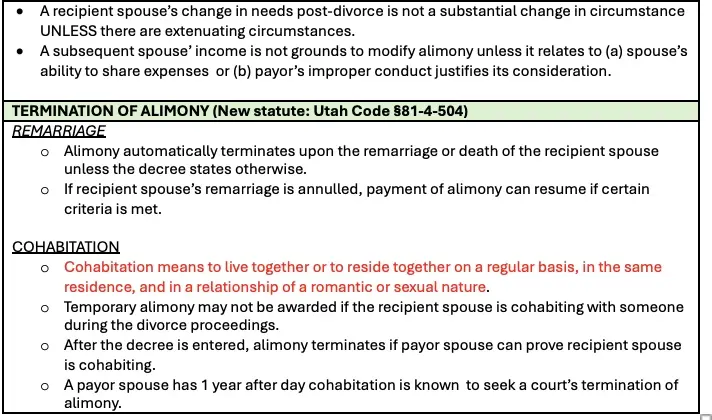
Our Utah legislature was busy this past 2024 session re-numbering the entire family law related statutes.  Here’s a chart for easy reference to understand how and when alimony is determined.  Any substantive changes are in red and become effective as of September 1, 2024.
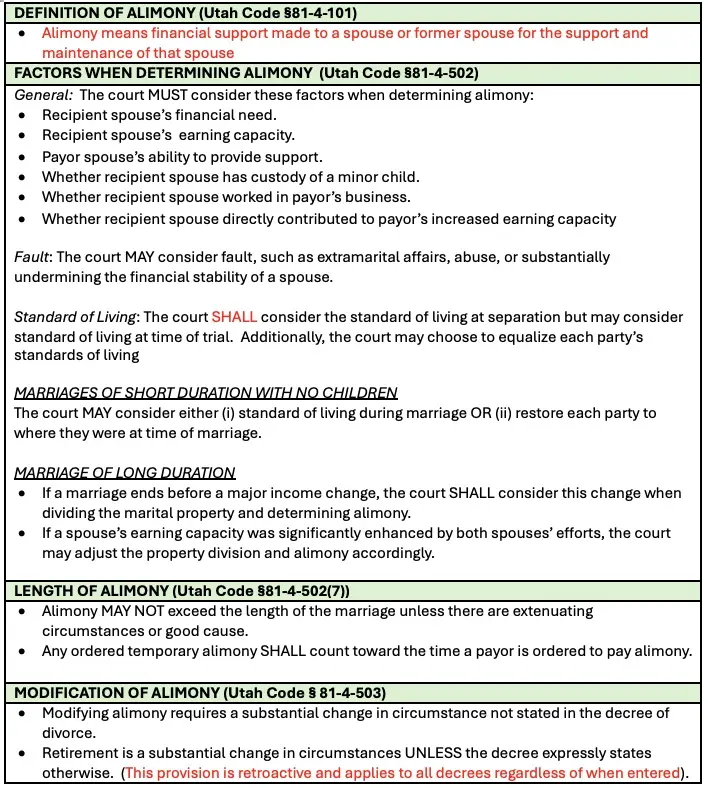
Alimony Under Utah Code §81-4
Termination of Alimony Under Utah Code §81-4-504

The purpose of alimony is to avoid a significant disparity between the parties’ lifestyles after their divorce.  Alimony is one of the most challenging and complex issues in a divorce because the factors can be quite subjective.  Over the past 19 years, I have expertly guided numerous clients through the complexities of alimony disputes, utilizing a range of strategic tools and solutions to achieve favorable outcomes without the need for court intervention.

For more information on alimony, feel free to contact me at (801)464-4004. 

Filed Under: Money & Divorce Tagged With: Alimony

Divorce, Abraham Maslow, and Financial Support

December 1, 2021 By Diana Telfer

It would be lovely if the starting point of any divorce could be deciding what we want. But more often than not, my first consultation with clients involves questions of survival. Many clients fear what their financial future will look like. They have worked hard to get where they are financially. Divorce presents a sharp reality that what one has now will not be what one has in the near future. Clients come wanting assurance. They want to know whether they will be able to stay in their home, maintain sufficient financial support for their household, and walk away with sufficient funds to maintain the lifestyle to which they have become accustomed. It can be a struggle to move the conversation beyond these basic concerns.

Abraham Maslow developed a motivational theory that consists of five levels of needs. The bottom level involves the physiological needs of food, shelter, warmth, and air. The most basic of all needs. These needs MUST be satisfied before any other issue can be explored. This explains why a stay-at-home parent who has not worked for years because they have dedicated their lives to serving the family at home may fixate upon support or on keeping the home. With Maslow’s explanation of human motivation, a person worried about their basic biological needs of food and shelter cannot think about the future.

So what type of financial support is available in Utah?

Child Support

If there are minor children, meaning children under the age of 18 or not graduated from high school, whichever is later, one parent is entitled to receive child support. Child support is relatively easy to calculate using the Utah.gov Child Support Calculator. It is based on the (i) number of overnights each parent has the children each year and (ii) each parent’s gross income. Gross income includes income from any source whether earned or unearned including salaries, wages, commissions, bonuses, rents, gifts from anyone, prizes, dividends, unemployment compensation, social security benefits, capital gains, alimony, etc. If one parent does not currently work, that parent has generally imputed income based upon his or her employment potential and probable earnings. A judge will look at such things as that parent’s work history, occupation qualifications, education, literacy, age, health, employment opportunities, criminal record, other employment barriers and background factors, and prevailing earnings and job availability of persons of similar backgrounds in the community. A parent who has no recent work history or if a parent’s occupation is unknown, that parent has imputed an income at the federal minimum wage for a 40-hour workweek. If one parent has the children for less than 110 overnights then child support is calculated using a sole custody worksheet. If each parent has more than 110 overnights then child support is calculated using a joint custody worksheet.

Alimony

Spousal support or alimony is the second form of support. It is the second most litigated issue in a divorce next to custody. The policy behind Utah’s alimony laws is to enable the receiving spouse to maintain as nearly as possible the standard of living enjoyed during the marriage and to prevent the spouse from becoming a public charge.
Unlike child support, there is no calculator to determine an appropriate amount of alimony. There are seven (7) different factors that a judge must consider when determining alimony with the three most significant ones being (i) the financial condition and needs of the recipient spouse, (ii) the recipient spouse’s earning capacity or ability to produce income; and (iii) the ability of the payor spouse to provide support. A recipient spouse’s need is based on the standard of living enjoyed during the marriage. Other factors include the length of the marriage, whether the recipient spouse has custody of a minor child requiring support, whether the recipient spouse worked in a business owned or operated by the other spouse; and whether the recipient spouse directly contributed to an increase in the payor spouse’s skill by paying for education received by the payor spouse or enabling the payor spouse to attend school during the marriage. A judge may consider the fault of the parties under certain circumstances (e.g. one party engaging in an extramarital affair, abuse, or a party substantially undermining the financial stability of the other party or the children). The length of alimony cannot exceed the length of the marriage and terminates upon remarriage, cohabitation as defined by Utah law, and death of either party.

Figuring out how much alimony you may be entitled to or may be expected to pay is a difficult task and one that you will likely want to seek legal advice on.

Next to the children, financial support is one of the biggest obstacles in divorce or separation. No one can reasonably be expected to focus on other issues if they are worried about how they are going to pay their bills, feed their children, or keep a roof over their head. It is critical for couples to understand and recognize that the financial needs of the other party to help move toward settlement. Not addressing these issues fairly create long-term negative effects on the family.

Filed Under: Money & Divorce Tagged With: Alimony, Financial Preparation

Alimony – To Pay or Not To Pay?

December 1, 2021 By Diana Telfer

Next to child custody, alimony is the most hotly contested issue if you are divorcing in Utah.  Why? Because there is no formula or calculator to determine the amount of alimony.  Instead, alimony is based on multiple factors, which can be highly subjective.  In Utah, the primary purposes of alimony are (1) to get the parties as close as possible to the same standard of living that existed during the marriage; (2) to equalize the standards of living of each party; and (3) to prevent the recipient spouse from becoming a public charge.”[1]  Alimony is not fashioned to provide for only the basic needs of the recipient spouse but should consider the parties’ standard of living enjoyed during the marriage as closely as possible.[2]  While this calculation may seem relatively easy, there is broad discretion when figuring out a recipient spouse’s needs and how long alimony should be paid.

The Utah legislature has identified seven factors[3] that must be considered when determining whether to award alimony with the primary three factors, often referred to as the “Jones factors,” requiring the examination of “(i) the financial condition and needs of the recipient spouse, (ii) the recipient’s earning capacity or ability to produce income; and (iii) the ability of the payor spouse to provide support.”[4]  To determine these factors, each spouse must complete a court-approved Financial Declaration that includes among other things, a monthly budget of expenses.  Certain financial documentation must also be exchanged including income verification documents, bank statements, and credit card statements.

Calculating the Needs of the Recipient Spouse and Payor Spouse’s Ability to Pay

It is common that a spouse’s circumstances will be different after the couple separates. For instance, one spouse may move in with his or her parents to avoid incurring any additional housing costs during the pendency of the divorce proceeding.  However, when calculating alimony, a couple is to look to the standard of living prior to separation rather than after separation.  The standard of living is based on the monthly expenditures.  So it is important for each spouse to be thorough when preparing their monthly budget.  It is advisable to review bank and credit card statements from the 6 to 12 months prior to your separation.  However, in most cases, a divorcing couple is not going to be able to maintain the standard of living during the marriage because there simply will not be enough money to go around.  In that situation, calculating alimony then turns to equalizing the standards of living between the parties so that each party has close to the same cash flow each month.

Each spouse needs to complete a budget to determine how much each spouse needs to live.  The spouses’ budgets will likely be different based on the expenses that the spouse will have post-divorce or the amount of time the children will be with each parent.  It is possible that one spouse will agree to be responsible for paying the marital debt after divorce.  That will obviously increase that spouse’s monthly expenses and decrease the other spouse’s expenses.  When completing the budget, it is important to include all expenses.  The court-approved Financial Declaration form is not an exhaustive list of expenses.  For instance, you will want to include such things as travel, grooming, pet expenses, gym memberships, tax preparation/accounting fees, etc.  These categories are missing from the court-approved Financial Declaration form but should be added if these are expenses incurred during the marriage.

If an expense was incurred during the marriage but will no longer exist after the divorce or the expense will be reduced in the future then that expense should be eliminated or adjusted in your monthly budget.  Many expenses will need to be adjusted.  For instance, if you are not the spouse that provides health insurance, it will be important for you to get quotes on how much your health insurance will be post-divorce since you will not be able to remain on your spouse’s health insurance.  If you have an older vehicle that will likely need to be replaced in the near future then you will likely want to include a reasonable amount for a future loan payment to replace that vehicle.  You will want to include student loan payments.  Student loans are typically the responsibility of the spouse that acquired the loan, regardless of whether it was incurred during the marriage to pay for family expenses.  If you typically contributed to retirement and other savings plans, those expenses can also be considered.

When determining future housing expenses, each party should do the research to determine what that amount will be since it will likely change.  If one spouse intends to keep the marital residence but will be required to buy out the other spouse’s interest, the mortgage payment will go up.  Or if you intend to sell your home, you will want to figure out what funds you will have for a down payment, the home price range that you can afford, and the amount of your mortgage payment.  There is a wide range of mortgage calculators that you can use to help with this process.  Also, depending upon the amount of time the children are spending with each parent, budgets for each parent may be different.  Lastly, if the budgets are contested, it will be critical to gather the financial documentation to support the amount of claimed expenses.

Depending upon the complexity of your situation, you might want to consider hiring a forensic accountant or certified divorce financial advisor to help review your financial records and create your budget.  Accurately creating your budget can feel overwhelming but it is one of the most important tasks to complete in your divorce.

Determining Incomes

Determining the incomes of each spouse can be relatively simple if you both worked during your marriage but there are a few principles that are often misunderstood.  The  Utah child support statute provides that child support is based on a 40-hour workweek.  However, if a spouse has historically worked overtime or received bonuses then that additional income should be included when calculating that spouse’s gross monthly income.

If the recipient spouse remained home to be a full-time caretaker for the children but is capable of working, then that spouse will likely be imputed income.  The question that must be answered is what is that spouse capable of earning?  Any income imputation is based on education, work history, occupation qualifications, employment opportunities, and the prevailing earnings for persons of similar backgrounds in the community.[5]

Determining incomes for a spouse who is self-employed can also be a challenge since the income reported on tax returns is undoubtedly less than what the actual gross income is.  For the self-employed, gross income is “calculated by subtracting the necessary expenses required for self-employment of business operation from gross receipts.”[6]  However, when calculating the necessary expenses, you want to make sure that you are not double-counting that expense.  Many expenses are commonly used for both business and personal purposes.  For instance, if a car loan or cellphone is paid by the business then that same expense should not be included in the self-employed spouse’s personal monthly budget.  Another approach, which was adopted in the Miner case, is to divide the expense in half applying one half of the expense as a reasonable business expense and the other half considered a personal expense.  Determining whether an expense is a necessary business expense or a personal expense is based on whether that expense is “necessary to allow the business to operate at a reasonable level.”[7]

How Long Should Alimony Be Awarded

Once alimony is calculated then the length of alimony must be determined.  The Utah “legislature has set an outer boundary on the length of alimony awards, mandating that, in the absence of extenuating circumstances, alimony may not be ordered for a duration longer than the number of years that the marriage existed.  But there is no inner boundary on the length of an alimony award.”[8]  Alimony can be paid for a shorter period of time, or the alimony award may taper off gradually.  This is often referred to as “rehabilitative alimony.”  “Rehabilitative alimony is a remedy intended to ease the recipient spouse’s financial adjustment period.”[9]  This is often considered appropriate “where the recipient spouse is of an age and in possession of employment skills that make self-sufficiency likely.”[10]  Rehabilitative alimony may be awarded to allow sufficient time for the recipient spouse to return to college and earn a higher degree.  Thus, increasing that spouse’s earning capacity and ability to provide for his or her own monthly needs.  Alimony also terminates upon the remarriage or cohabitation of the recipient spouse and the death of either spouse.

Conclusion

Determining alimony is a complicated issue.  If you have more questions, feel free to contact Telfer Family Law.

[1] See Rule v. Rule, 2017 UT App 137, ¶ 14, 402 P.3d 153.
[2] Id.
[3]
[4] Miner v. Miner, 2021 UT App 77, ¶ 16.
[5] Vanderzon v. Vanderzon, 2017 UT App 150, ¶ 63 (quoting Utah Code § 78B-12-203(7)(b).
[6] Utah Code § 78B-12-203(4).
[7] Barrani v. Barrani, 2014 UT App 204, ¶¶ 15-16, 334 P.3d 994.)
[8] Miner, 2017 UT App 77, ¶ 91 (quotation simplified).
[9] Id. At ¶ 92.
[10] Id.

See Also

A Checklist for Divorce Financial Planning
Financial Planning in Divorce – 5 Steps to Getting Your House in Order
The Soft Side of Finance: Navigating Divorce with Experts Diana & Chalise
The 5 Step P.L.A.N.S. for a Positive Divorce: Weathering the Storm

Filed Under: Money & Divorce Tagged With: Alimony

Primary Sidebar

"*" indicates required fields

Let’s Connect
801-464-4004
Preferred Method of Contact

From The Blog

Testimonials

Diana Telfer is the best attorney I could have asked for. She listened to all of my concerns and gave me the realistic outcomes of what would happen in court. She genuinely cared for my daughter and I, and fought tooth and nail for us. She’s extremely well organized, considerate, communicative, and professional. She is consistently staying updated on your case to ensure you have everything you need when going to court. She also makes you very aware of how much everything will cost and gives you the best for your money which I greatly appreciated. She has worked for me for two years now and I have zero complaints. Her and her team are the best, and definitely who you want on your side of the court room. I will recommend her to everyone because she was the blessing my daughter and I needed during a trying time in our lives.

Footer

Telfer Family Law & Mediation
1825 South 700 East,
Salt Lake City, UT 84105
801-464-4004

Copyright © 2026 - All Rights Reserved | Web Design by The Crouch Group | Log in