• Home
  • About Diana Telfer
    ▼
    • FAQs
  • Family Law
    ▼
    • Collaborative Divorce
    • Mediation
    • Premarital Agreements
    • Limited Representation Services
    • Child Custody/Child Support
    • Alimony
    • Negotiated Settlements
    • Special Master
  • Blog
    ▼
    • In The News
  • Schedule an Appointment
  • Pay Online
  • Skip to primary navigation
  • Skip to main content
  • Skip to primary sidebar
  • Skip to footer

Telfer Family Law & Mediation

Salt Lake City Divorce & Mediation

phone number
801-464-4004

  • Home
  • About Diana Telfer
    • FAQs
  • Family Law
    • Collaborative Divorce
    • Mediation
    • Premarital Agreements
    • Limited Representation Services
    • Child Custody/Child Support
    • Alimony
    • Negotiated Settlements
    • Special Master
  • Blog
    • In The News
  • Schedule an Appointment
  • Pay Online

Prenuptial Agreements

A Prenuptial Agreement Is Also a Family Conversation

October 12, 2026 By Diana Telfer

The Conversations Blended Families Need to Have – Part 2

When a couple plans to marry, there is usually plenty to talk about. Where they will live, how they will celebrate, and what their life together might look like. If either person has children from a prior relationship, those conversations become more layered.

There may be a home where the children have grown up, savings intended for their education, or a business built long before the new relationship began. There may also be hopes for shared finances, a new home, and a marriage in which both spouses feel secure.

A prenuptial agreement offers an opportunity to talk about how those responsibilities and hopes fit together. Yes, the legal document matters, and so do the conversations that help a couple understand what each person wants to protect—and why.

What are we bringing into the marriage?

A home, an investment account, or a business may represent years of work. It may also carry emotional significance. One person may see a house as an asset; the other may see it as the place their children return to.

Before deciding what should remain separate or become shared, take time to understand what each asset means to its owner.

For a home, the discussion should go beyond whose name is on the deed. If you will live there together, who will pay the mortgage, taxes, and repairs? What happens if the other spouse contributes money toward a renovation or spends months doing the work? Will those contributions create an ownership interest, be reimbursed, or be treated as part of the couple’s shared living expenses?

Consider a couple moving into a home one partner already owns. The owner assumes the house will remain entirely theirs. The other partner assumes that helping pay the mortgage will mean building equity together. Both may believe their expectations are reasonable. Discussing them before the wedding gives the couple a chance to reach an intentional agreement.

Personal income deserves the same attention. Will earnings go into a joint account, separate accounts, or a combination? How will shared expenses be paid if one person earns substantially more? If one spouse reduces work to care for children or support the household, how will the couple account for that contribution and the effect on that spouse’s financial security?

For a business, discuss ownership, income, growth in value, and any work or financial contributions the other spouse might make. Keeping a business separate still leaves important questions about how it will support the family and what each spouse can expect.

How will we provide for our children while building a life together?

In a blended family, money conversations can touch a sensitive question: Will caring for my children be understood as a responsibility, or viewed as competing with my commitment to this marriage?

That concern deserves a thoughtful response.

Begin with the commitments already in place, including child support, medical expenses, education savings, and obligations under an existing divorce decree. Then discuss the choices ahead: college contributions, extracurricular activities, help with a first car, or support for an adult child who needs additional assistance.

Some useful questions include:

  • Which children’s expenses will come from shared funds, and which will remain each parent’s responsibility?
  • Will savings already set aside for a child remain designated for that child?
  • How will we make decisions about substantial gifts or financial help to adult children?
  • What does fairness look like when our children have different ages, needs, or resources available from their other parents?
  • If we have a child together, how will that affect our plans?

Fairness does not always mean identical spending. One child may need ongoing medical care; another may already have a well-funded college account. What matters is whether the couple understands the differences and agrees on how to approach them.

The conversation should also include what happens if one spouse dies. A parent may want to preserve an inheritance for their children while ensuring the surviving spouse has financial support and a place to live. These goals deserve coordinated planning with the prenuptial agreement, estate documents, and beneficiary designations.

Under Utah law, a premarital agreement cannot affect a child’s rights to support, medical expenses, medical insurance, or child care coverage. Planning between future spouses must respect those protections.

What should we discuss even if it does not belong in the legal agreement?

Some of the most valuable premarital conversations concern daily life.

What role will the stepparent have in discipline? Who will communicate with the children’s other parent? Is the stepparent expected to provide transportation, supervise homework, or rearrange work for child care? How will the biological parent support the stepparent when disagreements arise?

These questions can be especially important when a stepparent has not raised children before, or when the adults have different parenting styles. Affection for a partner does not automatically provide a shared understanding of parenting.

Couples may find it helpful to write down their expectations about household and parenting responsibilities separately from the financial agreement. That conversation should account for existing parenting arrangements and leave room for relationships to develop. Children should not be expected to accept a new parental role on the adults’ timetable.

Other topics deserve attention, too: holidays, family traditions, privacy, time alone with each parent, relationships with grandparents, and the place adult children will have in the home.

A child may need reassurance that there will still be one-on-one time with their parent. A new spouse may need reassurance that household decisions will include them. Both needs can be heard.

Make room for an honest conversation

Start these discussions well before the wedding. Allow time to exchange financial information, ask questions, obtain separate legal advice, and consider proposals without the pressure of an approaching ceremony.

It can help to begin with the concern behind the request: “I want my children to have the education funds I have saved for them,” or “I want to feel secure if I invest in a home I do not own.”

Those statements give a partner something specific to understand and respond to.

As a family law attorney and mediator, I believe these conversations deserve as much care as the document itself. A thoughtful prenuptial agreement begins with understanding the family you are creating, the responsibilities you already carry, and the life you hope to build together.

If you are considering a prenuptial agreement in Utah, this is an opportunity to discuss both the financial terms and the family expectations that will shape your marriage.

With care,

Diana

Filed Under: Prenups & Marriage Agreements Tagged With: Money Conversations, Prenuptial Agreements

Loving forward while honoring the Past: Prenups in Second Marriages and Blended Families

March 3, 2026 By Diana Telfer

Falling in love again often comes with deeper self-knowledge, clearer priorities, and (very often) with more complexity.

Second marriages and blended families carry not only hope for the future, but meaningful ties to the past: children, shared history, financial responsibilities, and emotional commitments that do not disappear when a new relationship begins.

Yes, planning doesn’t sound very romantic. However, it is an act of deep care for everyone involved.

Why second Marriages are different

A first marriage is often built from a relatively clean financial slate. In contrast, second marriages frequently include:

  • Established careers and retirement accounts
  • Property owned before the relationship
  • Children who depend on a parent’s long-term financial security
  • Ongoing support obligations or shared business interests

Emotionally, there can also be lingering sensitivities from prior separations or losses. This combination of legal and emotional layers means assumptions that might work in a first marriage can create unintended consequences in a second.

Thoughtful planning acknowledges that this relationship is beginning in a landscape that already has history.

Commitment to a new Spouse and Responsibility to Children

One of the most tender balancing acts in second marriages is this: how do you fully commit to a new partner while also honoring responsibilities to children from a prior relationship?

Without clear planning, the law may make those decisions by default. That can lead to outcomes neither partner intended; such as assets passing in ways that leave a surviving spouse financially insecure, or children feeling unexpectedly excluded.

A prenuptial agreement creates space to talk openly about questions like:

  • How will we provide for each other during the marriage?
  • What do we want our children to receive in the long term?
  • How do we define fairness when our histories are different?

Naming these intentions together reduces the chance that love for one person will later be interpreted as disloyalty to another.

Common Sources of Tension

Certain assets tend to carry both financial and emotional weight in blended families:

  • Inheritances meant to stay within a family line
  • Family homes filled with history and memory
  • Retirement accounts built long before the current relationship
  • Business interests that support not only the couple but extended family or employees

Without clarity, these assets can become flashpoints. A surviving spouse may assume security that the children believe was promised to them. Adult children may fear being displaced. A new partner may worry about long-term stability.

Clear agreements do not eliminate emotion, but they do reduce ambiguity. And ambiguity is often what fuels conflict.

When Lack of Clarity Creates Conflict

Most families do not end up in conflict because someone intended harm. Conflict often arises because expectations were never discussed.

A parent may think, “Of course my children know I will always take care of them.”
A spouse may think, “Of course we share everything; we are married.”

Both can be sincere. Both can be incompatible if never reconciled. Without a plan, those unresolved expectations may collide at the worst possible time — during illness, incapacity, or after a death, when grief is already heavy.

Clarity now is a gift to the people who would otherwise have to untangle those questions later.

Aligning Prenups with Estate Planning

In second marriages, a prenuptial agreement should not stand alone. It works best when aligned with estate planning documents such as wills, trusts, and beneficiary designations.

Together, these tools can:

  • Provide security for a surviving spouse
  • Preserve intended inheritances for children
  • Clarify how specific assets will be handled
  • Reduce the likelihood of future legal disputes

When these pieces are coordinated, they tell a consistent story about care, responsibility, and intention.

Reducing Loyalty Conflicts and protecting Relationships

Blended families can carry invisible loyalty tensions. Children may worry that accepting a stepparent means betraying the other parent. A new spouse may fear always coming second to the past.

Thoughtful agreements help quiet these fears. When financial expectations are transparent and agreed upon, family members are less likely to interpret planning decisions as emotional rejection. The legal clarity creates emotional breathing room.

In this way, a prenup does not divide a family into sides. It helps define roles and responsibilities so that love does not have to compete with uncertainty.

I always remind my clients that planning is not about choosing one relationship over another; it is about honoring all of them with clarity. In second marriages and blended families, a well-crafted prenuptial agreement can be an act of protection, respect, and care for past, present, and future relationships alike.


With Warmth,

Diana

Filed Under: Prenups & Marriage Agreements Tagged With: Blended Families, Prenuptial Agreements, Second Marriages

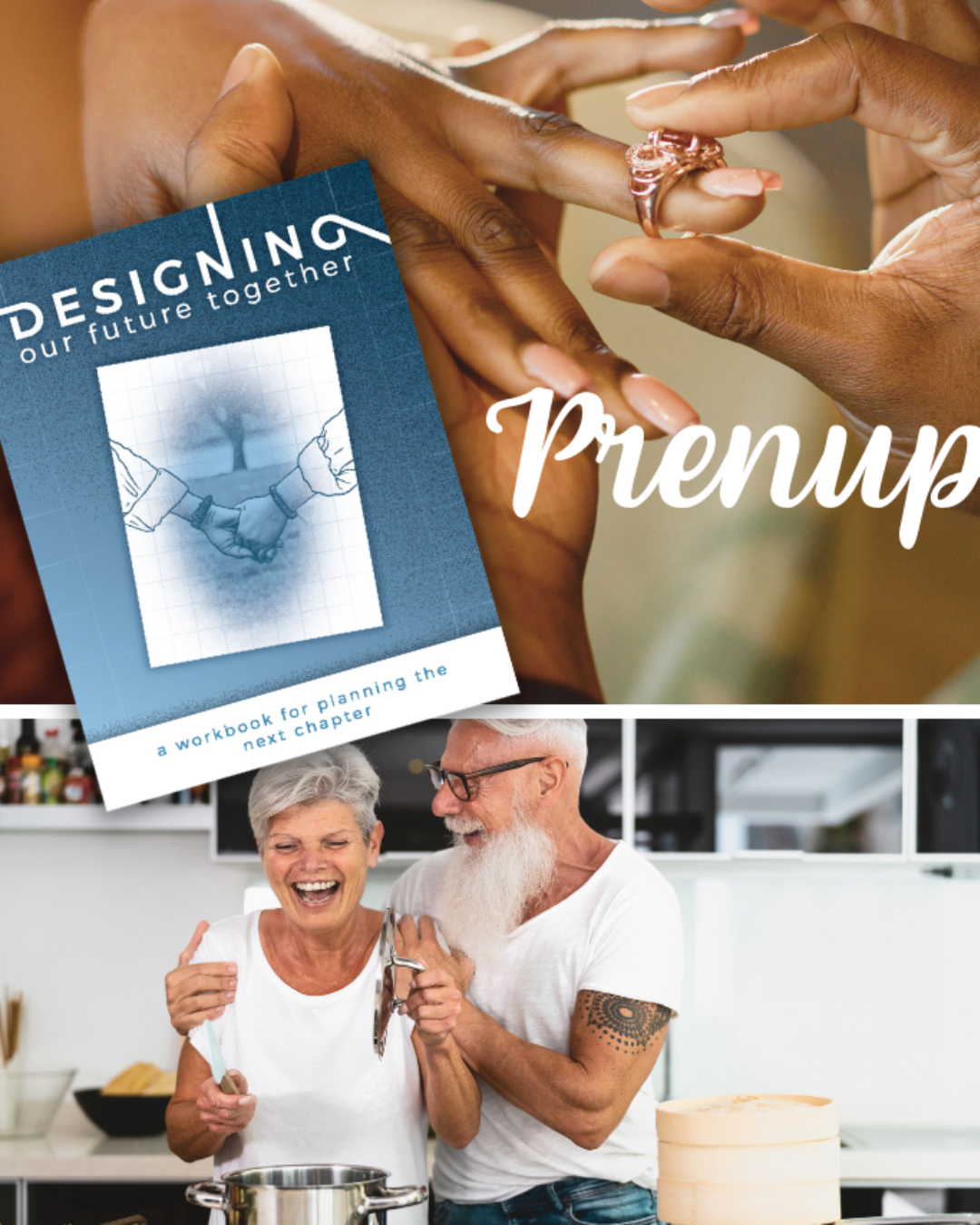
Designing Our Future: A Thoughtful Tool for Relationship Planning

February 24, 2026 By Diana Telfer

Talking about money, expectations, and long-term plans can feel overwhelming for couples — especially when those conversations are tied to legal agreements like prenuptial or post-nuptial planning. Many people want to approach these discussions with care but simply do not know where to begin.

That is where the Designing Our Future workbook can make a meaningful difference.

Starting with Values, not Legal Terms

Rather than jumping straight into legal language, the workbook helps couples begin where strong relationships are built: shared understanding. Through guided prompts and structured exercises, partners explore their beliefs, priorities, and hopes for the future.

The focus is not on “who gets what,” but on questions like:

  • What does financial partnership mean to us?
  • How do we make decisions together?
  • What responsibilities do we carry toward family, children, or past commitments?
  • What helps each of us feel secure and respected?

By the time legal planning enters the picture, couples have already built a foundation of clarity and empathy.

Slowing down in a good Way

Legal conversations can sometimes feel rushed or emotionally charged. A structured workbook slows the pace and creates space for reflection. Each partner has time to think, respond, and listen without feeling pressured to have immediate answers.

This slower, more intentional process often reduces defensiveness and helps partners feel like they are working together rather than negotiating against each other.

Supporting healthier Agreements

Whether couples are considering a prenup, a post-nup, or simply wanting greater alignment in their financial life, the workbook supports more thoughtful decision-making. Agreements that grow out of shared reflection tend to feel fairer and more sustainable because both people have been part of the conversation from the beginning.

In this way, the workbook is not just a preparatory exercise. It is a relationship tool that strengthens communication, deepens mutual understanding, and supports planning grounded in care.

I have been using this resource for three years. And it supports my intention that thoughtful planning begins with thoughtful conversations. Tools like Designing Our Future help couples approach important decisions with clarity, respect, and a shared vision for the life they are building together.

With Care,

Diana

Filed Under: Prenups & Marriage Agreements Tagged With: Money Conversations, Prenuptial Agreements

Love and Clarity: Rethinking Prenuptial Agreements

February 17, 2026 By Diana Telfer

Prenups as an Act of Care:
Why Planning doesn’t mean you expect Things to end
There are few topics that can change the emotional temperature of a room as quickly as the word prenuptial or “Prenup”. For many couples, it carries a quiet sting — a fear that bringing it up somehow predicts failure or reveals doubt.

But what if that reaction is based more on cultural myth than relational reality?

The Myth: Prenups mean Distrust
We have inherited a story that says: If you really believed in us, you would not need a prenup. That story sounds romantic. It is also deeply misleading.

Healthy relationships are not built on avoiding difficult conversations. They are built on the ability to have them with honesty and care. A prenuptial agreement does not signal an expectation that love will end. It signals a willingness to talk openly about the practical parts of building a life together.

In truth, silence about money, debt, expectations, or family obligations is far more likely to erode trust over time than a thoughtful planning conversation ever could.

So, let’s use a different Frame: A Conversation about Values
At its best, a prenup is not a stack of legal protections. I see it as a structured conversation about what matters most.
It invites couples to talk about questions like:

● How will we make financial decisions together?
● What responsibilities do we each carry into this marriage?
● How do we want to handle generosity toward extended family?
● What does financial partnership mean to us?

They might appear as legal questions. But they are not – they are values questions. The legal document simply records the clarity the couple creates together.

The Cost of avoiding “Money Talks”
Many couples glide into marriage with enormous goodwill and very little shared understanding about finances. They assume they will “figure it out later.” Unfortunately, “later” often arrives during moments of stress, like job changes, children, illness, or unexpected financial strain.

When expectations have never been voiced, partners may interpret differences as betrayal rather than misunderstanding. What could have been a calm early conversation becomes a conflict loaded with emotion and hurt.
Avoidance does not protect love. It postpones tension until it is heavier.

Fear-Based Prenups vs. Values-Based Planning
Let me illustrate fear-based prenups vs. values-based prenups.

A fear-based prenup often sounds like:
● “I need to protect myself from you.”
● “I have seen marriages fail, and I do not want to be vulnerable.”
● “Let us lock everything down just in case.”

A values-based prenup sounds different:
● “Let us talk about how we want to treat each other, even in hard seasons.”
● “Let us make sure neither of us feels financially powerless.”
● “Let us decide together what fairness looks like for us.”

The tone, the process, and the spirit behind the agreement matter as much as the terms themselves. One approach builds walls. The other builds understanding.

Why Couples often feel more secure afterward
Many of my clients are surprised to learn that many couples frequently report feeling closer after completing a thoughtful prenuptial process.
Why? Because they have practiced something essential to long-term partnership:
● Listening without defensiveness
● Naming fears without blame
● Making decisions collaboratively
● Seeing and being seen in vulnerable conversations

Clarity reduces anxiety. When both partners know where they stand and feel heard in the process, uncertainty shrinks and security grows.

Protecting the Relationship, not just Assets
The process used to create a prenup can either strain a relationship or strengthen it. A respectful, transparent approach — where both partners have support, space to reflect, and a voice in the outcome — helps protect the relationship itself.

When the focus is on mutual care rather than leverage, the agreement becomes less about dividing property and more about building a foundation of trust, honesty, and shared intention.

In that sense, the process is not a legal hurdle before marriage. It is an early exercise in the very skills a strong marriage requires.

Speaking from many years of experience, a prenup done well is not about preparing for divorce; it is about caring enough to talk about hard things early.

It is an act of clarity, respect, and love — choosing transparency now so that the relationship can grow on solid ground later.

With Care,
Diana L. Telfer

Filed Under: Prenups & Marriage Agreements Tagged With: Business Ownership, Money Conversations, Postnuptial Agreements, Prenuptial Agreements

Primary Sidebar

"*" indicates required fields

Let’s Connect
801-464-4004
Preferred Method of Contact

From The Blog

Testimonials

Diana Telfer is the best attorney I could have asked for. She listened to all of my concerns and gave me the realistic outcomes of what would happen in court. She genuinely cared for my daughter and I, and fought tooth and nail for us. She’s extremely well organized, considerate, communicative, and professional. She is consistently staying updated on your case to ensure you have everything you need when going to court. She also makes you very aware of how much everything will cost and gives you the best for your money which I greatly appreciated. She has worked for me for two years now and I have zero complaints. Her and her team are the best, and definitely who you want on your side of the court room. I will recommend her to everyone because she was the blessing my daughter and I needed during a trying time in our lives.

Footer

Telfer Family Law & Mediation
1825 South 700 East,
Salt Lake City, UT 84105
801-464-4004

Copyright © 2026 - All Rights Reserved | Web Design by The Crouch Group | Log in