
• Home
  • About Diana Telfer
    ▼
    • FAQs
  • Family Law
    ▼
    • Collaborative Divorce
    • Mediation
    • Premarital Agreements
    • Limited Representation Services
    • Child Custody/Child Support
    • Alimony
    • Negotiated Settlements
    • Special Master
  • Blog
    ▼
    • In The News
  • Schedule an Appointment
  • Pay Online
  • Skip to primary navigation
  • Skip to main content
  • Skip to primary sidebar
  • Skip to footer

Telfer Family Law & Mediation

Salt Lake City Divorce & Mediation

phone number
801-464-4004

  • Home
  • About Diana Telfer
    • FAQs
  • Family Law
    • Collaborative Divorce
    • Mediation
    • Premarital Agreements
    • Limited Representation Services
    • Child Custody/Child Support
    • Alimony
    • Negotiated Settlements
    • Special Master
  • Blog
    • In The News
  • Schedule an Appointment
  • Pay Online

Child Custody

Child Custody 101

December 1, 2021 By Diana Telfer

Growing up in the 70s and early 80s, I did not know anyone whose parents were divorced. My first introduction to “child custody” disputes was from watching Kramer v. Kramer, the 1979 movie where the mom (Meryl Streep) abandons her husband and son but returns after 15 months to claim her child. The custody battle involved each parent’s lawyer viciously attacking the other parent’s character. It was traumatizing to watch. In the end, the court awarded the mom custody of the child even though she had abandoned the child and the father (Dustin Hoffman) had made dramatic changes to his life, including sacrificing his career, to care for his son.

For most of the 20th century, courts followed what has been called the “tender years” doctrine when awarding custody of children. The tender years doctrine is a legal doctrine that presumes a mother should be awarded custody of her children because young children need their mother regardless of the father’s involvement in the care of the child, the child’s bond to the father, or the child’s lack of bond with the mother. Luckily, the courts have evolved beyond the tender years doctrine and now determine custody based on the best interests of a child. But what does that mean?

Often, I hear clients during an initial consult explain that they need “sole custody” of their children because he or she has stayed home with the children or that he or she needs “joint custody” because that is the fair approach. But when asked what they mean by that, the clients do not fully understand. Most clients believe it just means where the children live.

Child custody involves two components. The first is legal custody, which involves decision making authority. It is the right of a parent to be involved in making long-term decisions about their child. The second is physical custody or where a child will reside.

Legal Custody

In Utah, there is a presumption that it is in the child’s best interests that both parents should be involved in all major decisions related to that child’s welfare. This typically involves decisions relating to medical issues, education, and religious upbringing. There are certain circumstances where joint legal custody (or joint decision making) may not work such as in a relationship where there has been domestic violence or where the parties live far apart. But generally it is expected that when an issue arises, each parent should be notified of an issue, talk through the options, and then arrive at a mutual agreement on how to address the issue. Most issues can be resolved this way but what happens if that is not possible? There are different approaches to resolving a disagreement including (i) giving one parent the right to make the final decision only after a discussion has occurred; (ii) attending mediation; (iii) giving a parent the right to make the final decision only after mediation is attempted; (iv) hiring a special master (usually an attorney) to make the decision; or (iv) giving neither party the right to make a final decision and requiring the issue be brought to the court if no agreement can be reached.

Physical Custody and Parent-Time

There is no such legal presumption relative to physical custody. Instead, the court looks at various factors when determining where the child should live. There are 17 specific factors that are to be considered including such things as (i) a parent’s demonstrated understanding and ability to meet the needs of the child including physical, emotional, education, medical and any special needs; (ii) the parent’s ability and willingness to co-parent including the ability to appropriately communicate with the other parent, the ability to encourage the sharing of love and affection, and willingness to allow frequent contact between the child and the other parent; (iii) who has been the primary caretaker of the child; (iv) the parent’s financial responsibility; (iv) the relative benefit of keeping siblings together; and. (v) the relative strength of the child’s bond with the parent. The non-exhaustive list of custody factors can be found here.

“Sole physical custody” means when one parent has less than 111 overnights with the children. The traditional parent-time schedule when one parent is designated the primary custodian includes a midweek visit from the time school is dismissed until 8:30 p.m., alternating weekends from Friday afternoon until Sunday evening, four consecutive weeks during the summer, and alternating holidays. Often, attorneys refer to this schedule the “30-3-35” schedule because the schedule is described in Utah Code Section 30-3-35.

“Joint physical custody” means when each parent has the children at least 30% of the overnights each year. There are a variety of joint custody arrangements. Several years ago, the Utah legislature enacted an alternative schedule where one parent’s midweek parent-time is overnight, the alternating weekend is from Friday after school dismisses until Monday morning when school resumes, four consecutive weeks in summer, and alternating holiday schedule where the children are returned when school resumes. This schedule gives one parent 145 overnights and the other parent 220 overnights. In other words, this is a 40/60 division of parent-time. This schedule is often referred to as the “30-3-35.1” schedule since it is described in Utah Code Section 30-3-35.1.

As of May 5, 2021, there is now an additional alternative schedule that a court may award that has the children spend equal time with each parent. This schedule can be found in Utah Code Section 30-3-35.2 and identifies specific factors that a court may consider when awarding a 50/50 custody arrangement. A court may award equal parent-time if the court finds that it is in the child’s best interest, each parent has been actively involved in the child’s life, and each parent can effectively facilitate the equal parent-time schedule. There are specific factors that the court is to consider when determining whether a parent has been actively involved in the child’s life including each parent’s demonstrated responsibility in caring for the child, each parent’s involvement in child care, each parent’s presence or volunteer efforts in the child’s school and at extracurricular activities, each parent’s assistance with the child’s homework, and each parent’s involvement in preparation of meals, bath time, and bedtime. Some of the more common 50/50 custody schedules include (i) a “2/2/5/5 schedule” where the children reside with one parent every Monday through Wednesday morning, the other parent from Wednesday through Friday morning and alternating weekends from Friday through Sunday morning; (ii) “week on/week off” where the children reside with each parent for a week and exchange at a designated time such as on Friday or Sunday evening; or (iv) a “4/3/3/4 schedule” where one week the children reside with parent A for 4 days and reside with parent B for 3 days and the next week the children reside with parent A for 3 days and with parent B for 4 days.

In summary, custody means much more than where a child resides. It involves how much each parent will be involved in all aspects of a child’s life. Parents are also not restricted to the statutorily defined schedules. Parents can decide any schedule that works for their family. If the parents can agree, a court will adopt their schedule. It is the extremely rare case that a judge will reject the parents’ mutually agreed upon schedule. However, if the parents cannot decide then the court is more restricted and will likely adopt one of the schedules mentioned above.
Filed Under: Children & Co-Parenting Tagged With: Child Custody, Child Support, Parent-Time

Sharing Custody, The Holidays, and COVID-19: “Create a Roadmap for Success”

December 1, 2021 By Diana Telfer

Last year the Association of Family and Conciliation Courts published some useful tools to help those sharing custody in the holiday season.

For the full Roadmap, visit their file here.

“1. PLAN EARLY:
If there is one piece of advice you take away from these guidelines, it has to be this one. If there was ever a holiday season that could not be successfully navigated by the seat of your pants at the last minute, it is this season. Consider travel logistics, your holiday traditions, events with family and friends and the parenting time schedule, as usual. Include an accurate assessment of applicable guidelines and possible tracing requirements and quarantine times based on protections needed in each household.

2. FOLLOW THE RULES OF THE ROAD:
Stick to your parenting plan or schedule as much as you can, if there is one. If not, start working out a plan. Communicate with your co-parent as soon as possible if you think your customary schedule, family gatherings or travel arrangements will have to change because of the virus.

3. AGREE ON A DESTINATION:
Be straightforward with each other about your goals for the holidays. Discuss how to have a holiday that is both happy and safe for everyone. Look carefully at the level of disease at any location where you might plan to go and also where you live. You have to consider if you could be carrying the risk from your home to another part of the country, as well as the infection and positivity rates present in the community you will be visiting. Will you be among people who are carefully observing the recommendations and rules (masks, social distancing, hand washing)?

4. PLAN YOUR ROUTE TOGETHER:
Talk about the where, when and how. Agree on how to proceed if you disagree. Find ways to resolve disputes with each other, a trusted advisor, a mediator or a parenting coordinator—always a preferable alternative to going to court. If the dispute continues, consider reaching out to a mediator, with or without an attorney, to resolve the issues before seeking court intervention.

5. DON’T BE AFRAID TO STOP AND ASK FOR DIRECTIONS:
Your particular situation may benefit from a consultation with an expert, who might be the family pediatrician (if the point of dispute involves health risks), a family therapist, or your lawyer.

6. YIELD TO HAZARD SIGNS:
Be prepared to abide by local, state and national instructions regarding health and safety as they are updated.

7. SLOW DOWN IF THERE IS CONSTRUCTION OR AN ACCIDENT AHEAD:
Be willing to take a step back, slow down and communicate about any new concerns that may arise related to health and safety.

8. BE OPEN TO ALTERNATIVE ROUTES:
This year is going to be an exception for everyone, not just coparents. Everybody is concerned about doing the right thing, which will lead inevitably to finding new ways to gather and celebrate. For some it will mean get-togethers only on Zoom; for others, there will be gatherings of limited size and limited time, with masks and social distancing. Consider holding any gathering outside, if the weather permits. If you must be indoors, good ventilation with doors and windows open is a must. Social and family connections will have to be balanced by safe behaviors and mitigating risk.

Above all and despite the extra complications of the circumstances, we wish everyone a healthy, happy and peaceful holiday season!”

“From leaders of the American Academy of Matrimonial Lawyers and the Association of Family and Conciliation Courts, groups that deal with families in crisis:
Susan Myres, President, American Academy of Matrimonial Lawyers (AAML)
Larry Fong, President, Association of Family and Conciliation Courts (AFCC)
Mindy Mitnick, AFCC President Elect
Matt Sullivan, AFCC Past President
Laura Belleau, AAML Second Vice President
Kim Bonuomo, AAML committee co-chair for AAML/AFCC program
Nancy Kellman, AAML committee co-chair for AAML/AFCC program
Jill Peña, AAML Executive Director
Peter Salem, AFCC Executive Director”

Filed Under: Children & Co-Parenting Tagged With: Child Custody, Holidays, Parenting Plans

Divorce and Holiday Parent-Time in Utah – Tis the Season

December 1, 2021 By Diana Telfer

If you are a separated or divorced parent confused over your holiday parent-time schedule, you are not alone.  You would think figuring out when you have your children for a holiday would be straightforward.  Unfortunately, it is not so easy if your custody order follows the statutory holiday schedules.  Oftentimes, even attorneys are unable to agree on their interpretations of the holiday schedule.

The first step to figuring out what holiday schedule applies to you is looking at your custody decree or order.  You may have an order that specifically identifies the division of holidays with straightforward start and end times.  If so, count yourself lucky.  But it is more likely that you have a custody order that references one of the parent-time statutes (e.g. Utah Code Sections 30-3-35, 30-3-35.1, or 30-3-35.2).

The statutory parent-time schedules divide holidays between even-numbered years and odd-numbered years. Essentially holidays alternate between the parents throughout the year.  The statute lists the holidays assigned to the non-custodial parent (the parent who has less parent-time) in even and odd numbered years.  The custodial parent’s holidays in even-numbered years are the holidays assigned to the non-custodial parent in odd-numbered years.  In odd-numbered years, the custodial parent gets the non-custodial parent’s assigned even numbered year holidays.

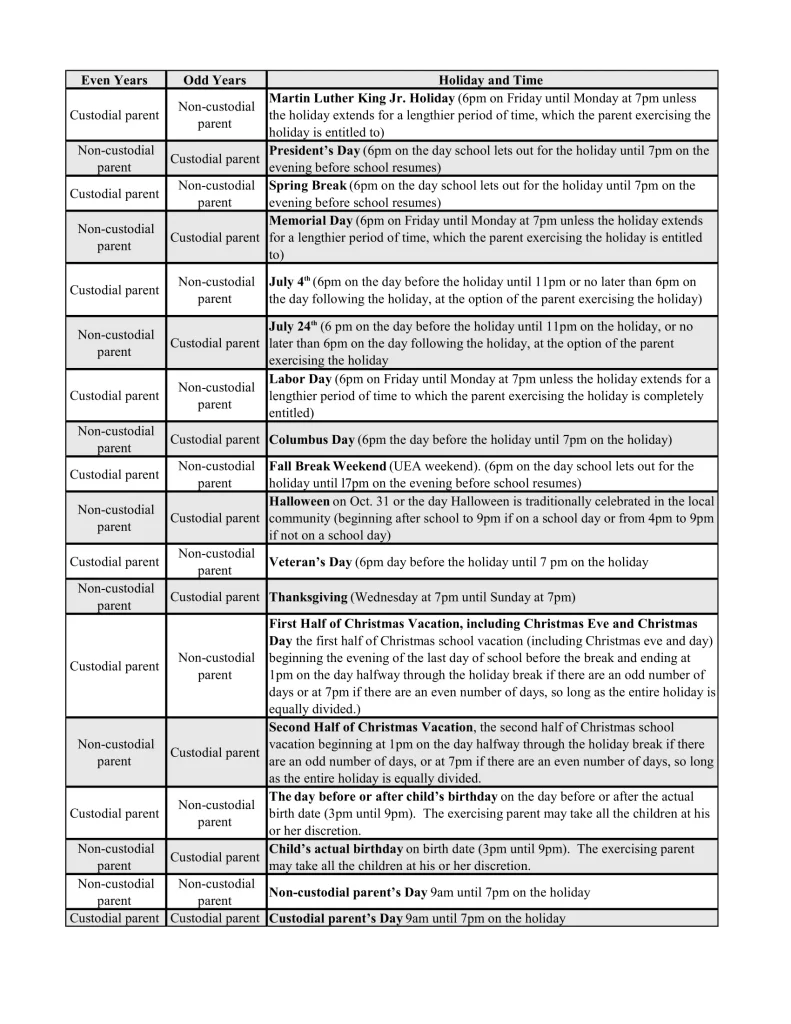
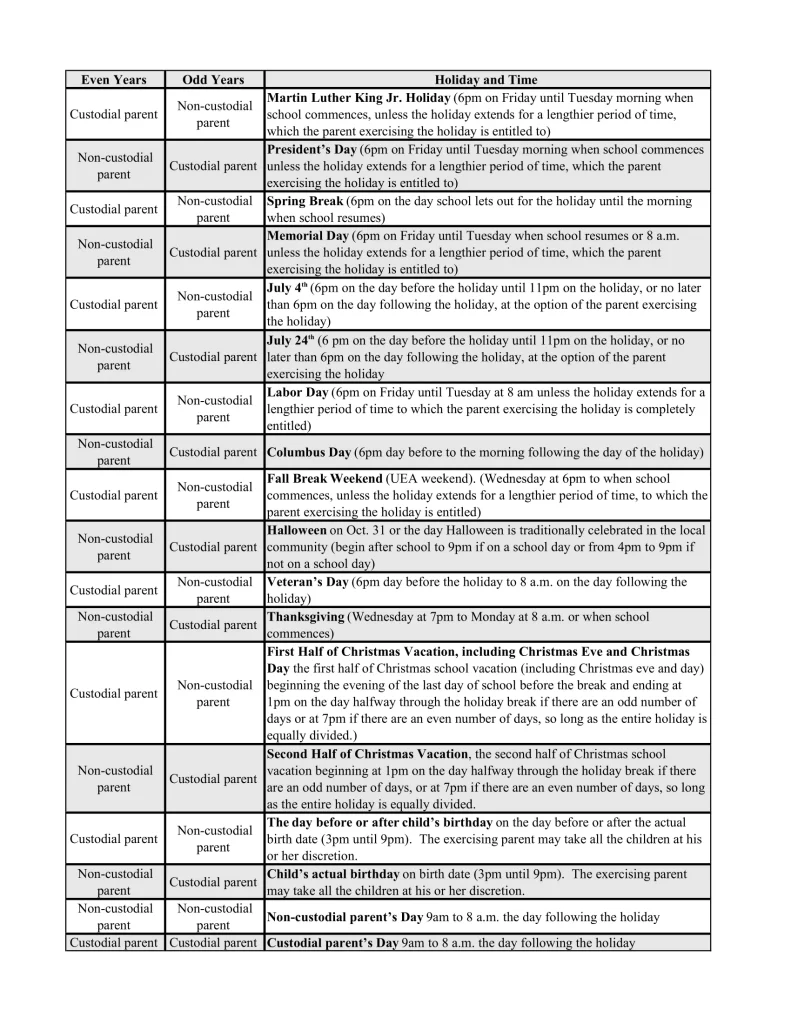
The primary difference between the holiday schedules in Utah Code Section 30-3-35 and Section 30-3-35.1 is when the holiday ends.   In Section 30-3-35, holidays generally end at 7 p.m. the night before school resumes.  In Section 30-3-35.1, holidays extend through to the morning when school commences.  Let’s take the President’s Day holiday as an example.  The holiday typically involves a 3-day weekend with school resuming on Tuesday morning.  Under Section 30-3-35, the holiday weekend ends at 7 p.m. on Monday and under Section 30-3-35.1, the holiday weekend ends Tuesday morning when school resumes.

This is where it gets tricky.  Holidays include any snow days, teacher development days, or other days when school is not scheduled and is contiguous to the holiday. For instance, if school dismisses on Thursday before Martin Luther King’s birthday weekend then the holiday extends from Thursday through Monday at 7 p.m. or Tuesday morning when school commences, depending upon which schedule you follow.   If the holiday falls on a weekend or on a Friday or Monday and the total holiday period extends beyond that time and the parent is free to care for the children, then the holiday extends over the time school is out.   For instance, if a school takes off the week following President’s Day weekend, then the President’s Day holiday includes the weekend and the following week.  Parent-time would resume either at 7 p.m. the night before school starts or the day school starts.

There are other nuances to holidays, including when parent-time can commence.  The best advice is to use common sense.  Talk to the other parent to ensure you are both on the same page.  If you are not, reach out to your attorneys if you have one.   Holidays are difficult enough.  Fighting over the length of a holiday only adds to the stress.

Below are two easy to read charts outlining the holidays for each statute for your reference.

Holiday Schedule Under Utah Code § 30-3-35:

Holiday Schedule Under Utah Code § 30-3-35

Holiday Schedule Under Utah Code § 30-3-35.1:

Holiday Schedule Under Utah Code § 30-3-35

Filed Under: Children & Co-Parenting Tagged With: Child Custody, Holidays, Parent-Time

Primary Sidebar

"*" indicates required fields

Let’s Connect
801-464-4004
Preferred Method of Contact

From The Blog

Testimonials

I reached out to Diana after already hiring an attorney that didn’t seem to believe in me. I set up a consultation and met with Diana. After the first meeting she gave me hope for my future endeavors and I hired her right away. I not only was fighting 1 custody relocation battle but I was fighting 2. Diana is very knowledgeable with family law and is realistic with what different outcomes may occur. She is concerned about the best interest of the children and uses your money in the most cost efficient way to help your needs. I wish I would’ve went to Diana very first! In the end we had a good outcome and I was able to relocate out of state with my entire family together. Thank you Diana!

Footer

Telfer Family Law & Mediation
1825 South 700 East,
Salt Lake City, UT 84105
801-464-4004

Copyright © 2026 - All Rights Reserved | Web Design by The Crouch Group | Log in