• Home
  • About Diana Telfer
    ▼
    • FAQs
  • Family Law
    ▼
    • Collaborative Divorce
    • Mediation
    • Premarital Agreements
    • Limited Representation Services
    • Child Custody/Child Support
    • Alimony
    • Negotiated Settlements
    • Special Master
  • Blog
    ▼
    • In The News
  • Schedule an Appointment
  • Pay Online
  • Skip to primary navigation
  • Skip to main content
  • Skip to primary sidebar
  • Skip to footer

Telfer Family Law & Mediation

Salt Lake City Divorce & Mediation

phone number
801-464-4004

  • Home
  • About Diana Telfer
    • FAQs
  • Family Law
    • Collaborative Divorce
    • Mediation
    • Premarital Agreements
    • Limited Representation Services
    • Child Custody/Child Support
    • Alimony
    • Negotiated Settlements
    • Special Master
  • Blog
    • In The News
  • Schedule an Appointment
  • Pay Online

Holidays

A Christmas Message of Hope

December 22, 2025 By Diana Telfer

This time of year has a way of bringing both softness and ache to the surface. Christmas lights glow in windows, families gather, and traditions unfold—but for many, the season also carries memories of hardship, loss, and transition. I know this intimately. My own journey through two divorces, years of separation, and the deep work of rebuilding myself taught me that the holidays can evoke both grief and gratitude, both longing and renewal.

And yet, Christmas is—and has always been—a season of hope.

Thirteen years ago, I was standing in the emotional rubble of a second marriage that, in truth, had ended years earlier. I clung to the belief that staying married was an act of strength, something noble and necessary to hold my family together. My internal mantra—do not be a two-time failure—kept me locked in place long after love and connection were gone. My daughters, my stepchildren, and I lived inside the unsteady rhythm of a family that no longer functioned as one.

It took time, courage, and a painful awakening to face the truth: this chapter had ended, and no amount of holding on would resurrect it. The moment I finally allowed myself to see reality was the moment I stepped onto a new path—one of healing, honesty, and, eventually, peace.

Christmas reminds me of that turning point. Because the heart of this season is not perfection. It is not about maintaining appearances or holding onto traditions that no longer fit. Christmas is about birth—new beginnings, unexpected light, and the quiet, persistent hope that rises even in the darkest places.

My experience taught me that brokenness does not mean failure.
Sometimes it is the very doorway to transformation.

Like the caterpillar dissolving within the chrysalis, I had to turn inward—to sit with grief, anger, guilt, and the fear of what others might think. I had to excavate beliefs that no longer served me and uncover the values that truly did. Slowly, painfully, beautifully, I rebuilt myself from the inside out.

And from that rebuilding came the work I now devote my life to: supporting families, loving children through transition, and helping others find peaceful pathways through conflict. My commitment to collaborative law, mediation, and child-centered solutions is rooted in what I lived. It is born from the certainty that even in seasons of heartbreak, we can choose peace. We can choose compassion. We can choose hope.

This Christmas, I invite you to remember:

Hope Often Arrives Quietly.

It shows up not in grand gestures, but in soft clarity, in a single brave decision, in the moment you realize you deserve joy.

Resilience is already within you.

Like the butterfly encoded inside the caterpillar, your future self—the stronger, wiser, freer version—is already there.

Love for our Children lights the Way.

When we choose healthy boundaries, peaceful communication, and kindness—even in conflict—we model the very values we want our children to carry forward.

Peaceful Transitions are possible.

Even when the path feels uncertain, there are ways to move through change with dignity, respect, and compassion for everyone involved.

You are not alone.

Transformation requires support. Allies, professionals, and communities exist to hold space while you build your own wings.

Christmas is a season of light returning—a reminder that no matter how long the night has felt, dawn always comes. If you are in a season of transition, uncertainty, or quiet heartbreak, let this message reach you gently:

You are not broken. You are becoming.
You are not behind. You are beginning.
You are not alone. You are held by hope.

May this Christmas bring you moments of peace, soft edges where there were sharp ones, and glimmers of the life that is waiting for you beyond this moment.

May your heart feel steady.
May your children feel loved.
May your future feel possible.

And may you—like the butterfly—emerge in your own time, with wings strong enough to carry you into the next beautiful chapter.

I am wishing you a Christmas filled with warmth, compassion, and hope.

With deep care,
Diana
Filed Under: Life During & After Divorce Tagged With: Emotional Wellbeing, Holidays

Navigating extended Family Expectations after Divorce: Finding Ease, Boundaries, and new Ways to connect

December 15, 2025 By Diana Telfer

Holidays can feel especially stressful after divorce, when extended family members still hold ideas about how things “should” look. Their intentions are often loving, but their expectations may no longer fit your family’s reality. The good news: clear boundaries and thoughtful communication can help the season feel calmer, more intentional, and even more meaningful.


Why Expectations feel so heavy

Holiday traditions are deeply rooted in memory and identity. After divorce, extended family members may want to preserve what feels familiar, which can create pressure around:

  • Longstanding gatherings that no longer fit
  • Competing invitations
  • Guilt or disappointment when plans change
  • Difficulty accepting new roles or routines

These reactions are normal, but you are not responsible for recreating a past that no longer exists.

Giving yourself Permission to set Boundaries

Divorce changes logistics and emotional capacity. Boundaries help protect everyone’s well-being, including your children’s.

Healthy boundaries may include:

  • Declining events that complicate schedules
  • Limiting how many gatherings your children attend
  • Asking relatives to celebrate on a different day
  • Keeping parts of the holiday simple or private

You do not need to please everyone. You need to care for your family.

Communicating with Compassion

Clear, kind communication helps extended family understand why things are shifting. Helpful phrases include:

  • “We are adjusting to new routines this year and appreciate your flexibility.”
  • “We are keeping things simple for the kids.”
  • “That tradition meant a lot, but it may not work the same way now.”

Share what your children truly need without over-explaining or apologizing.

Helping Family understand your Children’s Needs

Kids do best with:

  • Predictable routines
  • Low-pressure celebrations
  • Time to relax rather than rushing
  • Emotional breathing room

Quality of connection matters more than sticking to a specific tradition or date.

Creating new Ways to connect

Change also allows creativity. Encourage extended family to explore traditions that better fit your new rhythm:

  • A pre-holiday breakfast
  • A New Year’s cocoa night
  • A simple gift-opening ritual on another day
  • A calm January outing

Sometimes spreading out celebrations makes them more enjoyable.

Releasing Guilt and embracing what works

Guilt is common, but it is not a useful guide. You can prioritize your children and your well-being, even if others need time to adjust.

Remember:

  • You cannot recreate the past.
  • Extended family will adapt.
  • Calm, connected, authentic holidays matter most.

Moving forward TOGETHER

Extended families are resilient. With boundaries and open-hearted communication, relationships can strengthen rather than strain.

Holidays after divorce may look different, but they can still be rich with warmth and connection, because they’re built around what truly works for your family now.

Happy Holidays to you and yours!

With deep care,

Diana

Filed Under: Life During & After Divorce Tagged With: Boundaries, Difficult Conversations, Emotional Wellbeing, Holidays

Creating new Traditions: Reimagining the Holidays after Divorce

December 8, 2025 By Diana Telfer

The holidays often arrive carrying a bundle of expectations. Some joyful, some heavy, and many shaped by the past. After divorce, families may find that old traditions no longer fit the way they once did. Kids grow, family systems shift, and what once felt warm can suddenly feel complicated or even painful.

Yet this moment of change also holds an extraordinary invitation:

the chance to create new tradition

Traditions, that feel authentic, joyful, and aligned with who your family is becoming.


When holding onto old Traditions becomes a Struggle

It is completely understandable that some parents feel a deep pull to preserve “how we’ve always done it.” Longstanding holiday traditions can carry meaning, nostalgia, and a sense of identity. But after divorce, trying to maintain historic traditions exactly as they were may not be realistic (or healthy!) for anyone involved.

Schedules shift, families blend, logistics change, and the emotional landscape is different. What was once simple may now create tension, conflict, or disappointment. Parents can sometimes become entrenched in positions, insisting on honoring the past to avoid the grief of change. But rigidity often makes the holidays harder, not easier.


And here is the hopeful truth: Children are far more resilient than we often realize.

They do not require perfect replication of past traditions to feel secure or joyful. In fact, many kids appreciate the chance to create new rituals that reflect their current lives and relationships. New traditions can feel exciting, empowering, and freeing.

Letting go of the insistence on “how it used to be” opens space for “what could be” and that shift can bring genuine relief and connection.

Why reinventing Traditions matters

Traditions do more than mark holidays; they help shape a family’s identity. After divorce, children and parents alike may feel unmoored from what once felt familiar. Building new rituals offers stability and belonging. These traditions do not have to be grand; they simply need to feel like you.

When families consciously choose how they celebrate rather than defaulting to “what we’ve always done” they send a powerful message:

We are still a family.

We still celebrate.

We get to define what that looks like.

Seeing Change as an Opening, not a Loss

It is natural to grieve the loss of old traditions. But change does not have to mean emptiness. It can mean creativity, connection, and possibility.

Divorce makes room for:

  • New voices in the planning process
  • New activities that better fit the family now
  • New meaning in how you choose to gather, rest, and celebrate

Parents often discover that releasing unrealistic expectations creates space for genuine ease and joy.

Ideas for new, low-pressure Traditions

New traditions work best when they feel small, doable, and enjoyable not like another item on the holiday to-do list.

Here are a few “bite-sized” ideas some of my clients came up with:

1. A Five-Minute Tradition

Light a candle together and each person shares one thing they are grateful for.


2. The Cozy Tradition

Declare one night “Pajama Holiday,” where everyone wears PJs, eats something simple, and watches a favorite movie or reads aloud.


3. A Tradition of Giving

Choose one meaningful, age-appropriate act of generosity—donating a toy, baking cookies for a neighbor, making cards for a shelter.


4. A Nature Tradition

Take a holiday morning walk, collect leaves or pinecones, or simply breathe fresh air together before the day unfolds.


5. A Creative Ritual

Make or choose an ornament that represents something meaningful from the past year. Over time, the collection becomes a family story.

None of these require elaborate planning, perfect behavior, or an Instagram-worthy backdrop. They simply create a touchstone—a moment that says, we are here, together.

Permission to simplify & savor

The holidays can quickly become performative: perfectly wrapped gifts, elaborate meals, orchestrated schedules. But for families navigating transition, simplicity is often the greatest gift.

Give yourself permission to:

  • Drop traditions that feel heavy
  • Keep only the pieces that bring genuine joy
  • Say no to obligations that drain you
  • Choose rest over perfection

When parents lead with calm and authenticity, children feel it. What they remember years later is rarely the matching outfits or the spotless house—they remember the warmth, the laughter, and the ease of being together.


Reimagining the Holidays as a Family Story in Motion

Traditions are not relics; they are living practices that evolve as families evolve. Divorce may bring an ending, but it also offers a beginning. A chance to craft experiences that reflect who your family is now and where you are headed.

As you reimagine your holidays, trust your instincts.
Start small.
Let go of perfection.
Invite your children into the process.
And savor the moments that feel good.

In doing so, you are not just creating new traditions you are building a strong, resilient family identity rooted in love, creativity, and connection.

Happy Holidays to you and yours!

With warmth,

Diana

Filed Under: Life During & After Divorce Tagged With: Emotional Wellbeing, Holidays

Managing Holiday Emotions with Compassion

December 5, 2025 By Diana Telfer

Normalizing grief, navigating family gatherings, and caring for your emotional well-being

The holiday season often brings a mix of emotions—nostalgia, hope, stress, and sometimes sadness or uncertainty. For anyone moving through divorce, co-parenting, family transitions, or simply a challenging year, the holidays can stir feelings that are tender and complex. These emotions are not only normal—they are human.

Compassion for yourself and your experiences can help you move through the season with more steadiness and ease. Below are gentle ways to understand your emotions, navigate extended family gatherings, and care for your own emotional grounding.

Normalizing Grief, Nostalgia, and Uncertainty

Holidays often magnify the tension between expectation and reality.
When traditions shift or relationships change, you may notice:

  • Grief for what once felt familiar
  • Nostalgia for times when the holidays were simpler or more connected
  • Uncertainty about new routines, gatherings, or dynamics
  • A mix of emotions, including joy and sadness in the same moment

None of these feelings mean something is wrong. They simply reflect that you are navigating change. Grief can arise even when positive things are unfolding. Nostalgia can surface even when you are building a life that fits better now.

Compassion begins with acknowledgment: “Of course I feel this. I am in a season of transition.” You can honor the past and still allow room for new traditions and experiences to take shape.

Tips for regulating Emotions around extended Family Gatherings

Family gatherings can bring comfort and connection—but they can also activate old patterns, heighten stress, or trigger emotions you did not expect. A few grounding practices can help you care for yourself while staying present:

→ Set gentle expectations.

Before attending a gathering, remind yourself that mixed emotions are normal. You are not required to feel festive. Knowing the experience might be layered helps soften pressure.

→ Choose your pace.

Give yourself permission to arrive late, leave early, or take breaks. You do not owe your time or energy beyond what feels manageable.


→ Use grounding techniques.

Slow breathing, feeling your feet on the floor, placing a hand on your heart, or stepping outside for fresh air can quickly regulate rising emotions.


→ Hold compassionate boundaries.

If certain topics feel sensitive, prepare phrases such as:

  • “I appreciate your concern, but I am not discussing that today.”
  • “Let us focus on enjoying being together.”

These boundaries help protect your emotional space and reduce unnecessary stress.


→ Have a support person.

Identify someone—inside or outside the gathering—who can offer grounding if emotions become overwhelming. A brief text or check-in can help you recenter.


→ Give yourself permission to exit.

If the energy shifts or your emotional capacity is tapped, leaving is an act of self-respect, not conflict.

Loving Practices for Self-Care and Emotional Grounding

During the holidays, self-care becomes especially important. These small, loving practices can create steadiness and support:

Create a simple daily ritual: A morning walk, journaling, stretching, or lighting a candle can offer a moment of calm and predictability. Rituals help your nervous system feel anchored.

Care for your physical needs: Regular meals, hydration, rest, and gentle movement all support emotional balance. Your body is part of your emotional system.

Allow your feelings to surface: Instead of pushing down sadness, nostalgia, or overwhelm, give yourself permission to feel them. Acknowledgment—without judgment—creates internal space and relief.

Protect your energy: Say no when necessary. Choose meaningful activities rather than those driven by guilt or obligation. Simpler holidays are often calmer and more connected.

Invite small moments of joy: Joy may look different this year—quiet, subtle, or unexpected. Let it arrive naturally, without trying to force it.

End your day with reflection:Noting what felt grounding, peaceful, or brave helps reinforce emotional resilience and self-awareness.

Moving through the Holidays with Compassion

Whatever arises this season, know that your emotions are valid. You are allowed to grieve, to feel uncertain, to rest, and to shape the holidays in a way that honors your capacity. Compassion does not erase difficult feelings, but it softens them. It gives you room to breathe, to adjust, and to care for yourself with gentleness.

The holidays may look different this year or in the years to come, but they can still hold warmth and meaning. When you honor your emotional needs and respond to yourself with kindness, you create a holiday experience that feels authentic, supportive, and deeply human.

Filed Under: Life During & After Divorce Tagged With: Emotional Wellbeing, Holidays

How To Thrive During The Holidays With A Blended Family

November 18, 2024 By Diana Telfer

As a mother of two, stepmother of five, and a previous stepmother of five children, I understand firsthand how challenging holidays can be in a blended family. Bringing together two different family cultures is no small feat, and it can be overwhelming to create meaningful holiday memories for everyone involved.

Blended Family and the Holidays

In my family law practice, I’ve come across many wonderful examples of how blended families not only survive but truly thrive during the holiday season by embracing cooperation, flexibility, and a little creativity.

Here are some tips inspired by the Thrive Program at Penn State to help you enjoy a joyful holiday season with your blended family.

  • PLAN TOGETHER EARLY: Involve Co-Parents, Partners, and Children

Collaborate with your co-parent and your partner early to develop a holiday schedule that accommodates all family members as best as possible. Including your children and their step-siblings in some of these celebrations can help them build new traditions together. Planning ahead ensures that each family feels involved and provides a smoother experience for everyone.

  • BE FLEXIBLE

Life is unpredictable, and with blended families, multiple holiday celebrations often need to be managed. Unforeseen circumstances can arise, so it’s wise to have a backup plan in case things go awry. Being open to adjustments helps everyone enjoy the holidays more peacefully and with less stress.

  • RESPECT AND EMBRACE TRADITIONS

Each family has unique holiday traditions. When coordinating with your co-parent, ask about the customs they celebrate with their spouse or family. Discussing these openly can lead to opportunities for compromise, helping children understand and appreciate diversity within their family. Modeling respectful compromise fosters empathy and understanding for the children in your blended family.

  • CREATE NEW TRADITIONS

While established traditions bring comfort, creating new ones can also be a wonderful bonding experience. The first holiday you spend without your children can be hard—I remember one Thanksgiving where I spent time at a hot springs resort, trying to distract myself. Over time, however, I created traditions that worked for our new blended family. They don’t have to be elaborate; for instance, one year, we skipped the traditional turkey dinner and had a smorgasbord of appetizers because the kids didn’t want multiple turkey dinners. On Christmas, we started a tradition of going to the movies. Be open to new traditions—they’ll emerge naturally as your family grows together.

  • MANAGE EXPECTATIONS

The holiday season often stirs up a mix of emotions. Social media and ads can sometimes amplify this by depicting perfect families enjoying seamless celebrations. Remember, these images aren’t always reality. Support your children by helping them process their feelings, whether it’s joy, sadness, or frustration. Being available to talk can prevent small concerns from becoming bigger issues and helps create a calm holiday atmosphere.

  • RESPECT BOUNDARIES

It’s essential to honor boundaries, both for yourself and for others. Allow family members space if they need it and avoid environments where someone may feel unwelcome. Respecting boundaries also includes maintaining the self-care practices that support your mental health. Taking time to recharge ensures you can give your best to your family.

  • PRIORITIZE QUALITY TIME

Children are less likely to remember the specific dates they spent with each parent than the quality of time they had, and memories that were created. When planning holiday activities, think about creating simple, meaningful experiences like sledding, baking cookies, having a gingerbread house competition, or going to see holiday lights. Invite friends, extended family, or neighbors to join in if it feels right. These activities build lasting memories and help strengthen the bonds within your blended family.

LAST TIP: ASK FOR FEEDBACK

Check in with your co-parent and children after the holidays. Ask what they enjoyed or didn’t enjoy and gather ideas for future celebrations. This simple act of listening can make each family member feel valued and included, creating a foundation of trust and openness for years to come.

Using these strategies, you can create a holiday season filled with joy, cooperation, and meaningful connections for every member of your blended family.

Remember, there’s no one right way to celebrate—just find what works for you and your unique family!

If you have questions about navigating co-parenting during the holidays or are facing challenges with your former partner, a short mediation session with me might be just what you need to ensure a peaceful, joyful holiday season.

Reach out today to align your plans and celebrate with ease with many wonderful memories!

For more information, feel free to reach out to my team at (801)464-4004 or assistant@telferfamilylaw.com. Our office is located at 2150 South 1300 East #500, Salt Lake City, UT 84106.

Filed Under: Children & Co-Parenting Tagged With: Blended Families, Holidays

5 Tips for Creating Holiday Parenting Plans that Support Families

November 12, 2024 By Diana Telfer

Holidays can bring unique challenges for divorced and separated families, as I experienced firsthand with my own children. Their father and I were separated for seven years before finalizing our divorce, and without a formal parenting plan, we relied on conversations to arrange holidays.

Holidays and Parenting Plans

Birthdays, Thanksgiving, and Christmas were especially challenging holidays for our family since our ability to communicate was often strained, leading to confusion and sometimes stress around these special days. Coordinating with ex-spouses also added complexity and conflict, making holidays a time we didn’t always look forward to. Unfortunately, the challenges around these holidays left long-term scars for my children.

Because of this personal experience, I strongly advise divorced and separated parents that a clear, thoughtful holiday parenting plan can make all the difference. What is most important is not where the kids spent the holiday day but what memories were created.

Here are my five tips to create a holiday plan that truly supports your family, helping everyone enjoy the season with less conflict and more peace.

  1. Take the time to establish a clear holiday schedule
    It’s easy to gloss over the holiday schedule in the parenting plan, especially when there are so many other issues to tackle. However, holiday schedules are crucial to ensuring a smooth transition for everyone involved. Skipping over these details often leads to last-minute conflicts, misunderstandings, or hurt feelings, which can put stress on the whole family. Make time to create a schedule that both parents can agree on and avoid leaving things to chance.
  2. Discuss the Holidays important to each parent
    While many parents think primarily about Thanksgiving, Christmas, and New Year’s, there are other significant holidays and observances that might hold special meaning for each parent. Take time to understand which holidays or traditions are especially important and discuss how both parents would like to approach these days. This conversation helps both parents feel heard and ensures that each has the opportunity to celebrate with their children in meaningful ways.
  3. Avoid putting children in the middle of Holiday decisions
    Asking children where they would like to spend a holiday can place unnecessary stress on them and create divided loyalties. Instead, parents should approach the holiday schedule with a unified message. For instance, saying, “Your mom and I have worked out that you will be spending Fall Break with her this year and Thanksgiving with me,” can provide clarity and reassurance. When parents work together to communicate this plan, it helps children feel secure and removes any burden of decision-making from them.
  4. Don’t forget about adult children
    While holiday planning often focuses on younger children, adult children can also feel torn between their parents during the holiday season. Adult children, too, benefit when parents communicate openly and avoid putting pressure on them. By working together to plan holiday time, parents can help adult children avoid the guilt or stress of feeling like they have to choose between parents.
  5. Consider whether spending Holidays together works for you
    For some families, spending the holidays together shortly after separation can provide a sense of familiarity and comfort for children. However, it’s essential to think about whether this arrangement will be sustainable long-term. As parents start to build their own routines, new traditions, and possibly new relationships, it might become challenging to spend holidays together. Consider what’s best for everyone in the long run and remain open to adjusting plans as time goes on.

Contrary to what you may hear, you are not required to adopt the statutory holiday schedule. It is often the cookie cutter approach that attorneys tell their clients they must follow. Very few cases ever spend time crafting a holiday parent-time plan that supports their unique family. Creating a holiday parenting plan may feel complex, but it’s a valuable investment in ensuring positive family experiences. With clear communication, flexibility, and a focus on the well-being of the children, parents can develop a plan that supports everyone through the holiday season and beyond.

For more information or if you would like support in drafting a parenting plan, feel free to reach out to me and my team at (801)464-4004 or assistant@telferfamilylaw.com.

Filed Under: Children & Co-Parenting Tagged With: Holidays, Parent-Time, Parenting Plans

Sharing Custody, The Holidays, and COVID-19: “Create a Roadmap for Success”

December 1, 2021 By Diana Telfer

Last year the Association of Family and Conciliation Courts published some useful tools to help those sharing custody in the holiday season.

For the full Roadmap, visit their file here.

“1. PLAN EARLY:
If there is one piece of advice you take away from these guidelines, it has to be this one. If there was ever a holiday season that could not be successfully navigated by the seat of your pants at the last minute, it is this season. Consider travel logistics, your holiday traditions, events with family and friends and the parenting time schedule, as usual. Include an accurate assessment of applicable guidelines and possible tracing requirements and quarantine times based on protections needed in each household.

2. FOLLOW THE RULES OF THE ROAD:
Stick to your parenting plan or schedule as much as you can, if there is one. If not, start working out a plan. Communicate with your co-parent as soon as possible if you think your customary schedule, family gatherings or travel arrangements will have to change because of the virus.

3. AGREE ON A DESTINATION:
Be straightforward with each other about your goals for the holidays. Discuss how to have a holiday that is both happy and safe for everyone. Look carefully at the level of disease at any location where you might plan to go and also where you live. You have to consider if you could be carrying the risk from your home to another part of the country, as well as the infection and positivity rates present in the community you will be visiting. Will you be among people who are carefully observing the recommendations and rules (masks, social distancing, hand washing)?

4. PLAN YOUR ROUTE TOGETHER:
Talk about the where, when and how. Agree on how to proceed if you disagree. Find ways to resolve disputes with each other, a trusted advisor, a mediator or a parenting coordinator—always a preferable alternative to going to court. If the dispute continues, consider reaching out to a mediator, with or without an attorney, to resolve the issues before seeking court intervention.

5. DON’T BE AFRAID TO STOP AND ASK FOR DIRECTIONS:
Your particular situation may benefit from a consultation with an expert, who might be the family pediatrician (if the point of dispute involves health risks), a family therapist, or your lawyer.

6. YIELD TO HAZARD SIGNS:
Be prepared to abide by local, state and national instructions regarding health and safety as they are updated.

7. SLOW DOWN IF THERE IS CONSTRUCTION OR AN ACCIDENT AHEAD:
Be willing to take a step back, slow down and communicate about any new concerns that may arise related to health and safety.

8. BE OPEN TO ALTERNATIVE ROUTES:
This year is going to be an exception for everyone, not just coparents. Everybody is concerned about doing the right thing, which will lead inevitably to finding new ways to gather and celebrate. For some it will mean get-togethers only on Zoom; for others, there will be gatherings of limited size and limited time, with masks and social distancing. Consider holding any gathering outside, if the weather permits. If you must be indoors, good ventilation with doors and windows open is a must. Social and family connections will have to be balanced by safe behaviors and mitigating risk.

Above all and despite the extra complications of the circumstances, we wish everyone a healthy, happy and peaceful holiday season!”

“From leaders of the American Academy of Matrimonial Lawyers and the Association of Family and Conciliation Courts, groups that deal with families in crisis:
Susan Myres, President, American Academy of Matrimonial Lawyers (AAML)
Larry Fong, President, Association of Family and Conciliation Courts (AFCC)
Mindy Mitnick, AFCC President Elect
Matt Sullivan, AFCC Past President
Laura Belleau, AAML Second Vice President
Kim Bonuomo, AAML committee co-chair for AAML/AFCC program
Nancy Kellman, AAML committee co-chair for AAML/AFCC program
Jill Peña, AAML Executive Director
Peter Salem, AFCC Executive Director”

Filed Under: Children & Co-Parenting Tagged With: Child Custody, Holidays, Parenting Plans

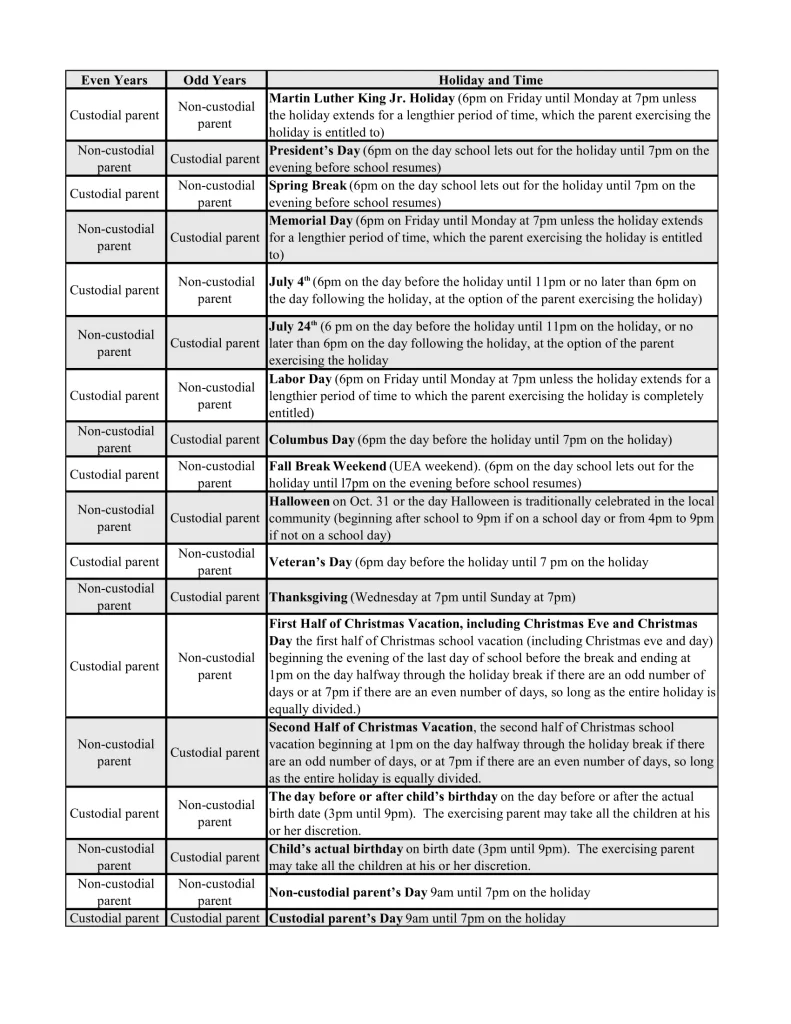
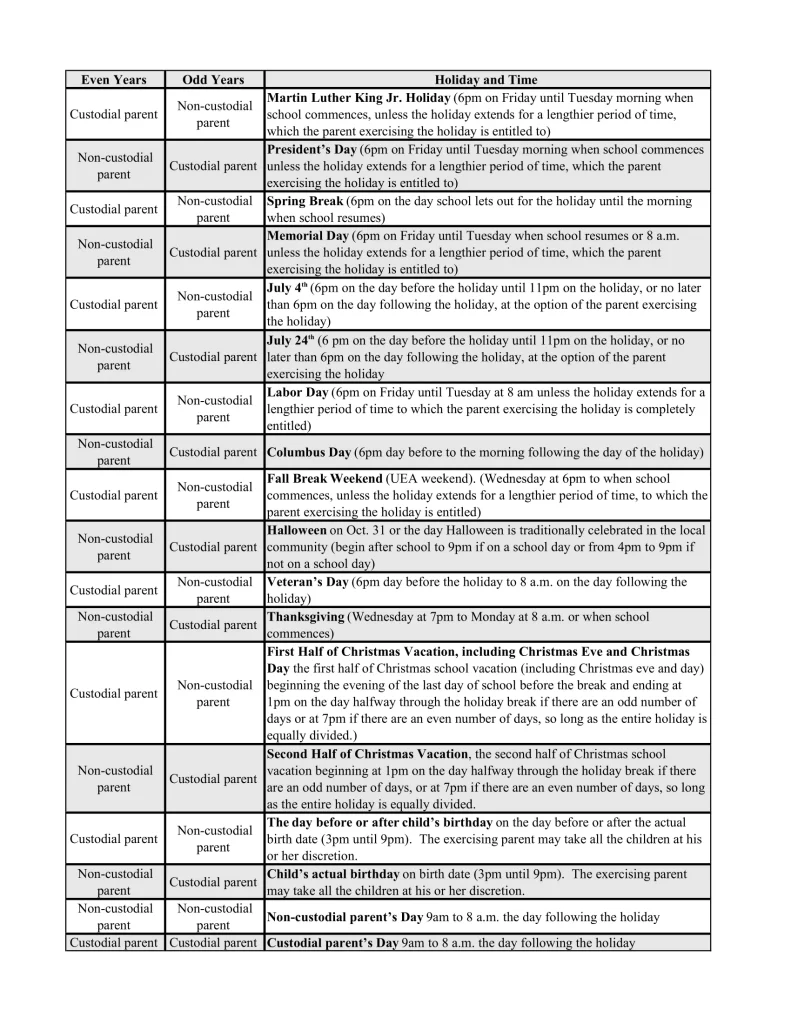
Divorce and Holiday Parent-Time in Utah – Tis the Season

December 1, 2021 By Diana Telfer

If you are a separated or divorced parent confused over your holiday parent-time schedule, you are not alone.  You would think figuring out when you have your children for a holiday would be straightforward.  Unfortunately, it is not so easy if your custody order follows the statutory holiday schedules.  Oftentimes, even attorneys are unable to agree on their interpretations of the holiday schedule.

The first step to figuring out what holiday schedule applies to you is looking at your custody decree or order.  You may have an order that specifically identifies the division of holidays with straightforward start and end times.  If so, count yourself lucky.  But it is more likely that you have a custody order that references one of the parent-time statutes (e.g. Utah Code Sections 30-3-35, 30-3-35.1, or 30-3-35.2).

The statutory parent-time schedules divide holidays between even-numbered years and odd-numbered years. Essentially holidays alternate between the parents throughout the year.  The statute lists the holidays assigned to the non-custodial parent (the parent who has less parent-time) in even and odd numbered years.  The custodial parent’s holidays in even-numbered years are the holidays assigned to the non-custodial parent in odd-numbered years.  In odd-numbered years, the custodial parent gets the non-custodial parent’s assigned even numbered year holidays.

The primary difference between the holiday schedules in Utah Code Section 30-3-35 and Section 30-3-35.1 is when the holiday ends.   In Section 30-3-35, holidays generally end at 7 p.m. the night before school resumes.  In Section 30-3-35.1, holidays extend through to the morning when school commences.  Let’s take the President’s Day holiday as an example.  The holiday typically involves a 3-day weekend with school resuming on Tuesday morning.  Under Section 30-3-35, the holiday weekend ends at 7 p.m. on Monday and under Section 30-3-35.1, the holiday weekend ends Tuesday morning when school resumes.

This is where it gets tricky.  Holidays include any snow days, teacher development days, or other days when school is not scheduled and is contiguous to the holiday. For instance, if school dismisses on Thursday before Martin Luther King’s birthday weekend then the holiday extends from Thursday through Monday at 7 p.m. or Tuesday morning when school commences, depending upon which schedule you follow.   If the holiday falls on a weekend or on a Friday or Monday and the total holiday period extends beyond that time and the parent is free to care for the children, then the holiday extends over the time school is out.   For instance, if a school takes off the week following President’s Day weekend, then the President’s Day holiday includes the weekend and the following week.  Parent-time would resume either at 7 p.m. the night before school starts or the day school starts.

There are other nuances to holidays, including when parent-time can commence.  The best advice is to use common sense.  Talk to the other parent to ensure you are both on the same page.  If you are not, reach out to your attorneys if you have one.   Holidays are difficult enough.  Fighting over the length of a holiday only adds to the stress.

Below are two easy to read charts outlining the holidays for each statute for your reference.

Holiday Schedule Under Utah Code § 30-3-35:

Holiday Schedule Under Utah Code § 30-3-35

Holiday Schedule Under Utah Code § 30-3-35.1:

Holiday Schedule Under Utah Code § 30-3-35

Filed Under: Children & Co-Parenting Tagged With: Child Custody, Holidays, Parent-Time

Primary Sidebar

"*" indicates required fields

Let’s Connect
801-464-4004
Preferred Method of Contact

From The Blog

Testimonials

And Diana is too modest to say, but if the unfortunate need does arrive to need legal assistance in a divorce, Diana truely cares about her clients.

Footer

Telfer Family Law & Mediation
1825 South 700 East,
Salt Lake City, UT 84105
801-464-4004

Copyright © 2026 - All Rights Reserved | Web Design by The Crouch Group | Log in