• Home
  • About Diana Telfer
    ▼
    • FAQs
  • Family Law
    ▼
    • Collaborative Divorce
    • Mediation
    • Premarital Agreements
    • Limited Representation Services
    • Child Custody/Child Support
    • Alimony
    • Negotiated Settlements
    • Special Master
  • Blog
    ▼
    • In The News
  • Schedule an Appointment
  • Pay Online
  • Skip to primary navigation
  • Skip to main content
  • Skip to primary sidebar
  • Skip to footer

Telfer Family Law & Mediation

Salt Lake City Divorce & Mediation

phone number
801-464-4004

  • Home
  • About Diana Telfer
    • FAQs
  • Family Law
    • Collaborative Divorce
    • Mediation
    • Premarital Agreements
    • Limited Representation Services
    • Child Custody/Child Support
    • Alimony
    • Negotiated Settlements
    • Special Master
  • Blog
    • In The News
  • Schedule an Appointment
  • Pay Online

Emotional Wellbeing

Growth and Change

March 10, 2026 By Diana Telfer

Post-Nuptial Agreements as Relationship Tools

When Life changes after “I Do”: Understanding Post-Nuptial Agreements

Most people think of relationship planning as something that happens before the wedding. But marriage is not static. Careers shift, families grow, health changes, and financial landscapes evolve. A post-nuptial agreement — created after marriage — can be a way to thoughtfully respond to those changes together.

Rather than signaling trouble, a post-nup can reflect maturity: a willingness to adjust agreements as real life unfolds.

Post-Nups as responsive Planning

There is a common misconception that post-nuptial agreements only appear when a marriage is in crisis. In reality, many strong couples use them as tools for clarity during times of transition.

A post-nup says, “Our circumstances have changed. Let us revisit how we want to handle things now.” That is not failure. That is responsiveness.

Just as couples update estate plans or insurance policies over time, it makes sense to revisit financial understandings as a marriage grows and shifts.

Life Changes that often prompt Post-Nups

Certain transitions naturally raise new questions about fairness, risk, and long-term security:

Career shifts or business growth
If one partner starts a business, receives equity compensation, or experiences a significant rise in income, the couple may want to clarify how that growth is treated and how risk is shared.

One partner stepping back for caregiving
When a spouse reduces work hours or leaves a career to care for children or aging parents, the financial partnership changes. A post-nup can acknowledge that non-financial contributions deserve protection and recognition.

Inheritances or financial windfalls
Unexpected assets can create uncertainty. Couples may want to decide together how those funds fit into their shared life while respecting personal or family intentions.

Health changes or increased financial risk
A diagnosis, disability, or a career that carries new liability risks may prompt conversations about security, support, and how to shield family stability.

→ These are not signs of a weak marriage. They are signs of a life in motion.

When contributions shift, resentment can grow quietly

Over time, many couples experience an imbalance between financial and non-financial contributions. One partner may feel pressure as the primary earner. The other may feel unseen in caregiving or household labor.

If these shifts remain unspoken, resentment can build quietly. A post-nup conversation can open space to say:

  • “Our roles have changed.”
  • “I want to feel secure in the sacrifices I am making.”
  • “I want us both to feel this is fair.”

Putting language, and sometimes legal structure, around those changes can transform unspoken tension into mutual understanding.

How Post-Nups can strengthen Marriages

Far from threatening a marriage, a well-handled post-nup can reinforce partnership. It shows that both people are willing to revisit assumptions, acknowledge change, and make intentional choices together.

Clarity reduces fear. Fairness reduces resentment. Shared decision-making builds trust. These are foundations of strong marriages, not warning signs of weak ones.

A post-nup can be one of the ways couples say, “We are still a team, even as life changes.”

A Tool that supports the Conversation

To help couples move into these discussions with care rather than defensiveness, I often use the Designing Our Future workbook created by Jacinta Gallant. The workbook guides couples through structured conversations about values, expectations, financial philosophies, and long-term goals before those ideas are translated into legal language.

Instead of beginning with technical provisions, couples first explore questions like what financial partnership means to them now, how their roles have evolved, and what each person needs in order to feel secure and respected. This shared reflection builds understanding and helps ensure that any agreement grows out of mutual clarity rather than fear or assumption.

Healthy relationships evolve, and thoughtful planning allows agreements to evolve with them. At their best, pre- and post-nuptial agreements are not about control or fear. They are about clarity, respect, and caring enough to plan together.

With Clarity & Care,

Diana

Filed Under: Life During & After Divorce Tagged With: Emotional Wellbeing, Personal Reflections

A Christmas Message of Hope

December 22, 2025 By Diana Telfer

This time of year has a way of bringing both softness and ache to the surface. Christmas lights glow in windows, families gather, and traditions unfold—but for many, the season also carries memories of hardship, loss, and transition. I know this intimately. My own journey through two divorces, years of separation, and the deep work of rebuilding myself taught me that the holidays can evoke both grief and gratitude, both longing and renewal.

And yet, Christmas is—and has always been—a season of hope.

Thirteen years ago, I was standing in the emotional rubble of a second marriage that, in truth, had ended years earlier. I clung to the belief that staying married was an act of strength, something noble and necessary to hold my family together. My internal mantra—do not be a two-time failure—kept me locked in place long after love and connection were gone. My daughters, my stepchildren, and I lived inside the unsteady rhythm of a family that no longer functioned as one.

It took time, courage, and a painful awakening to face the truth: this chapter had ended, and no amount of holding on would resurrect it. The moment I finally allowed myself to see reality was the moment I stepped onto a new path—one of healing, honesty, and, eventually, peace.

Christmas reminds me of that turning point. Because the heart of this season is not perfection. It is not about maintaining appearances or holding onto traditions that no longer fit. Christmas is about birth—new beginnings, unexpected light, and the quiet, persistent hope that rises even in the darkest places.

My experience taught me that brokenness does not mean failure.
Sometimes it is the very doorway to transformation.

Like the caterpillar dissolving within the chrysalis, I had to turn inward—to sit with grief, anger, guilt, and the fear of what others might think. I had to excavate beliefs that no longer served me and uncover the values that truly did. Slowly, painfully, beautifully, I rebuilt myself from the inside out.

And from that rebuilding came the work I now devote my life to: supporting families, loving children through transition, and helping others find peaceful pathways through conflict. My commitment to collaborative law, mediation, and child-centered solutions is rooted in what I lived. It is born from the certainty that even in seasons of heartbreak, we can choose peace. We can choose compassion. We can choose hope.

This Christmas, I invite you to remember:

Hope Often Arrives Quietly.

It shows up not in grand gestures, but in soft clarity, in a single brave decision, in the moment you realize you deserve joy.

Resilience is already within you.

Like the butterfly encoded inside the caterpillar, your future self—the stronger, wiser, freer version—is already there.

Love for our Children lights the Way.

When we choose healthy boundaries, peaceful communication, and kindness—even in conflict—we model the very values we want our children to carry forward.

Peaceful Transitions are possible.

Even when the path feels uncertain, there are ways to move through change with dignity, respect, and compassion for everyone involved.

You are not alone.

Transformation requires support. Allies, professionals, and communities exist to hold space while you build your own wings.

Christmas is a season of light returning—a reminder that no matter how long the night has felt, dawn always comes. If you are in a season of transition, uncertainty, or quiet heartbreak, let this message reach you gently:

You are not broken. You are becoming.
You are not behind. You are beginning.
You are not alone. You are held by hope.

May this Christmas bring you moments of peace, soft edges where there were sharp ones, and glimmers of the life that is waiting for you beyond this moment.

May your heart feel steady.
May your children feel loved.
May your future feel possible.

And may you—like the butterfly—emerge in your own time, with wings strong enough to carry you into the next beautiful chapter.

I am wishing you a Christmas filled with warmth, compassion, and hope.

With deep care,
Diana

Filed Under: Life During & After Divorce Tagged With: Emotional Wellbeing, Holidays

Navigating extended Family Expectations after Divorce: Finding Ease, Boundaries, and new Ways to connect

December 15, 2025 By Diana Telfer

Holidays can feel especially stressful after divorce, when extended family members still hold ideas about how things “should” look. Their intentions are often loving, but their expectations may no longer fit your family’s reality. The good news: clear boundaries and thoughtful communication can help the season feel calmer, more intentional, and even more meaningful.


Why Expectations feel so heavy

Holiday traditions are deeply rooted in memory and identity. After divorce, extended family members may want to preserve what feels familiar, which can create pressure around:

  • Longstanding gatherings that no longer fit
  • Competing invitations
  • Guilt or disappointment when plans change
  • Difficulty accepting new roles or routines

These reactions are normal, but you are not responsible for recreating a past that no longer exists.

Giving yourself Permission to set Boundaries

Divorce changes logistics and emotional capacity. Boundaries help protect everyone’s well-being, including your children’s.

Healthy boundaries may include:

  • Declining events that complicate schedules
  • Limiting how many gatherings your children attend
  • Asking relatives to celebrate on a different day
  • Keeping parts of the holiday simple or private

You do not need to please everyone. You need to care for your family.

Communicating with Compassion

Clear, kind communication helps extended family understand why things are shifting. Helpful phrases include:

  • “We are adjusting to new routines this year and appreciate your flexibility.”
  • “We are keeping things simple for the kids.”
  • “That tradition meant a lot, but it may not work the same way now.”

Share what your children truly need without over-explaining or apologizing.

Helping Family understand your Children’s Needs

Kids do best with:

  • Predictable routines
  • Low-pressure celebrations
  • Time to relax rather than rushing
  • Emotional breathing room

Quality of connection matters more than sticking to a specific tradition or date.

Creating new Ways to connect

Change also allows creativity. Encourage extended family to explore traditions that better fit your new rhythm:

  • A pre-holiday breakfast
  • A New Year’s cocoa night
  • A simple gift-opening ritual on another day
  • A calm January outing

Sometimes spreading out celebrations makes them more enjoyable.

Releasing Guilt and embracing what works

Guilt is common, but it is not a useful guide. You can prioritize your children and your well-being, even if others need time to adjust.

Remember:

  • You cannot recreate the past.
  • Extended family will adapt.
  • Calm, connected, authentic holidays matter most.

Moving forward TOGETHER

Extended families are resilient. With boundaries and open-hearted communication, relationships can strengthen rather than strain.

Holidays after divorce may look different, but they can still be rich with warmth and connection, because they’re built around what truly works for your family now.

Happy Holidays to you and yours!

With deep care,

Diana

Filed Under: Life During & After Divorce Tagged With: Boundaries, Difficult Conversations, Emotional Wellbeing, Holidays

Creating new Traditions: Reimagining the Holidays after Divorce

December 8, 2025 By Diana Telfer

The holidays often arrive carrying a bundle of expectations. Some joyful, some heavy, and many shaped by the past. After divorce, families may find that old traditions no longer fit the way they once did. Kids grow, family systems shift, and what once felt warm can suddenly feel complicated or even painful.

Yet this moment of change also holds an extraordinary invitation:

the chance to create new tradition

Traditions, that feel authentic, joyful, and aligned with who your family is becoming.


When holding onto old Traditions becomes a Struggle

It is completely understandable that some parents feel a deep pull to preserve “how we’ve always done it.” Longstanding holiday traditions can carry meaning, nostalgia, and a sense of identity. But after divorce, trying to maintain historic traditions exactly as they were may not be realistic (or healthy!) for anyone involved.

Schedules shift, families blend, logistics change, and the emotional landscape is different. What was once simple may now create tension, conflict, or disappointment. Parents can sometimes become entrenched in positions, insisting on honoring the past to avoid the grief of change. But rigidity often makes the holidays harder, not easier.


And here is the hopeful truth: Children are far more resilient than we often realize.

They do not require perfect replication of past traditions to feel secure or joyful. In fact, many kids appreciate the chance to create new rituals that reflect their current lives and relationships. New traditions can feel exciting, empowering, and freeing.

Letting go of the insistence on “how it used to be” opens space for “what could be” and that shift can bring genuine relief and connection.

Why reinventing Traditions matters

Traditions do more than mark holidays; they help shape a family’s identity. After divorce, children and parents alike may feel unmoored from what once felt familiar. Building new rituals offers stability and belonging. These traditions do not have to be grand; they simply need to feel like you.

When families consciously choose how they celebrate rather than defaulting to “what we’ve always done” they send a powerful message:

We are still a family.

We still celebrate.

We get to define what that looks like.

Seeing Change as an Opening, not a Loss

It is natural to grieve the loss of old traditions. But change does not have to mean emptiness. It can mean creativity, connection, and possibility.

Divorce makes room for:

  • New voices in the planning process
  • New activities that better fit the family now
  • New meaning in how you choose to gather, rest, and celebrate

Parents often discover that releasing unrealistic expectations creates space for genuine ease and joy.

Ideas for new, low-pressure Traditions

New traditions work best when they feel small, doable, and enjoyable not like another item on the holiday to-do list.

Here are a few “bite-sized” ideas some of my clients came up with:

1. A Five-Minute Tradition

Light a candle together and each person shares one thing they are grateful for.


2. The Cozy Tradition

Declare one night “Pajama Holiday,” where everyone wears PJs, eats something simple, and watches a favorite movie or reads aloud.


3. A Tradition of Giving

Choose one meaningful, age-appropriate act of generosity—donating a toy, baking cookies for a neighbor, making cards for a shelter.


4. A Nature Tradition

Take a holiday morning walk, collect leaves or pinecones, or simply breathe fresh air together before the day unfolds.


5. A Creative Ritual

Make or choose an ornament that represents something meaningful from the past year. Over time, the collection becomes a family story.

None of these require elaborate planning, perfect behavior, or an Instagram-worthy backdrop. They simply create a touchstone—a moment that says, we are here, together.

Permission to simplify & savor

The holidays can quickly become performative: perfectly wrapped gifts, elaborate meals, orchestrated schedules. But for families navigating transition, simplicity is often the greatest gift.

Give yourself permission to:

  • Drop traditions that feel heavy
  • Keep only the pieces that bring genuine joy
  • Say no to obligations that drain you
  • Choose rest over perfection

When parents lead with calm and authenticity, children feel it. What they remember years later is rarely the matching outfits or the spotless house—they remember the warmth, the laughter, and the ease of being together.


Reimagining the Holidays as a Family Story in Motion

Traditions are not relics; they are living practices that evolve as families evolve. Divorce may bring an ending, but it also offers a beginning. A chance to craft experiences that reflect who your family is now and where you are headed.

As you reimagine your holidays, trust your instincts.
Start small.
Let go of perfection.
Invite your children into the process.
And savor the moments that feel good.

In doing so, you are not just creating new traditions you are building a strong, resilient family identity rooted in love, creativity, and connection.

Happy Holidays to you and yours!

With warmth,

Diana

Filed Under: Life During & After Divorce Tagged With: Emotional Wellbeing, Holidays

Managing Holiday Emotions with Compassion

December 5, 2025 By Diana Telfer

Normalizing grief, navigating family gatherings, and caring for your emotional well-being

The holiday season often brings a mix of emotions—nostalgia, hope, stress, and sometimes sadness or uncertainty. For anyone moving through divorce, co-parenting, family transitions, or simply a challenging year, the holidays can stir feelings that are tender and complex. These emotions are not only normal—they are human.

Compassion for yourself and your experiences can help you move through the season with more steadiness and ease. Below are gentle ways to understand your emotions, navigate extended family gatherings, and care for your own emotional grounding.

Normalizing Grief, Nostalgia, and Uncertainty

Holidays often magnify the tension between expectation and reality.
When traditions shift or relationships change, you may notice:

  • Grief for what once felt familiar
  • Nostalgia for times when the holidays were simpler or more connected
  • Uncertainty about new routines, gatherings, or dynamics
  • A mix of emotions, including joy and sadness in the same moment

None of these feelings mean something is wrong. They simply reflect that you are navigating change. Grief can arise even when positive things are unfolding. Nostalgia can surface even when you are building a life that fits better now.

Compassion begins with acknowledgment: “Of course I feel this. I am in a season of transition.” You can honor the past and still allow room for new traditions and experiences to take shape.

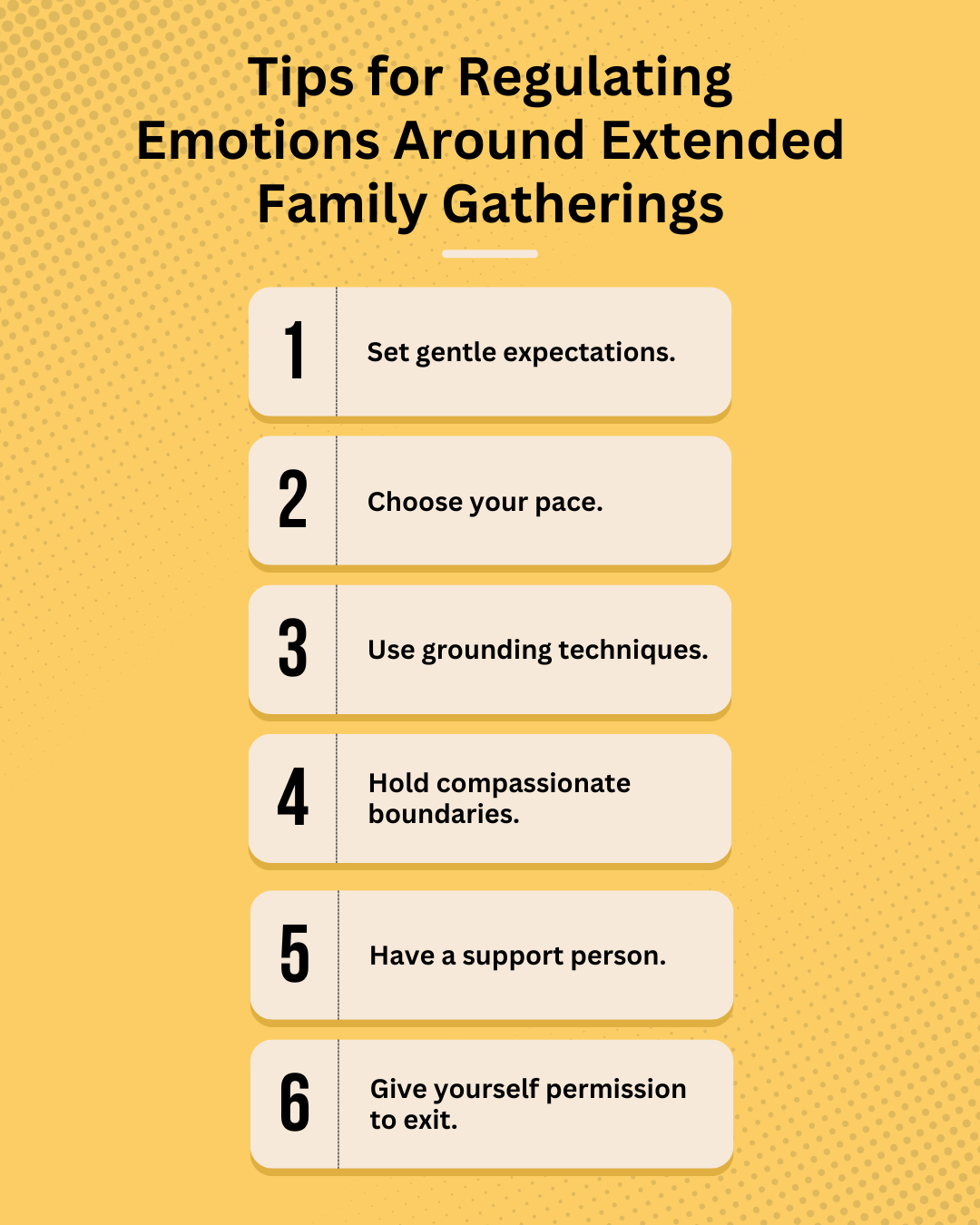
Tips for regulating Emotions around extended Family Gatherings

Family gatherings can bring comfort and connection—but they can also activate old patterns, heighten stress, or trigger emotions you did not expect. A few grounding practices can help you care for yourself while staying present:

→ Set gentle expectations.

Before attending a gathering, remind yourself that mixed emotions are normal. You are not required to feel festive. Knowing the experience might be layered helps soften pressure.

→ Choose your pace.

Give yourself permission to arrive late, leave early, or take breaks. You do not owe your time or energy beyond what feels manageable.


→ Use grounding techniques.

Slow breathing, feeling your feet on the floor, placing a hand on your heart, or stepping outside for fresh air can quickly regulate rising emotions.


→ Hold compassionate boundaries.

If certain topics feel sensitive, prepare phrases such as:

  • “I appreciate your concern, but I am not discussing that today.”
  • “Let us focus on enjoying being together.”

These boundaries help protect your emotional space and reduce unnecessary stress.


→ Have a support person.

Identify someone—inside or outside the gathering—who can offer grounding if emotions become overwhelming. A brief text or check-in can help you recenter.


→ Give yourself permission to exit.

If the energy shifts or your emotional capacity is tapped, leaving is an act of self-respect, not conflict.

Loving Practices for Self-Care and Emotional Grounding

During the holidays, self-care becomes especially important. These small, loving practices can create steadiness and support:

Create a simple daily ritual: A morning walk, journaling, stretching, or lighting a candle can offer a moment of calm and predictability. Rituals help your nervous system feel anchored.

Care for your physical needs: Regular meals, hydration, rest, and gentle movement all support emotional balance. Your body is part of your emotional system.

Allow your feelings to surface: Instead of pushing down sadness, nostalgia, or overwhelm, give yourself permission to feel them. Acknowledgment—without judgment—creates internal space and relief.

Protect your energy: Say no when necessary. Choose meaningful activities rather than those driven by guilt or obligation. Simpler holidays are often calmer and more connected.

Invite small moments of joy: Joy may look different this year—quiet, subtle, or unexpected. Let it arrive naturally, without trying to force it.

End your day with reflection:Noting what felt grounding, peaceful, or brave helps reinforce emotional resilience and self-awareness.

Moving through the Holidays with Compassion

Whatever arises this season, know that your emotions are valid. You are allowed to grieve, to feel uncertain, to rest, and to shape the holidays in a way that honors your capacity. Compassion does not erase difficult feelings, but it softens them. It gives you room to breathe, to adjust, and to care for yourself with gentleness.

The holidays may look different this year or in the years to come, but they can still hold warmth and meaning. When you honor your emotional needs and respond to yourself with kindness, you create a holiday experience that feels authentic, supportive, and deeply human.

Filed Under: Life During & After Divorce Tagged With: Emotional Wellbeing, Holidays

Reflection: The Path to Empowered Advocacy

February 1, 2024 By Diana Telfer

I was raised to work. My father’s mentality was “God helps those that help themselves.” While my childhood friends enjoyed watching Saturday morning cartoons, I had my weekly chores to complete: cleaning my room, cleaning the bathroom, vacuuming and dusting the living rooms and hallways, and then weeding. Growing up in California, weeding was year-round and I hated it. Holidays were also spent working. I vividly remember a Thanksgiving where my parents told my brother and I that if we finished weeding the garden, which was no small job with flower gardens surrounding our home and an overrun juniper garden encircled by our driveway, we could “earn” ourselves a brand-new color television. I also remember my father saying when I was a teenager, “You are my only hope for a successful daughter.”

Roots of Work Ethic. So it is no surprise that I started working at the age of 16 and never stopped. Much of my self-worth has been unconsciously tied to working. After graduating with my Bachelor’s degree in psychology, not the most useful degree, I started out as a secretary moving up to a paralegal. Once I became the director of the legal department for a software company, I decided to go to law school. After law school, I worked for the Third District Guardian ad Litem’s office, started my own firm, then joined a downtown Salt Lake law firm where I was co-chair of the Family Law section. After 12 years at that firm, I fed my entrepreneurial drive and started my own family law collaborative divorce and mediation firm.

Struggles and Successes. While I’ve done well professionally as an attorney and business owner, I struggled personally. I had two failed marriages and essentially raised two daughters as a single parent. As a result of being a stressed out mother, my relationships with my daughters can be challenging at times. Had I accepted who I was when I was in my twenties rather than trying to change my core self to satisfy others, my children would have had a very different mother and a much easier childhood.

Reflection and Awakening. I previously wrote about this but after the demise of my second marriage, I was emotionally destroyed. Both marriages were unhealthy. I did not want to repeat this pattern so I began what became 8 years of self-reflection and asking curious questions. I dived deep into exploring the beliefs that I held, questioning whether those were my beliefs versus beliefs that were instilled in me. I questioned whether those beliefs still served me in a positive way. I explored my spiritual beliefs, beliefs about myself, and beliefs around what family relationships should be. I studied different religions. I studied Carl Jung, Marion Woodman, Thich Nhat Hahn, Sharon Salzburg, Wayne Dyer, Caroline Myss, Judith Orloff, and many others. I read biographies of female trailblazers. After years of study, I finally started getting a glimpse of who I really was and not being ashamed of that person. I am a direct communicator and a strong advocate that can, at times, come across as “a bull in a china shop,” as one male colleague called me.

During my self-reflection period, I changed the way I practiced as a family lawyer and how I ran my law practice. It was a struggle since my model was different than my other law firm partners. I could no longer just focus on the legal aspects of divorce. I recognized the importance of addressing the other aspects of my cases that were the “elephants in the room” and influenced decision making including the emotional fears, spiritual values, and financial concerns of the divorcing or separating couples. I wanted to help my clients see that the challenging situation they found themselves in could be an opportunity of transformation like it was for me. However, the only way to accomplish that was to provide opportunities of insight for my clients.

Evolution. It is for this reason that I offer a resource called “Our Family in Two Homes” and “Our Family in Few Homes” for divorcing or separating couples with adult children. This resource is a tool for my clients to thoughtfully prepare for negotiating their settlement. Prior to offering this resource, I would spend time with my clients asking similar questions but the clients paid for the time they met with me. Now my clients can accomplish the same on their own time.

Insight Resource. The “Our Family in Two Homes” workbook allows my clients to really think about their responses, determine what is most important, understand better where conflict arises with their partner, and think about how each of them shows up when conflict arises. The workbook helps clients figure out the values that influence their decision making process and their partners since these strongly impact the settlement negotiations. Not only does it explore the areas of trust that have been broken but the areas that have not been broken, which can be the starting point for healing the areas of trust that have been broken. All these aspects are critical in consciously creating a settlement that supports the future envisioned by my clients.

Is this something of interest? If so, feel free to complete an inquiry form or call me at (801)464-4004.

Filed Under: Life During & After Divorce Tagged With: Emotional Wellbeing, Personal Reflections

Embracing Growth: Confronting Imposter Syndrome in Professional Women

January 17, 2024 By Diana Telfer

Embracing Growth

In the dynamic landscape of the tech industry, my journey was inspired by a remarkable female patent attorney. Little did I know, my curiosity, fueled by a genuine desire to learn, would later uncover a prevalent challenge—imposter syndrome. Join me as I share personal reflections, insights from a revealing study, and explore the transformative power of embracing growth amid doubts.

Before I returned to law school at age 37, I worked in the high-tech industry for nine years. My first boss was a female patent attorney for an international software company. She inspired me with her intelligence, work ethic, and ambition. She outshined her male counterparts.

Questioning Judgment. **I wanted to learn everything I could about intellectual property (I know, I am a nerd at heart). However, it seemed to put my boss on edge when I asked questions. After a while I asked if I was doing something wrong because she seemed to get agitated when I asked so many questions. Her response shocked me. She said, “I feel like your questions are questioning my judgment.”

This took me aback because the purpose of my questions was to learn why she did things the way she did. I wanted to learn how she thought so I could then anticipate her requests in the future without having to ask questions. That has always been my approach to life. Ask questions so I can understand how the other person thinks so I can anticipate their needs. But here, my questioning caused a completely different reaction. Unfortunately, it was not the last time a professional woman with whom I worked would feel my questions questioned their judgment.

Imposter Syndrome Unveiled. **I’ve often wondered why professional women feel threatened by questions much more than a male colleague does. I recently discovered a KPMG study that found “75% of female executives experience imposter syndrome in the work place.” “Imposter syndrome” refers to a feeling that one is a fraud or involves someone who doubts their abilities. I know I have felt this throughout my career. That is what has motivated me to work twice as hard as others. When I encounter a problem at work, I have always made sure I came in with solutions so others would see me as competent. I have felt the need to be an “expert” before trying something new because what happens if I fail. I have feared failure because that would expose my ignorance.

Overcoming Fears and Failures. **Luckily, I know that I’m not alone in my fears. The “imposter syndrome” has been an ongoing conversation with many of my female colleagues and my clients. These experiences I previously characterized as “failures” has added to my success because my resiliency has helped me learn from these experiences.

Empathy Through Experience. What have I learned? It is because of my past “failures” that I can empathize with my clients going through separation and divorce. I share my life experiences because it often gives hope to my clients. If I can go from being a single mom on welfare who has survived abusive relationships to a successful attorney and business owner so can my clients. The things that I have learned the hard way has enabled me to discover  tools and develop skills that I can share with my clients.

When fears around making a mistake creep up inside of me now, I try to reassure myself that it is an opportunity to learn and get “back on the saddle.” I also reach out to my mentors and trusted friends.

Failure is an important part of our growth. It is what we do with our “failures” that makes all the difference in the world.

How do you empower your clients facing doubts?

For more information or to schedule a consultation call (801) 464-4004. Our office is located at 2150 South 1300 East #500, Salt Lake City, UT 84106.

Filed Under: Life During & After Divorce Tagged With: Emotional Wellbeing, Professional Women

Reflection: The Path To Empowerment

January 4, 2024 By Diana Telfer

Reflecting and Empowerment

I was raised to work. My father’s mentality was “God helps those that help themselves.” While my childhood friends enjoyed watching Saturday morning cartoons, I had my weekly chores to complete cleaning my room, cleaning the bathroom, vacuuming, and dusting the living rooms and hallways, and then weeding. Growing up in California, weeding was year-round, and I hated it. Holidays were also spent working. I vividly remember a Thanksgiving where my parents told my brother and I that if we finished weeding the garden, which was no small job with flower gardens surrounding our home and an overrun juniper garden encircled by our driveway, we could “earn” ourselves a brand-new color television. I also remember my father saying when I was a teenager, “You are my only hope for a successful daughter.”

Roots of Work Ethic. So, it is no surprise that I started working at the age of 16 and never stopped. Much of my self-worth has been unconsciously tied to working. After graduating with my bachelor’s degree in psychology, not the most useful degree, I started out as a secretary moving up to a paralegal. Once I became the director of the legal department for a software company, I decided to go to law school. After law school, I worked for the Third District Guardian ad Litem’s office, started my own firm, then joined a downtown Salt Lake law firm where I was co-chair of the Family Law section. After 12 years at that firm, I fed my entrepreneurial drive and started my own family law collaborative divorce and mediation firm.

Struggles and Successes. While I’ve done well professionally as an attorney and business owner, I struggled personally. I had two failed marriages and essentially raised two daughters as a single parent. As a result of being a stressed-out mother, my relationships with my daughters can be challenging at times. Had I accepted who I was when I was in my twenties rather than trying to change my core self to satisfy others, my children would have had a very different mother and a much easier childhood.

Reflection and Awakening. I previously wrote about this but after the demise of my second marriage, I was emotionally destroyed. Both marriages were unhealthy. I did not want to repeat this pattern, so I began what became 8 years of self-reflection and asking curious questions. I have dived deep into exploring the beliefs that I held, questioning whether those were my beliefs versus beliefs that were instilled in me. I questioned whether those beliefs still served me in a positive way. I explored my spiritual beliefs, beliefs about myself, and beliefs around what family relationships should be. I studied different religions. I studied Carl Jung, Marion Woodman, Thich Nhat Hahn, Sharon Salzburg, Wayne Dyer, Caroline Myss, Judith Orloff, and many others. I read biographies of female trailblazers. After years of study, I finally started getting a glimpse of who I really was and not being ashamed of that person. I am a direct communicator and a strong advocate that can, at times, come across as “a bull in a China shop,” as one male colleague called me.

During my self-reflection period, I changed the way I practiced as a family lawyer and how I ran my law practice. It was a struggle since my model was different than my other law firm partners. I could no longer just focus on the legal aspects of divorce. I recognized the importance of addressing the other aspects of my cases that were the “elephants in the room” and influenced decision making including the emotional fears, spiritual values, and financial concerns of the divorcing or separating couples. I wanted to help my clients see that the challenging situation they found themselves in could be an opportunity of transformation like it was for me. However, the only way to accomplish that was to provide opportunities of insight for my clients.

Evolution. It is for this reason that I offer a resource called “Our Family in Two Homes” and “Our Family in Few Homes” for divorcing or separating couples with adult children. This resource is a tool for my clients to thoughtfully prepare for negotiating their settlement. Prior to offering this resource, I would spend time with my clients asking similar questions, but the clients paid for the time they met with me. Now my clients can accomplish the same on their own time.

Insight Resource. The “Our Family in Two Homes” workbook allows my clients to really think about their responses, determine what is most important, understand better where conflict arises with their partner, and think about how each of them shows up when conflict arises. The workbook helps clients figure out the values that influence their decision-making process and their partners since these strongly impact the settlement negotiations. Not only does it explore the areas of trust that have been broken but the areas that have not been broken, which can be the starting point for healing the areas of trust that have been broken. All these aspects are critical in consciously creating a settlement that supports the future envisioned by my clients.

Is this something of interest? If so, feel free to complete an inquiry form or call me at (801)464-4004. Our office is located at 1945 South 1100 East, Suite 200, Salt Lake City, UT 84106.

Filed Under: Life During & After Divorce Tagged With: Emotional Wellbeing, Personal Reflections

The 5 Step P.L.A.N.S. for a Positive Divorce: Weathering the Storm

December 1, 2021 By Diana Telfer

“Feare no more the heate o’ th’ Sun,
Nor the furious Winter’s rages.”
– William Shakespeare

As with any devastating storm, your divorce can often leave a path of destruction.  Feelings of helplessness and despair regularly take over.  Fear prevails.  Anger may ensue. Must it be this way? “NO.” Can you avoid it?  The answer is an affirming “YES.”

The key to weathering any storm is preparation and planning.  Aesop’s fable, “The Ant and the Grasshopper” illustrates this point artfully.  The fable begins one summer day when a Grasshopper, who is hopping and singing to his heart’s content, comes across an Ant.  The Ant is working hard carrying an ear of corn to his nest when the Grasshopper suggests he join in his frolicking.  The Ant answers, “I am helping lay-up food for the winter and recommend you do the same.”  The Grasshopper responds by saying, “Why bother about winter?”  When winter comes the Grasshopper finds himself without food and dying of hunger while he watches the Ant distributing corn and grain from his stores.  At this point, the Grasshopper realizes only too late that “It is best to prepare for the days of necessity.”

Preparation and planning will be essential in reducing the conflict and stress that so often overshadows divorce.   Once the decision to divorce has been made, take the time to prepare mentally, physically, emotionally, and spiritually for what is about to unfold.  Explore your feelings and motivations.  Identify your wants and needs.  In his article entitled “Waging War Against Procrastination,” Dr. Bill Knaus points out that “Decisions are affected by the preparations you take prior to taking any action.”

Divorcing couples so often forget that they are the most critical piece of the divorce process.  Retaining the right attorney and/or mediator will be important.  However, you and your spouse will be setting the tone of your divorce.  You will be making the decisions.  Most importantly, you and your spouse will be the ones having to live with the final resolution.  Taking the time to reflect and gather information will be instrumental in keeping you focused.  It will lessen the chance of being driven by emotionally based decision-making.   It will help you “keep your eye on the ball.” Remember that even if a judge is left to make the ultimate decision as to your divorce, the choice to proceed to trial is yours.  Why choose to leave the determination of your life to a stranger?

Prior to retaining an attorney, take the time to complete the following few steps that I refer to as P.L.A.N.S.  This is best done as a couple, but it can still be effective if done on an individual basis as well.

Step 1:  PINPOINT the issues in your divorce.  The following issues are among those most addressed in divorce.

  • Child-Related Issues
    • Who will have decision-making authority (legal custody) relative to your children?
    • Where will your children live?
    • How should the time with your children be shared between each parent?
    • How much in child support will there be?
    • Who will cover the medical, dental, and vision insurance for the children?
    • Who will be responsible for paying the out-of-pocket expenses including premiums, medical expenses, dental expenses, orthodontia, mental health, and vision expenses?
    • How do you want to handle the participation, transportation, and payment of the extracurricular activities for your children?
    • Who should be responsible for paying school fees including private school tuition, tutoring, or other fees?
    • Do you want to create or maintain educational funds for your children?
    • How will you handle college related payments on behalf of your children?
  • Alimony and Other Related Issues:
    • How much income does each of you earn a year?
    • What will your monthly expenses be during the divorce and after divorce?
    • Does one of you need additional financial support from the other spouse?
    • How long will that person need additional financial support?
    • Who will cover health insurance during the divorce? Where will each of you get health insurance coverage after the divorce? How will it be paid?
    • Should you get or maintain life insurance on our lives while the children are minors?
  • Property and Liabilities:
    • What real property do you own?
    • Who will get the property and who will pay for it?
    • How do you handle the marital home? Does one of you get the home or do you sell it? Who will pay the mortgage on the home?
    • For the moving spouse, where will you live during the divorce and after?
    • What is the value of your real property?
    • How do you handle joint bank accounts during the divorce? Do you maintain or close them?
    • How do you want your debts and other obligations to be paid (e.g., mortgages, auto loans, auto insurance, credit cards, and other loan obligations)?

Step 2:  LIST your marital assets and liabilities that may include the following:

  • What do you own as a couple?
    • Real property
    • Automobiles
    • Recreational vehicles
    • Personal property
    • Bank accounts (savings, checking, money market, etc.)
    • Education savings accounts
    • Investment accounts
    • Retirement accounts
    • Life insurance policies
  • What debts do you share as a couple?
    • Mortgage, home equity loans, HELOCs
    • Personal loans
    • Automobile loans
    • Student loans
    • Credit cards; and
    • Any other liability.

Step 3: ASSEMBLE all documentation. You must verify your incomes, assets, and liabilities. You may need to contact your accountant or financial advisor to help you with this step.  Documents may include monthly statements, titles to property, copies of policies, billing statements, tax returns including W-2s, 1099s, and K-1s, and other supporting tax schedules and attachments, appraisals, property tax assessments, financial statements, and loan applications.

Step 4: NOTE the issues that are most emotionally charged for you and your spouse.

Step 5: START writing down the ideal outcomes.  First, begin by imagining the ideal outcome from your perspective.  Write this down.  Second, imagine the ideal outcome from your spouse’s perspective.  Write that down.  Third, identify where the areas of agreement and disputes will likely be.   As part of this process, consider looking at the areas where compromises may be made.

These exercises will not only help you with getting organized but are also intended to help you see the divorce from each side’s perspective.   As the wise Chinese military general, strategist, and philosopher Sun Tzu once said, “If ignorant both of your enemy and yourself, you are certain to be in peril.” Know yourself and know your spouse.  By viewing the situation from both perspectives, you will be better prepared for finding a resolution.

Following the steps above will be well worth your time.  You will be in a much better position to face the winter storm of divorce.

See Also

A Checklist for Divorce Financial Planning
Financial Planning in Divorce – 5 Steps to Getting Your House in Order
The Soft Side of Finance: Navigating Divorce with Experts Diana & Chalise
Alimony – To Pay or Not To Pay?

Filed Under: Life During & After Divorce Tagged With: Decision-Making, Difficult Conversations, Emotional Wellbeing

Could Our Limits Be Gifts to Discovering Our Potential?

December 1, 2021 By Diana Telfer

Today’s blog provides a question rather than answers.

In his book, The Sacred Enneagram, author Christopher L. Heuertz writes that our limitations, destructive patterns, addictions, or other seemingly unpresentable parts are invitations “to return to what wounded us as children so that our eyes may be opened to the gift of who we are and who we can become.”   Mr. Heuertz has spent his career understanding the Enneagram of Personality.  If you have not heard of the Enneagram, it is a tool that has been around for thousands of years.  As Mr. Heuertz explains, the Enneagram offers nine personality types that “explain the ‘why’ of how we think, act, and feel.”  He further writes “the Enneagram is a blueprint for developing character that each of us carries throughout our life, but one that we don’t open until we discover our type.”  The Enneagram types explain the strengths common in each type and also the “shadow” side of each type caused by childhood wounds. For instance, my dominant type is Type Six, the Loyalist.  It is the type that needs to be sure and certain.  At their best Sixes are a source of determination and strength. But often Sixes doubt themselves.  Type Sixes include individuals who were often raised in unpredictable situations that left them doubting and disbelieving.    The Enneagram is a complex tool that not only can help us understand who we are, the good and the bad, but also our incredible potential that is there to be uncovered.  Mr. Heuertz asks “are we suffering the pathology of how we were hurt or neglected in our childhood?  Is it because someone harmed us or is it because we actually need an obvious limitation as an invitation to give ourselves to our inner work?”

Here’s my question for you to ponder: What would happen if you perceived your destructive tendencies as needed gifts rather than limitations and invitations to discover who we are and who we can become?  

Filed Under: Life During & After Divorce Tagged With: Emotional Wellbeing, Personal Reflections

Primary Sidebar

"*" indicates required fields

Let’s Connect
801-464-4004
Preferred Method of Contact

From The Blog

Testimonials

I just wanted to take a minute and tell everyone what a great experience I had with Diana and her team. They were fantastic in every way. She kept me informed and answered any and all questions that my family had in regards to our trial. She was very patient and thorough in every aspect. She always came prepared. Not only did she have my best interest in mind in the courtroom, but she was also very cautious on the amount of money it was going to cost me. I would definitely recommend Diana to anyone that is in need of an attorney. She is very good at her job and very professional.

Footer

Telfer Family Law & Mediation
1825 South 700 East,
Salt Lake City, UT 84105
801-464-4004

Copyright © 2026 - All Rights Reserved | Web Design by The Crouch Group | Log in