• Home
  • About Diana Telfer
    ▼
    • FAQs
  • Family Law
    ▼
    • Collaborative Divorce
    • Mediation
    • Premarital Agreements
    • Limited Representation Services
    • Child Custody/Child Support
    • Alimony
    • Negotiated Settlements
    • Special Master
  • Blog
    ▼
    • In The News
  • Schedule an Appointment
  • Pay Online
  • Skip to primary navigation
  • Skip to main content
  • Skip to primary sidebar
  • Skip to footer

Telfer Family Law & Mediation

Salt Lake City Divorce & Mediation

phone number
801-464-4004

  • Home
  • About Diana Telfer
    • FAQs
  • Family Law
    • Collaborative Divorce
    • Mediation
    • Premarital Agreements
    • Limited Representation Services
    • Child Custody/Child Support
    • Alimony
    • Negotiated Settlements
    • Special Master
  • Blog
    • In The News
  • Schedule an Appointment
  • Pay Online

Children & Co-Parenting

5 Stepparenting do’s and don’ts that help children feel at home

October 1, 2026 By Diana Telfer

The conversations blended families need to have — Part 1

I’ve been a stepparent, so I know how much care the role can require and how little guidance comes with it. In my work as a child custody lawyer, I’ve also seen how easily tensions can arise around a stepparent’s place in the family. Sometimes originating from choices adults make, and sometimes from expectations they haven’t recognized yet.

Stepparenting can be deeply rewarding. And it can also be hard. You may help with homework, make dinner, drive to appointments, and worry about a child’s well-being, only to hear, “You’re not my parent.” That can sting, even when you understand why a child might say it.

Some stepparents build close, lasting bonds. Others struggle to find their place or push for closeness before a child is ready. These five do’s and don’ts offer a place to start.

1. Do make room for the child’s other parent. Don’t compete.

A child may enjoy being with a stepparent and still worry that showing affection will hurt their mother or father. That worry can grow when the other parent feels threatened by the stepparent’s presence.

You cannot control how another adult feels about you. You can make it clear to the child that caring about you is not a betrayal.

Make room for calls, photographs, stories, and traditions involving the other household. Avoid comparisons about who does more for the child or knows them best. And resist the urge to defend yourself through the child if the other parent criticizes you.

A child should be free to say, “I had fun with my stepparent,” without worrying about either parent’s reaction.

2. Do build trust slowly. Don’t demand a title or affection.

A stepparent may be ready to embrace a new family long before the children are. They may still be grieving changes in their family or trying to understand where everyone fits.

Let children decide what to call you. Invite them to spend time together, but allow them to decline. Notice their interests, keep your promises, and be kind without expecting immediate gratitude. A nickname, hug, or “I love you” means more when it comes freely.

Try not to treat a child’s hesitation as a verdict on you. Trust is built through ordinary moments over time. The quality of the stepparent–child relationship affects the children’s well-being, which is one reason to give that relationship room to develop.

3. Do talk about parenting styles. Don’t assume you already agree.

A stepparent who has not raised biological children may be surprised by the noise, interrupted plans, and constant decisions that come with living with children. Loving your partner does not mean you will instantly feel comfortable with every part of parenting. That adjustment deserves patience and honest conversation, not shame.

Even adults who have both raised children may have very different approaches. One may expect children to speak up and negotiate; the other may see that as disrespect. One may value a strict bedtime; the other may be more flexible. Those differences become especially difficult when a stepparent is expected to enforce a rule they do not believe in—or when the biological parent feels judged.

Talk about the specifics before a disagreement happens in front of the children. What are the household rules? Which ones are flexible? How will you handle discipline, privacy, chores, and time alone with your partner? What can the stepparent decide when the parent is unavailable?

The biological parent should take the lead in explaining expectations to their children and support the stepparent’s agreed-upon role. The stepparent, in turn, can be curious about the family’s history before trying to change its routines. Neither adult should have to guess where they stand.

Couples sometimes have this conversation while preparing premarital agreements. In addition to discussing finances, they can write down their expectations for daily parenting responsibilities. That understanding does not replace a Utah child custody order, but it can help the couple identify disagreements before children are living with them.

4. Do recognize that stepmothers and stepfathers may face different pressures. Don’t rely on assumptions.

I think stepmothers and stepfathers often encounter different expectations. A stepmother may be expected to do the work of mothering while being reminded that she is “not the mom.” A stepfather may be pushed to act as an authority figure before he has built a relationship with the children.

Neither pattern describes every family. But assumptions about gender can influence who does the caregiving, who is expected to discipline, and whose mistakes are judged most harshly.

Ask each other:

Are we expecting one person to take on a role they never agreed to?

Are we giving the stepparent responsibility without support

Does the role we have imagined fit what these children need?

5.Do protect children from adult conflict. Don’t ask them to manage your feelings.

If the other biological parent feels threatened by you, it may be tempting to ask what the child has heard or to correct the record. Please leave the child out of that conversation.

Do not ask children to report on the other household, deliver messages, reassure you that you matter, or take sides. Do not speak poorly of a parent to win the child’s trust. Those choices can make a child feel responsible for keeping peace among the adults.

Instead, speak directly with your partner about your concerns. The child’s parents may need help addressing an ongoing conflict. Your role is to offer the child a steady, welcoming presence while the adults work on adult problems.

A useful question is:
Does what I’m about to say make this child’s life easier, or am I asking the child to take care of my feelings?

The conversation to have before blending households

Stepparenting asks for patience with a relationship you cannot force. The goal is to become someone a child can count on while leaving them free to love all the people who matter to them.

Before blending households, talk honestly about the care and authority each adult will have, the parenting styles each brings to the home, and how you will support each other when the role becomes difficult. If those conversations are hard to navigate, a mediator or family professional can help. A child custody lawyer in Salt Lake City can also help parents consider how a proposed household arrangement fits with their existing parenting plan and their children’s needs.

Blended families do not need to have every answer before they begin. They do need honest conversations about expectations, boundaries, and what will help the children feel secure. If you would like guidance around parenting plans, household changes, or family transitions, contact me at Telfer Family Law & Mediation to schedule a consultation.

https://telferfamilylaw.com/contact/

With care,

Diana.

Filed Under: Children & Co-Parenting Tagged With: Blended Families, Children’s Emotional Wellbeing, Stepparenting

Why Children Should Never Be the Messenger Between Divorced Parents

July 30, 2026 By Diana Telfer

One of the simplest ways parents can reduce conflict after separation or divorce is also one of the most overlooked:

Why Children Should Never

Do not use your children to communicate with the other parent.

That includes verbal messages, text messages sent from a child’s phone, questions to pass along, and even notes tucked into a child’s backpack.

While these methods may seem convenient, they place children in the middle of adult issues and can have lasting emotional consequences.

Why Parents do it

Most parents do not intend to put their children in the middle. Often, they are simply trying to solve a practical problem.

They may think:

  • “It’s just a quick message.”
  • “The backpack is going there anyway.”
  • “I can’t get the other parent to respond.”
  • “This will save time.”

Although the intention may be harmless, the impact on the child is often quite different.

The Problem with using children as messengers

When parents rely on children to communicate, the child is no longer just a child. They become responsible for delivering information between two adults who may already be experiencing conflict.

Children may worry:

  • What if I forget?
  • What if Mom gets mad because I didn’t tell Dad?
  • What if Dad gets upset about the message?
  • What if I lose the note?

Instead of focusing on school, friends, sports, or simply enjoying time with each parent, they begin carrying responsibilities that belong to the adults.

Even seemingly innocent messages can create anxiety.

“I’ll just put a note in their backpack”

This is one of the most common forms of indirect communication.

A note in a backpack may seem less confrontational than an email or text, but it still places the child in the middle.

The child becomes responsible for transporting the communication. They may discover the note, wonder what it says, worry about whether it will be found, or feel responsible if it is misplaced.

More importantly, the backpack should carry homework, library books, lunch boxes, and artwork—not the emotional weight of their parents’ disagreements.

Communication is an adult responsibility

Parents have many tools available to communicate directly:

  • Email
  • Text messages
  • Co-parenting apps
  • Phone calls
  • Attorneys
  • Mediators
  • Parenting coordinators or other professionals when appropriate

Using these methods keeps children where they belong—outside the communication loop. Even when communication is difficult, it is the adults’ responsibility to find an appropriate way to communicate.

There are rare exceptions

Occasionally, children may naturally share information about their lives:

  • “Dad said my soccer game starts at 6:00.”
  • “Mom told me Grandma is visiting this weekend.”

That is very different from asking a child to deliver a message, negotiate a schedule change, discuss expenses, or relay a parent’s concerns.

The distinction is simple:

Children may share their experiences. They should not be responsible for delivering their parents’ communications.

What to do instead

The next time you are tempted to send a message via your child, pause and ask yourself:

“Could I send this directly to the other parent instead?”

The answer is almost always yes. If communication has become so strained that direct communication feels impossible, that is usually a sign that additional support—a mediator, collaborative divorce professional, parenting coordinator, or counselor—may be helpful.

Your child deserves to be just that—a child

Every interaction after divorce teaches children something about conflict, communication, and relationships. When parents communicate directly with one another, they send an important message:

“Our disagreements are ours to solve—not yours.”

That simple shift relieves children of a burden they were never meant to carry and allows them to focus on what matters most: learning, growing, and simply being children.

Remember: If your message belongs in an email, text, or phone call between adults, it does not belong in your child’s mouth—or in your child’s backpack.

Diana.

Filed Under: Children & Co-Parenting Tagged With: Children’s Emotional Wellbeing, Co-Parent Communication

Children Hear More Than Words

July 23, 2026 By Diana Telfer

Parents often assume that if they avoid arguing in front of their children or keep their voices down, their children are protected from conflict.

Children Hear More Than Words

Unfortunately, children hear much more than words.

They notice the sigh when the other parent’s name appears on your phone. They see the eye roll during a parent-time exchange. They recognize the tension in your voice, the slammed cabinet door, the silence after a difficult text message, and the forced smile that doesn’t quite reach your eyes.

Children are incredibly perceptive. Long before they understand the details of a divorce, they understand how it feels.

Children are emotional detectives

Children are wired to look to their parents for cues about whether they are safe.

They notice:

  • Your facial expressions.
  • Your tone of voice.
  • Your body language.
  • How you talk about—or avoid talking about—the other parent.
  • The tension before and after exchanges.
  • The atmosphere in the home when a co-parenting issue arises.

Even if you never say a negative word about the other parent, your child may still sense your frustration, anxiety, or resentment.

That is not a reason to feel guilty. It is simply a reminder that our actions often communicate more powerfully than our words.

It’s not about pretending everything is fine

Protecting children does not require parents to hide every emotion or pretend divorce is easy. Children benefit from seeing authentic emotions expressed in healthy ways.

There is a significant difference between saying, “I’m feeling stressed today, but I’ll be okay,” and allowing your child to absorb ongoing anger, hostility, or conflict directed toward the other parent.

The goal is not perfection. The goal is emotional responsibility.

Your child is watching how you handle conflict

One of the greatest lessons children learn after divorce has nothing to do with the divorce itself. They are learning how adults handle disappointment, frustration, disagreement, and change. When you pause before responding to an upsetting text, speak respectfully during exchanges, or wait until your child is asleep before discussing a difficult issue, you are teaching emotional regulation.

Those lessons may stay with your child far longer than the details of your divorce.

Small moments matter

You may not remember the look on your face when the other parent arrived for pickup. Your child probably will.

You may forget the sarcastic comment made under your breath. Your child may not.

Likewise, your child will notice the calm greeting, the genuine “Have a great time,” and the respectful exchange that tells them they do not have to worry about what comes next.

Children often build their sense of security from these small, everyday moments.

Things you can do this week

You do not have to eliminate every difficult emotion. Instead, try to become more aware of what your children are observing.

This week, consider these practices:

  • Pause before reacting to a text or email from the other parent.
  • Save difficult conversations for when your children are not present.
  • Take a deep breath before parent-time exchanges.
  • Speak in a calm, respectful tone, even if the conversation is brief.
  • Remember that your facial expressions communicate as much as your words.
  • Find healthy outlets for your emotions, such as talking with a friend, therapist, divorce coach, attorney, or journaling.
  • If your child notices that you are upset, reassure them: “I’m having a hard moment, but this is an adult issue, and I’ll take care of it.”

The message your child needs to hear

Children do not need perfect parents. They need parents who help them feel emotionally safe.

Every calm interaction, every respectful exchange, and every moment you choose to manage your own emotions instead of expressing them through conflict sends your child a powerful message:

“You do not have to carry my worries. I will handle the adult problems so you can focus on being a child.”

Because in the end, children hear far more than our words. They hear our attitudes, our reactions, and feel the emotional climate we create.

Let’s make sure what they hear is safety, stability, and love.

With care,

Diana

Filed Under: Children & Co-Parenting Tagged With: Children’s Emotional Wellbeing, Co-Parent Communication

Things You Can Do This Week to Keep Your Children Out of the Conflict

July 16, 2026 By Diana Telfer

Protecting your children from conflict does not require perfection. It requires intention. Even small changes in how parents communicate can have a significant impact on a child’s sense of safety and security.

Things You Can Do

This week, commit to trying a few of these practices:

✓ Communicate directly with the other parent. Resist the temptation to use your child as a messenger, scheduler, or go-between.

✓ Keep adult issues between adults. Discuss legal matters, finances, parenting disagreements, and relationship issues with your attorney, mediator, therapist, or trusted support—not with your children.

✓ Pause before speaking. Before making a comment about the other parent, ask yourself: “Will this help my child, or am I trying to relieve my own frustration?”

✓ Do not ask your children to report back. Questions about the other parent’s home, relationships, finances, or activities place children in the uncomfortable position of feeling like they must choose between honesty and loyalty.

✓ Make transitions peaceful. A warm goodbye, a friendly greeting, or a simple “Have a great time!” helps children move between homes without carrying the emotional weight of their parents’ relationship.

✓ Repair when necessary. If your child overhears an argument or becomes aware of adult conflict, acknowledge it. You might say, “I’m sorry you had to hear that. That was an adult conversation, and it wasn’t your responsibility.” Repairing these moments helps children feel safe and reminds them that adult problems belong to adults.

✓ Focus on what you can control. You cannot control the other parent’s behavior, but you can control your own. Children benefit enormously when even one parent consistently models calm, respectful, child-focused behavior.

Divorce changes a family, but it does not have to rob children of their sense of security. Every time you choose to keep them out of adult conflict, you send a powerful message: 

“You get to be a child. The adults will handle the adult problems.”

With warmth,

Diana

Filed Under: Children & Co-Parenting Tagged With: Children’s Emotional Wellbeing, Co-Parent Communication

You Never Have to Pick Sides

July 9, 2026 By Diana Telfer

One of the most heartbreaking things I hear from children of divorce—whether they are six or sixty—is the feeling that they have to choose between their parents.

You Never Have to Pick Sides

Sometimes that pressure is obvious. More often, it is subtle.

A child notices one parent becoming upset when they talk about having fun at the other parent’s house. They hear critical comments about the other parent. They feel guilty for looking forward to a vacation, celebrating a holiday, or simply enjoying time with the other side of their family.

Without anyone ever saying the words, the child begins to believe:

“If I love one parent, I’m betraying the other.”

No child should ever carry that burden.

Loyalty conflicts can be silent

Children rarely announce that they feel caught in the middle.

Instead, they often try to protect both parents.

They may:

  • Avoid talking about the other parent’s home.
  • Hide exciting experiences so one parent does not feel hurt.
  • Tell each parent what they think that parent wants to hear.
  • Become anxious before parent-time exchanges.
  • Feel responsible for keeping the peace.

Parents sometimes interpret these behaviors as moodiness or withdrawal. In reality, the child may simply be trying to survive an impossible emotional situation.

Children should never feel responsible for adult emotions

It is not a child’s job to make either parent feel loved, validated, or chosen.

Children are not responsible for:

  • Making one parent feel less lonely.
  • Taking sides during disagreements.
  • Deciding which parent is “right.”
  • Protecting one parent from the other’s feelings.
  • Carrying guilt for enjoying time with the other parent.

Those are adult responsibilities.

Children deserve the freedom to have a healthy relationship with each parent without worrying about how the other parent will react.

The messages parents may not realize they are sending

Children often feel pressured to choose sides because of subtle messages, not direct demands.

For example:

  • “I guess you had more fun at Dad’s house.”
  • “Your mom always does things her way.”
  • “Tell your dad he needs to…”
  • A disappointed look when your child talks about the other parent.
  • Asking your child to keep something secret from the other parent.

Even when these moments seem insignificant, children are incredibly perceptive. They often interpret them as instructions about where their loyalty should lie.

What children need to hear

Imagine the relief a child feels when they hear:

  • “You never have to choose between us.”
  • “It’s okay to have fun at your other parent’s house.”
  • “You don’t have to worry about our disagreements.”
  • “The adults will handle the adult problems.”
  • “My love for you doesn’t depend on whose house you’re at.”

Those words create emotional safety.

Even more importantly, your actions can reinforce them.

Things you can do this week

If you want your child to know they never have to pick sides, try these simple practices:

  • Encourage your child to enjoy their time with the other parent.
  • Smile when they tell you about something fun they did in the other home.
  • Keep adult frustrations out of conversations with your child.
  • Avoid asking questions that make your child feel they must report on the other household.
  • Never ask your child to defend you or criticize the other parent.
  • Remind your child often that they are free to love both parents without guilt.

The gift every child deserves

Divorce changes many things. It should never change a child’s freedom to love each parent.

One of the greatest gifts parents can give their children is the assurance that they never have to choose between the two people they love most. When children know they are free from loyalty conflicts, they no longer have to divide their hearts.

They can be children.

And perhaps the most important words EVERY child of divorce (no matter what age) deserves to hear:

“You never have to pick sides. You only have to be my child.”

With care,

Diana

Filed Under: Children & Co-Parenting Tagged With: Children’s Emotional Wellbeing, Co-Parent Communication

Why Children Need Permission to Love Both Parents

June 20, 2026 By Diana Telfer

One of the most important things children need during a separation or divorce is something many parents never think to give them:

Permission to love both parents.

permission

Most parents would immediately respond, “Of course my child can love both of us.” And in most cases, that is genuinely how they feel. Yet children often experience a very different reality.

When parents are hurt, angry, disappointed, or overwhelmed by the changes taking place around them, children can begin to absorb emotions that were never meant for them. Without anyone explicitly saying so, they may start to feel that loving one parent somehow betrays the other. They may worry that sharing a happy memory, expressing affection, or enjoying time with one parent will cause pain to the other.

Rarely do children voice these concerns directly. Many carry the burden quietly.

In my work with families, I have seen this happen in ways that are both subtle and significant.

A child hesitates before talking about a fun weekend with the other parent.

A teenager keeps exciting news to themselves because they worry about how someone might react.

A child changes the way they speak about one parent depending on which home they are in.

At first glance, these moments may seem small. Yet they reveal something deeply important: the child is spending energy managing adult emotions instead of simply enjoying the freedom to be a child.

The Conflict Most Children Never Talk About

Children naturally want meaningful relationships with both parents. They want to share stories, celebrate achievements, talk about their experiences, and feel connected to every part of their family.

When conflict exists between parents, however, children can begin to feel responsible for protecting everyone else’s feelings. Without realizing it, they learn to edit what they say.

They hide parts of their experiences, become cautious, and start to carefully monitor their words and reactions.

Over time, this emotional balancing act can create anxiety, guilt, sadness, and confusion. The child may feel trapped between two people they love deeply, unsure of how to remain loyal to both.

What makes loyalty conflicts particularly challenging is that they are rarely created intentionally.

Most parents do not wake up in the morning wanting to place their child in the middle of adult problems.

More often, these conflicts emerge through small interactions that accumulate over time, gradually sending messages children were never meant to receive.

How Loyalty Conflicts Are Created

It can begin with a parent rolling their eyes when the other parent’s name is mentioned or the child is asked questions about what happens in the other home.

A parent may share frustrations about legal proceedings or speak critically about the other parent during a difficult moment. Or occasionally, a parent may seek comfort or reassurance from the child without realizing the position it creates.

Individually, none of these moments may seem particularly significant.

Together, however, they can shape how safe a child feels expressing love and connection toward both parents.

Children are remarkably sensitive to emotional cues. They notice facial expressions, tone of voice, pauses, and reactions. They quickly learn which topics feel welcome and which seem to create tension.

Many become experts at reading the emotional atmosphere around them and adjusting their behaviour accordingly. While this adaptability may appear mature, it is a responsibility no child should have to carry.

Children deserve the freedom to express themselves honestly without worrying about how their words will affect the adults they love.

Why Speaking Negatively About the Other Parent Matters

Children understand themselves as coming from both parents. Whether parents remain together or live separately, a child’s identity is connected to both sides of their family. For that reason, criticism directed at one parent can sometimes feel personal to the child, even when that was never the intention.

When children repeatedly hear negative comments about one parent, they may begin to internalize some of those messages.

Part of them may quietly wonder:

“If Mom is bad, what does that mean about me?”

“If Dad is selfish, do I have those qualities too?”

Children do not necessarily think through these questions consciously or logically.

Rather, they experience them emotionally.

Identity, belonging, and self-worth are deeply intertwined.

When children feel free to love both parents, they are also permitted to embrace all parts of themselves.

That freedom is essential to healthy emotional development.

Your Child Is Not a Messenger

One of the simplest and most effective ways to reduce loyalty conflicts is for parents to communicate directly with one another whenever possible.

In the conversations with my clients, I emphasize that children should never be responsible for carrying schedules, messages, requests, complaints, updates, or information between homes. Even messages that seem harmless can place children in an uncomfortable position.

A child who regularly carries information between parents may begin to feel responsible for whether communication goes smoothly or poorly. They may worry about saying the wrong thing, forgetting a detail, or triggering conflict.

That burden belongs with the adults, not the child.

Parents can support their children by creating communication systems that keep adult conversations where they belong.

Email, parenting apps, text messages, or scheduled check-ins can all help reduce the pressure placed on children and allow them to remain outside of adult disputes.

What Children Need to Hear

Children often need more than assumptions.

They need explicit reassurance.

They need to hear, clearly and consistently, that they do not have to choose between the people they love.

Simple statements can have a profound impact:

  • “You never have to pick sides.”
  • “It is okay to love both of us.”
  • “You do not need to worry about our feelings.”
  • “You are allowed to enjoy your time with your other parent.”
  • “We both love you.”

To adults, these messages may seem obvious. To children, they can feel incredibly freeing. They remove an invisible weight.

They reassure children that they are not responsible for managing adult relationships and that their love does not need to be divided or rationed.

The Gift of Permission

During separation and divorce, parents often spend enormous amounts of time focusing on schedules, holidays, transportation arrangements, finances, and legal details.

All of those things matter. But a child’s emotional experience matters just as much.

One of the greatest gifts parents can offer is the freedom to maintain healthy, loving relationships with both parents without guilt, fear, or hesitation.

Permission to love both parents creates emotional safety reduces pressure and eases anxiety.

It allows children to focus their energy where it belongs—on school, friendships, activities, growth, and the ordinary experiences that make up childhood.

In the end, children should not feel responsible for managing the relationship between their parents. They should not have to carry adult worries or navigate divided loyalties. They should feel free to simply be children.

And that freedom begins when they know, without question, that they are allowed to love both parents fully, openly, and without fear of hurting either one.

Filed Under: Children & Co-Parenting Tagged With: Children’s Emotional Wellbeing

How To Thrive During The Holidays With A Blended Family

November 18, 2024 By Diana Telfer

As a mother of two, stepmother of five, and a previous stepmother of five children, I understand firsthand how challenging holidays can be in a blended family. Bringing together two different family cultures is no small feat, and it can be overwhelming to create meaningful holiday memories for everyone involved.

Blended Family and the Holidays

In my family law practice, I’ve come across many wonderful examples of how blended families not only survive but truly thrive during the holiday season by embracing cooperation, flexibility, and a little creativity.

Here are some tips inspired by the Thrive Program at Penn State to help you enjoy a joyful holiday season with your blended family.

  • PLAN TOGETHER EARLY: Involve Co-Parents, Partners, and Children

Collaborate with your co-parent and your partner early to develop a holiday schedule that accommodates all family members as best as possible. Including your children and their step-siblings in some of these celebrations can help them build new traditions together. Planning ahead ensures that each family feels involved and provides a smoother experience for everyone.

  • BE FLEXIBLE

Life is unpredictable, and with blended families, multiple holiday celebrations often need to be managed. Unforeseen circumstances can arise, so it’s wise to have a backup plan in case things go awry. Being open to adjustments helps everyone enjoy the holidays more peacefully and with less stress.

  • RESPECT AND EMBRACE TRADITIONS

Each family has unique holiday traditions. When coordinating with your co-parent, ask about the customs they celebrate with their spouse or family. Discussing these openly can lead to opportunities for compromise, helping children understand and appreciate diversity within their family. Modeling respectful compromise fosters empathy and understanding for the children in your blended family.

  • CREATE NEW TRADITIONS

While established traditions bring comfort, creating new ones can also be a wonderful bonding experience. The first holiday you spend without your children can be hard—I remember one Thanksgiving where I spent time at a hot springs resort, trying to distract myself. Over time, however, I created traditions that worked for our new blended family. They don’t have to be elaborate; for instance, one year, we skipped the traditional turkey dinner and had a smorgasbord of appetizers because the kids didn’t want multiple turkey dinners. On Christmas, we started a tradition of going to the movies. Be open to new traditions—they’ll emerge naturally as your family grows together.

  • MANAGE EXPECTATIONS

The holiday season often stirs up a mix of emotions. Social media and ads can sometimes amplify this by depicting perfect families enjoying seamless celebrations. Remember, these images aren’t always reality. Support your children by helping them process their feelings, whether it’s joy, sadness, or frustration. Being available to talk can prevent small concerns from becoming bigger issues and helps create a calm holiday atmosphere.

  • RESPECT BOUNDARIES

It’s essential to honor boundaries, both for yourself and for others. Allow family members space if they need it and avoid environments where someone may feel unwelcome. Respecting boundaries also includes maintaining the self-care practices that support your mental health. Taking time to recharge ensures you can give your best to your family.

  • PRIORITIZE QUALITY TIME

Children are less likely to remember the specific dates they spent with each parent than the quality of time they had, and memories that were created. When planning holiday activities, think about creating simple, meaningful experiences like sledding, baking cookies, having a gingerbread house competition, or going to see holiday lights. Invite friends, extended family, or neighbors to join in if it feels right. These activities build lasting memories and help strengthen the bonds within your blended family.

LAST TIP: ASK FOR FEEDBACK

Check in with your co-parent and children after the holidays. Ask what they enjoyed or didn’t enjoy and gather ideas for future celebrations. This simple act of listening can make each family member feel valued and included, creating a foundation of trust and openness for years to come.

Using these strategies, you can create a holiday season filled with joy, cooperation, and meaningful connections for every member of your blended family.

Remember, there’s no one right way to celebrate—just find what works for you and your unique family!

If you have questions about navigating co-parenting during the holidays or are facing challenges with your former partner, a short mediation session with me might be just what you need to ensure a peaceful, joyful holiday season.

Reach out today to align your plans and celebrate with ease with many wonderful memories!

For more information, feel free to reach out to my team at (801)464-4004 or assistant@telferfamilylaw.com. Our office is located at 2150 South 1300 East #500, Salt Lake City, UT 84106.

Filed Under: Children & Co-Parenting Tagged With: Blended Families, Holidays

5 Tips for Creating Holiday Parenting Plans that Support Families

November 12, 2024 By Diana Telfer

Holidays can bring unique challenges for divorced and separated families, as I experienced firsthand with my own children. Their father and I were separated for seven years before finalizing our divorce, and without a formal parenting plan, we relied on conversations to arrange holidays.

Holidays and Parenting Plans

Birthdays, Thanksgiving, and Christmas were especially challenging holidays for our family since our ability to communicate was often strained, leading to confusion and sometimes stress around these special days. Coordinating with ex-spouses also added complexity and conflict, making holidays a time we didn’t always look forward to. Unfortunately, the challenges around these holidays left long-term scars for my children.

Because of this personal experience, I strongly advise divorced and separated parents that a clear, thoughtful holiday parenting plan can make all the difference. What is most important is not where the kids spent the holiday day but what memories were created.

Here are my five tips to create a holiday plan that truly supports your family, helping everyone enjoy the season with less conflict and more peace.

  1. Take the time to establish a clear holiday schedule
    It’s easy to gloss over the holiday schedule in the parenting plan, especially when there are so many other issues to tackle. However, holiday schedules are crucial to ensuring a smooth transition for everyone involved. Skipping over these details often leads to last-minute conflicts, misunderstandings, or hurt feelings, which can put stress on the whole family. Make time to create a schedule that both parents can agree on and avoid leaving things to chance.
  2. Discuss the Holidays important to each parent
    While many parents think primarily about Thanksgiving, Christmas, and New Year’s, there are other significant holidays and observances that might hold special meaning for each parent. Take time to understand which holidays or traditions are especially important and discuss how both parents would like to approach these days. This conversation helps both parents feel heard and ensures that each has the opportunity to celebrate with their children in meaningful ways.
  3. Avoid putting children in the middle of Holiday decisions
    Asking children where they would like to spend a holiday can place unnecessary stress on them and create divided loyalties. Instead, parents should approach the holiday schedule with a unified message. For instance, saying, “Your mom and I have worked out that you will be spending Fall Break with her this year and Thanksgiving with me,” can provide clarity and reassurance. When parents work together to communicate this plan, it helps children feel secure and removes any burden of decision-making from them.
  4. Don’t forget about adult children
    While holiday planning often focuses on younger children, adult children can also feel torn between their parents during the holiday season. Adult children, too, benefit when parents communicate openly and avoid putting pressure on them. By working together to plan holiday time, parents can help adult children avoid the guilt or stress of feeling like they have to choose between parents.
  5. Consider whether spending Holidays together works for you
    For some families, spending the holidays together shortly after separation can provide a sense of familiarity and comfort for children. However, it’s essential to think about whether this arrangement will be sustainable long-term. As parents start to build their own routines, new traditions, and possibly new relationships, it might become challenging to spend holidays together. Consider what’s best for everyone in the long run and remain open to adjusting plans as time goes on.

Contrary to what you may hear, you are not required to adopt the statutory holiday schedule. It is often the cookie cutter approach that attorneys tell their clients they must follow. Very few cases ever spend time crafting a holiday parent-time plan that supports their unique family. Creating a holiday parenting plan may feel complex, but it’s a valuable investment in ensuring positive family experiences. With clear communication, flexibility, and a focus on the well-being of the children, parents can develop a plan that supports everyone through the holiday season and beyond.

For more information or if you would like support in drafting a parenting plan, feel free to reach out to me and my team at (801)464-4004 or assistant@telferfamilylaw.com.

Filed Under: Children & Co-Parenting Tagged With: Holidays, Parent-Time, Parenting Plans

Navigating New Norms: A Guide to “Our Family in Two Homes” Workbook

August 26, 2024 By Diana Telfer

When families experience separation or divorce, it often creates a whirlwind of emotions and adjustments, particularly for children who may find themselves shuttling between two homes. In these situations, finding the right resources to support kids through such transitions becomes crucial. One valuable tool that I use that is designed for this purpose is the “Our Family in Two Homes” workbook. This insightful workbook aims to help children understand and manage their feelings during this time of change, and today, we’ll explore why it’s a vital resource that I use for families.

Understanding “Our Family in Two Homes”

Navigating New Norms

Created by Jacinta Gallant, a Canadian collaborative family law attorney and mediator, the “Our Family in Two Homes” workbook is specifically tailored to support parents who are navigating the complex emotions associated with separation and divorce. The workbook is designed with a child-centric focus, incorporating engaging activities and prompts to make the process of decision making as smooth as possible.

Key Features and Benefits

  1. Hopes, Goals, and Values: One of the core aspects of the workbook is its focus on helping parents identify their hopes and goals for the divorce process and co-parenting relationship, the communication conflicts that have created obstacles to resolution, and the values that impact their decision making. It provides various exercises that encourage each parent to express their emotions in a safe and structured way.  This workbook inspires curiosity and self-discovery through engaging exercises and questions.
  2. Resource: The workbook helps parents make sense of their family situation. Through illustrations and simple explanations, it answers common questions and concerns that parents have regarding custody, parent-time, spousal support, and property division. 
  3. Resilience Building: Adjusting to life in two homes can be challenging, but the workbook includes activities that build resilience and coping skills. By focusing on strategies for managing emotions and adapting to new routines, it empowers parents to handle transitions with greater ease.
  4. Positive Reinforcement: It emphasizes the positive aspects of living in two homes and helps parents create parenting plans that address their unique situation and new family arrangement.  This positive reinforcement can be crucial in shifting a parent’s perspective and reducing feelings of fear or confusion.  With the insight that comes in completing the workbook, couples can learn better communication skills that can improve their coparenting relationship.

Final Thoughts

Adjusting to life with two homes is undoubtedly a complex journey for parents and their children, but resources like “Our Family in Two Homes” workbook offer invaluable support. By providing my clients with tools to express their emotions, understand their new family dynamics, and build resilience, this workbook helps ease the transition and foster a positive outlook for my client’s new family arrangement.

My clients feel more empowered through the divorce or separation process having completed the exercises in “Our Family in Two Homes.”  This resource is a total game changer – my clients who decided to use it loved it.

I do get it, that “Workbook” might trigger some school memories, but rest assured there is no wrong when you are working with it. It is intuitive. It will help you and your family embark on this transition. Plus, you have myself and my team guiding you along the way with all our experiences and competencies.

Contact me at (801)464-4004 for more information.

Filed Under: Children & Co-Parenting Tagged With: Children’s Emotional Wellbeing, Co-Parent Communication, Parenting Plans

Child Custody 101

December 1, 2021 By Diana Telfer

Growing up in the 70s and early 80s, I did not know anyone whose parents were divorced. My first introduction to “child custody” disputes was from watching Kramer v. Kramer, the 1979 movie where the mom (Meryl Streep) abandons her husband and son but returns after 15 months to claim her child. The custody battle involved each parent’s lawyer viciously attacking the other parent’s character. It was traumatizing to watch. In the end, the court awarded the mom custody of the child even though she had abandoned the child and the father (Dustin Hoffman) had made dramatic changes to his life, including sacrificing his career, to care for his son.

For most of the 20th century, courts followed what has been called the “tender years” doctrine when awarding custody of children. The tender years doctrine is a legal doctrine that presumes a mother should be awarded custody of her children because young children need their mother regardless of the father’s involvement in the care of the child, the child’s bond to the father, or the child’s lack of bond with the mother. Luckily, the courts have evolved beyond the tender years doctrine and now determine custody based on the best interests of a child. But what does that mean?

Often, I hear clients during an initial consult explain that they need “sole custody” of their children because he or she has stayed home with the children or that he or she needs “joint custody” because that is the fair approach. But when asked what they mean by that, the clients do not fully understand. Most clients believe it just means where the children live.

Child custody involves two components. The first is legal custody, which involves decision making authority. It is the right of a parent to be involved in making long-term decisions about their child. The second is physical custody or where a child will reside.

Legal Custody

In Utah, there is a presumption that it is in the child’s best interests that both parents should be involved in all major decisions related to that child’s welfare. This typically involves decisions relating to medical issues, education, and religious upbringing. There are certain circumstances where joint legal custody (or joint decision making) may not work such as in a relationship where there has been domestic violence or where the parties live far apart. But generally it is expected that when an issue arises, each parent should be notified of an issue, talk through the options, and then arrive at a mutual agreement on how to address the issue. Most issues can be resolved this way but what happens if that is not possible? There are different approaches to resolving a disagreement including (i) giving one parent the right to make the final decision only after a discussion has occurred; (ii) attending mediation; (iii) giving a parent the right to make the final decision only after mediation is attempted; (iv) hiring a special master (usually an attorney) to make the decision; or (iv) giving neither party the right to make a final decision and requiring the issue be brought to the court if no agreement can be reached.

Physical Custody and Parent-Time

There is no such legal presumption relative to physical custody. Instead, the court looks at various factors when determining where the child should live. There are 17 specific factors that are to be considered including such things as (i) a parent’s demonstrated understanding and ability to meet the needs of the child including physical, emotional, education, medical and any special needs; (ii) the parent’s ability and willingness to co-parent including the ability to appropriately communicate with the other parent, the ability to encourage the sharing of love and affection, and willingness to allow frequent contact between the child and the other parent; (iii) who has been the primary caretaker of the child; (iv) the parent’s financial responsibility; (iv) the relative benefit of keeping siblings together; and. (v) the relative strength of the child’s bond with the parent. The non-exhaustive list of custody factors can be found here.

“Sole physical custody” means when one parent has less than 111 overnights with the children. The traditional parent-time schedule when one parent is designated the primary custodian includes a midweek visit from the time school is dismissed until 8:30 p.m., alternating weekends from Friday afternoon until Sunday evening, four consecutive weeks during the summer, and alternating holidays. Often, attorneys refer to this schedule the “30-3-35” schedule because the schedule is described in Utah Code Section 30-3-35.

“Joint physical custody” means when each parent has the children at least 30% of the overnights each year. There are a variety of joint custody arrangements. Several years ago, the Utah legislature enacted an alternative schedule where one parent’s midweek parent-time is overnight, the alternating weekend is from Friday after school dismisses until Monday morning when school resumes, four consecutive weeks in summer, and alternating holiday schedule where the children are returned when school resumes. This schedule gives one parent 145 overnights and the other parent 220 overnights. In other words, this is a 40/60 division of parent-time. This schedule is often referred to as the “30-3-35.1” schedule since it is described in Utah Code Section 30-3-35.1.

As of May 5, 2021, there is now an additional alternative schedule that a court may award that has the children spend equal time with each parent. This schedule can be found in Utah Code Section 30-3-35.2 and identifies specific factors that a court may consider when awarding a 50/50 custody arrangement. A court may award equal parent-time if the court finds that it is in the child’s best interest, each parent has been actively involved in the child’s life, and each parent can effectively facilitate the equal parent-time schedule. There are specific factors that the court is to consider when determining whether a parent has been actively involved in the child’s life including each parent’s demonstrated responsibility in caring for the child, each parent’s involvement in child care, each parent’s presence or volunteer efforts in the child’s school and at extracurricular activities, each parent’s assistance with the child’s homework, and each parent’s involvement in preparation of meals, bath time, and bedtime. Some of the more common 50/50 custody schedules include (i) a “2/2/5/5 schedule” where the children reside with one parent every Monday through Wednesday morning, the other parent from Wednesday through Friday morning and alternating weekends from Friday through Sunday morning; (ii) “week on/week off” where the children reside with each parent for a week and exchange at a designated time such as on Friday or Sunday evening; or (iv) a “4/3/3/4 schedule” where one week the children reside with parent A for 4 days and reside with parent B for 3 days and the next week the children reside with parent A for 3 days and with parent B for 4 days.

In summary, custody means much more than where a child resides. It involves how much each parent will be involved in all aspects of a child’s life. Parents are also not restricted to the statutorily defined schedules. Parents can decide any schedule that works for their family. If the parents can agree, a court will adopt their schedule. It is the extremely rare case that a judge will reject the parents’ mutually agreed upon schedule. However, if the parents cannot decide then the court is more restricted and will likely adopt one of the schedules mentioned above.

Filed Under: Children & Co-Parenting Tagged With: Child Custody, Child Support, Parent-Time

Sharing Custody, The Holidays, and COVID-19: “Create a Roadmap for Success”

December 1, 2021 By Diana Telfer

Last year the Association of Family and Conciliation Courts published some useful tools to help those sharing custody in the holiday season.

For the full Roadmap, visit their file here.

“1. PLAN EARLY:
If there is one piece of advice you take away from these guidelines, it has to be this one. If there was ever a holiday season that could not be successfully navigated by the seat of your pants at the last minute, it is this season. Consider travel logistics, your holiday traditions, events with family and friends and the parenting time schedule, as usual. Include an accurate assessment of applicable guidelines and possible tracing requirements and quarantine times based on protections needed in each household.

2. FOLLOW THE RULES OF THE ROAD:
Stick to your parenting plan or schedule as much as you can, if there is one. If not, start working out a plan. Communicate with your co-parent as soon as possible if you think your customary schedule, family gatherings or travel arrangements will have to change because of the virus.

3. AGREE ON A DESTINATION:
Be straightforward with each other about your goals for the holidays. Discuss how to have a holiday that is both happy and safe for everyone. Look carefully at the level of disease at any location where you might plan to go and also where you live. You have to consider if you could be carrying the risk from your home to another part of the country, as well as the infection and positivity rates present in the community you will be visiting. Will you be among people who are carefully observing the recommendations and rules (masks, social distancing, hand washing)?

4. PLAN YOUR ROUTE TOGETHER:
Talk about the where, when and how. Agree on how to proceed if you disagree. Find ways to resolve disputes with each other, a trusted advisor, a mediator or a parenting coordinator—always a preferable alternative to going to court. If the dispute continues, consider reaching out to a mediator, with or without an attorney, to resolve the issues before seeking court intervention.

5. DON’T BE AFRAID TO STOP AND ASK FOR DIRECTIONS:
Your particular situation may benefit from a consultation with an expert, who might be the family pediatrician (if the point of dispute involves health risks), a family therapist, or your lawyer.

6. YIELD TO HAZARD SIGNS:
Be prepared to abide by local, state and national instructions regarding health and safety as they are updated.

7. SLOW DOWN IF THERE IS CONSTRUCTION OR AN ACCIDENT AHEAD:
Be willing to take a step back, slow down and communicate about any new concerns that may arise related to health and safety.

8. BE OPEN TO ALTERNATIVE ROUTES:
This year is going to be an exception for everyone, not just coparents. Everybody is concerned about doing the right thing, which will lead inevitably to finding new ways to gather and celebrate. For some it will mean get-togethers only on Zoom; for others, there will be gatherings of limited size and limited time, with masks and social distancing. Consider holding any gathering outside, if the weather permits. If you must be indoors, good ventilation with doors and windows open is a must. Social and family connections will have to be balanced by safe behaviors and mitigating risk.

Above all and despite the extra complications of the circumstances, we wish everyone a healthy, happy and peaceful holiday season!”

“From leaders of the American Academy of Matrimonial Lawyers and the Association of Family and Conciliation Courts, groups that deal with families in crisis:
Susan Myres, President, American Academy of Matrimonial Lawyers (AAML)
Larry Fong, President, Association of Family and Conciliation Courts (AFCC)
Mindy Mitnick, AFCC President Elect
Matt Sullivan, AFCC Past President
Laura Belleau, AAML Second Vice President
Kim Bonuomo, AAML committee co-chair for AAML/AFCC program
Nancy Kellman, AAML committee co-chair for AAML/AFCC program
Jill Peña, AAML Executive Director
Peter Salem, AFCC Executive Director”

Filed Under: Children & Co-Parenting Tagged With: Child Custody, Holidays, Parenting Plans

Divorce and Holiday Parent-Time in Utah – Tis the Season

December 1, 2021 By Diana Telfer

If you are a separated or divorced parent confused over your holiday parent-time schedule, you are not alone.  You would think figuring out when you have your children for a holiday would be straightforward.  Unfortunately, it is not so easy if your custody order follows the statutory holiday schedules.  Oftentimes, even attorneys are unable to agree on their interpretations of the holiday schedule.

The first step to figuring out what holiday schedule applies to you is looking at your custody decree or order.  You may have an order that specifically identifies the division of holidays with straightforward start and end times.  If so, count yourself lucky.  But it is more likely that you have a custody order that references one of the parent-time statutes (e.g. Utah Code Sections 30-3-35, 30-3-35.1, or 30-3-35.2).

The statutory parent-time schedules divide holidays between even-numbered years and odd-numbered years. Essentially holidays alternate between the parents throughout the year.  The statute lists the holidays assigned to the non-custodial parent (the parent who has less parent-time) in even and odd numbered years.  The custodial parent’s holidays in even-numbered years are the holidays assigned to the non-custodial parent in odd-numbered years.  In odd-numbered years, the custodial parent gets the non-custodial parent’s assigned even numbered year holidays.

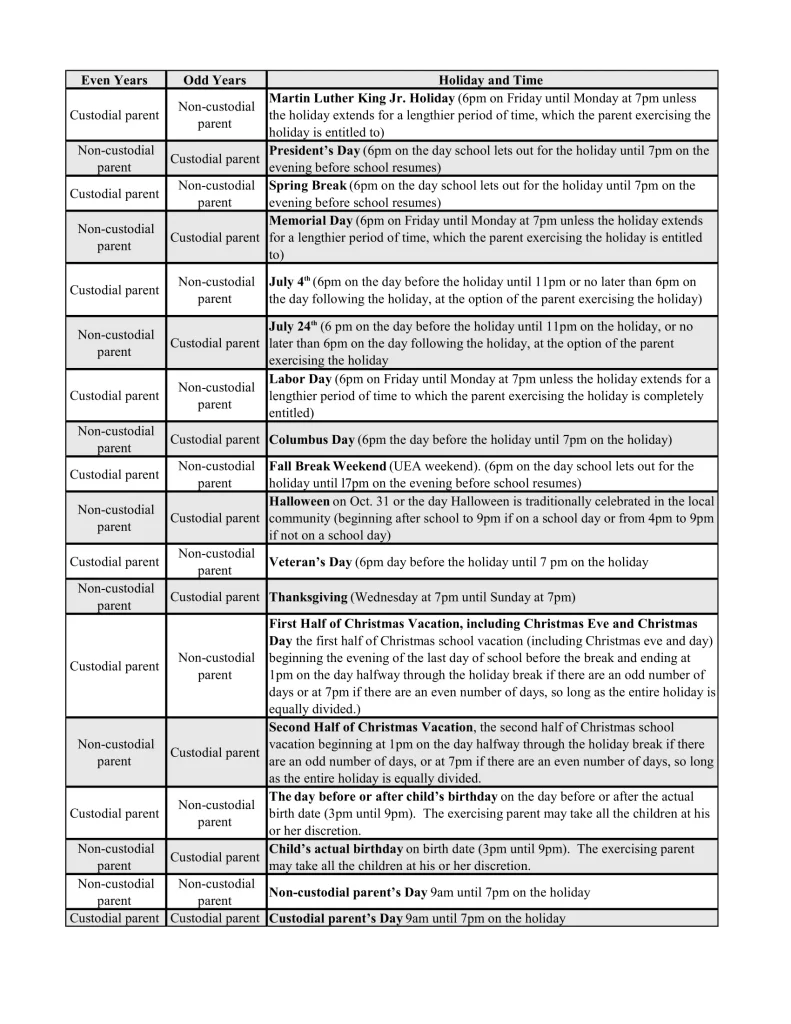
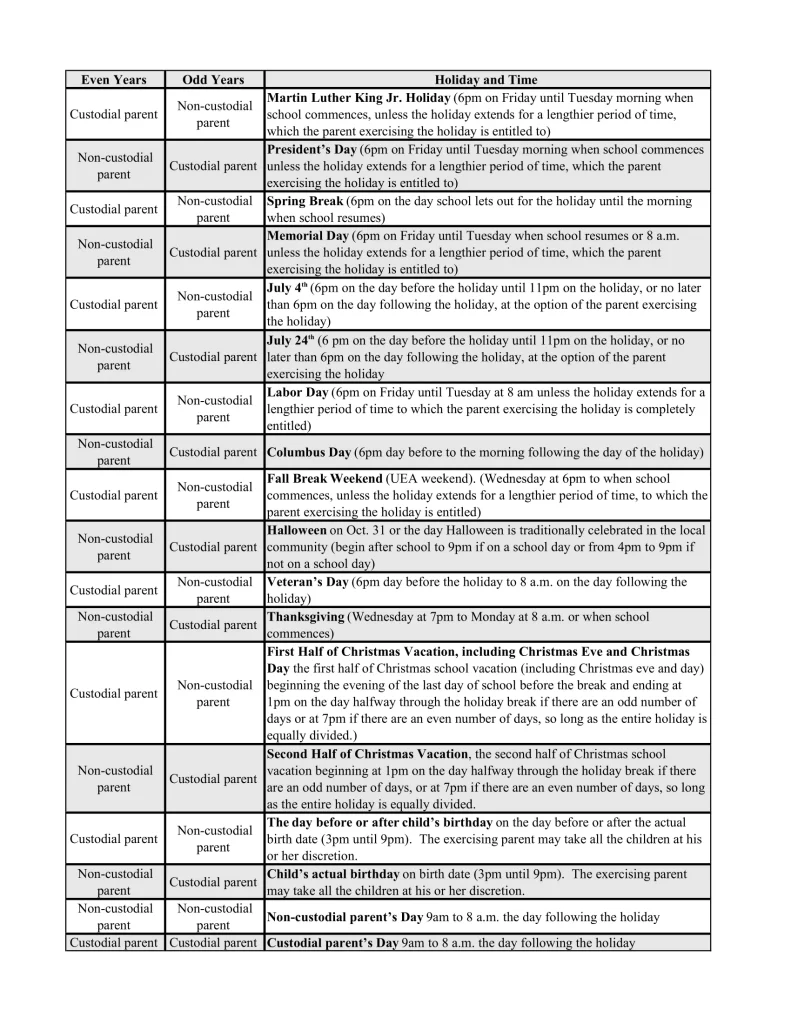
The primary difference between the holiday schedules in Utah Code Section 30-3-35 and Section 30-3-35.1 is when the holiday ends.   In Section 30-3-35, holidays generally end at 7 p.m. the night before school resumes.  In Section 30-3-35.1, holidays extend through to the morning when school commences.  Let’s take the President’s Day holiday as an example.  The holiday typically involves a 3-day weekend with school resuming on Tuesday morning.  Under Section 30-3-35, the holiday weekend ends at 7 p.m. on Monday and under Section 30-3-35.1, the holiday weekend ends Tuesday morning when school resumes.

This is where it gets tricky.  Holidays include any snow days, teacher development days, or other days when school is not scheduled and is contiguous to the holiday. For instance, if school dismisses on Thursday before Martin Luther King’s birthday weekend then the holiday extends from Thursday through Monday at 7 p.m. or Tuesday morning when school commences, depending upon which schedule you follow.   If the holiday falls on a weekend or on a Friday or Monday and the total holiday period extends beyond that time and the parent is free to care for the children, then the holiday extends over the time school is out.   For instance, if a school takes off the week following President’s Day weekend, then the President’s Day holiday includes the weekend and the following week.  Parent-time would resume either at 7 p.m. the night before school starts or the day school starts.

There are other nuances to holidays, including when parent-time can commence.  The best advice is to use common sense.  Talk to the other parent to ensure you are both on the same page.  If you are not, reach out to your attorneys if you have one.   Holidays are difficult enough.  Fighting over the length of a holiday only adds to the stress.

Below are two easy to read charts outlining the holidays for each statute for your reference.

Holiday Schedule Under Utah Code § 30-3-35:

Holiday Schedule Under Utah Code § 30-3-35

Holiday Schedule Under Utah Code § 30-3-35.1:

Holiday Schedule Under Utah Code § 30-3-35

Filed Under: Children & Co-Parenting Tagged With: Child Custody, Holidays, Parent-Time

Primary Sidebar

"*" indicates required fields

Let’s Connect
801-464-4004
Preferred Method of Contact

From The Blog

Testimonials

Diana is extremely organized, professional, competent, and compassionate. She was very skilled at taking my emotional perspective on the situation and sorting out the important facts to help support my case. She always helped me keep a realistic perspective yet provided me with the professional support I needed under a highly stressful situation. Her written responses were well formulated, organized, and always to the point. In court proceedings, she was always professional, respectful, competent, and organized. I always felt that she held the best interest of my children in mind when helping me make decisions. When decisions were made that did not feel favorable to me, she helped me to put the situation in perspective and to not take decisions personally. Diana is a woman and lawyer with integrity. She always took the high road and never spoke of anyone with disrespect. She utilized the facts to speak for themselves and refused to match disparaging remarks made by others. Without question, I would return to her again for legal representation. Furthermore, I give her the highest recommendation to anyone seeking legal representation.

Footer

Telfer Family Law & Mediation
1825 South 700 East,
Salt Lake City, UT 84105
801-464-4004

Copyright © 2026 - All Rights Reserved | Web Design by The Crouch Group | Log in